


The Net Zero City Expo and Net Zero City Leaders Summit opened in Taipei yesterday, with the theme chosen for the expo being digital and green transition.
Addressing the expo’s opening ceremony, National Development Council Deputy Minister Kao Shien-quey (高仙桂) expressed hope that the event would showcase Taiwan’s expertise in promoting digital and net-zero solutions.
The council, which co-organized the event, has set up a national net zero policy pavilion that showcases Taiwan’s carbon reduction goals for 2030 and 2035, it said in a news release.

Photo: CNA
As the city is the best test area for digital and net zero solutions, 12 of Taiwan’s local governments also attended the exhibition, showing the results of low-carbon transition powered by artificial intelligence to enhance public governance, the council said.
A total of 550 businesses are also participating, representing the private sector, another important driving force in the transition, it said.
Attending the leaders' summit, Executive Yuan Secretary-General Kung Ming-hsin (龔明鑫) said in his speech that the exhibition has witnessed Taiwan’s industry transitions, from manufacturing components and contract manufacturing, to developing systems and the current phase of problem-solving.
Taiwan continues to push forward on its net-zero goals, Kung said, adding that President William Lai (賴清德) established a climate change committee at the Presidential Office after his inauguration in May last year, which he chairs.
The expo and summit are being held from yesterday to Friday at Taipei Nangang Exhibition Center’s Hall 2, with more than 59 countries and regions, 138 cities and more than 2,800 guests from overseas attending, according to the council.

FUKUOKA SITUATION: Japanese media reported that the pathogen is expected to be identified by the summer, while the CDC downplayed the idea that it was hMPV A “mysterious cold-like illness” reported in Japan’s Fukuoka Prefecture does not seem to be a new disease, but Japanese authorities have been asked about the situation, the Centers for Disease Control (CDC) said yesterday. The Fukuoka Prefectural Medical Association on Wednesday told a news conference that a “mystery cold” that has become a hot topic on social media is “highly likely to be caused by some kind of viral infection,” Japan’s KBC News reported. “Many people are experiencing symptoms starting with a sore throat, followed by a runny nose, phlegm and a severe cough,” KBC News reported, citing association officials. Health authorities are

Nvidia Corp CEO Jensen Huang (黃仁勳) arrived in Taiwan yesterday ahead of upcoming AI and technology events, saying he plans to meet with clients and Taiwan Semiconductor Manufacturing Co Chairman C.C. Wei (魏哲家) during his visit. After landing at Taipei Songshan Airport, Huang posed for photos with fans and handed out Yakult drinks to reporters and supporters waiting at the scene, saying he has “a lot to do” during the trip. Asked about reports that Nvidia’s planned headquarters site in Taipei’s Beitou Shilin Technology Park could break ground on May 27, Huang said that if the company holds an event, he would

Carrefour Taiwan is to begin using a new name from the start of July, but it cannot divulge the name until then, the chairman of the supermarket chain's parent company said today. President Chain Store Co chairman Lo Chih-hsien (羅智先) was asked by reporters after a shareholders' meeting to confirm whether the company has settled on a new name for the supermarket brand. In March, the government-registered name of two Carrefour Taiwan branches was quietly changed to "Le Chia Kang" (樂家康) in Chinese, raising speculation that has been selected as the name. Lo said that because of local regulations and contractual obligations, the
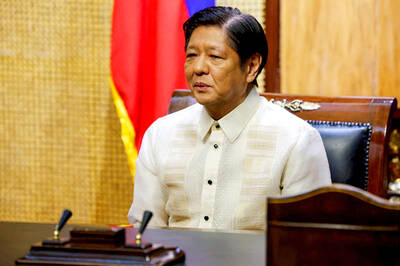
The Philippines would likely be involved in any conflict over Taiwan due to its proximity to the democracy claimed by China, President Ferdinand Marcos Jr said, reiterating a stance that risks angering Beijing. “In the Philippines, we do not have a choice because Taiwan is so close to the Philippines and we have almost 200,000 Filipino nationals living and working in Taiwan,” Marcos said in an interview with Japanese media in Manila on Monday. The Philippine leader’s comments come ahead of a state visit to Japan next week, where he is to meet with Japanese Prime Minister Sanae Takaichi to discuss security


 RSS
RSS