


The Supreme Court has finalized the ruling in Taiwan’s first trial involving citizen judges, sentencing a Taichung man who murdered a colleague to life in prison.
A 23-year-old man surnamed Huang (黃) has been sentenced to life imprisonment with lifetime deprivation of civil rights for stabbing and killing his friend, surnamed Shih (施), who rejected his confessions of love.
The case was the first to be trialed under the Citizen Judges Act (國民法官法) with randomly selected members of the public forming part of a judging panel.
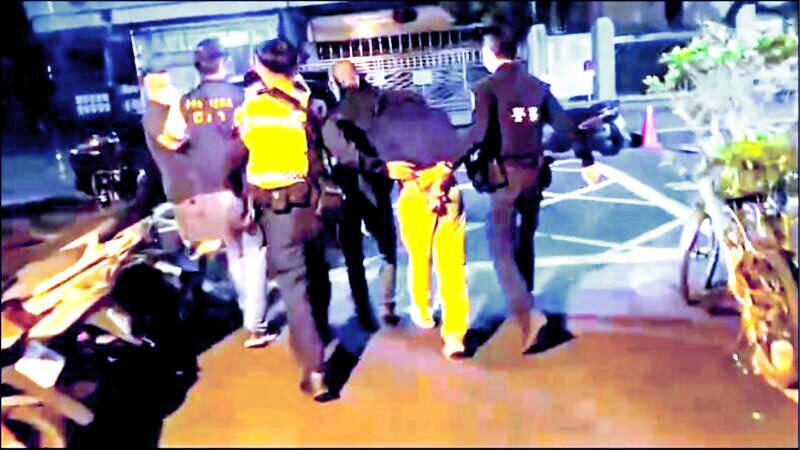
Photo courtesy of a member of the public
The first ruling sentenced Huang to life in prison, which was upheld by the second trial.
The Supreme Court recently rejected an appeal, finalizing the sentence.
Shih had invited Huang, a fellow recent graduate of Tunghai University, to join the direct sales company where he worked, court documents said.
Huang developed feelings for Shih, but was rejected by Shih when he confessed, they said, adding that the two were not able to return to being close friends, leaving Huang distressed.
The court heard that on Oct. 20, 2022, Huang snuck into Shih’s residence and hid, resulting in a confrontation between the two when Shih returned home.
Huang took out two kitchen knives that he had brought to the residence and stabbed Shih 13 times before calling the police to confess.
Shih was sent to a hospital, where he succumbed to his injuries.
The Taichung District Prosecutors’ Office pressed charges against Huang, including homicide.
Huang’s lawyer argued that the defendant had autism spectrum disorder, suggesting he undergo treatment and rehabilitation.
However, the court found no evidence of intellectual disability and noted that Huang had not sought treatment before the incident.
Additionally, the court found that Huang’s actions were premeditated, and believed that Huang confessed as he believed he would be easily identified, rather than due to remorse, so he did not meet the conditions for a reduced sentence.
The Taichung branch of the High Court upheld the first ruling after an appeal, finding no issue with the original trial.
Huang then appealed to the Supreme Court, which rejected the appeal and finalized the ruling.
Shih’s parents filed an additional civil suit, requesting NT$8.02 million (US$244,628) in compensation.
In November last year, the civil section of the Taichung District Court ordered Huang to pay NT$7.37 million to the family.
Although this was the first case involving citizen judges, as the first trial alone took almost one year to reach a verdict, 27 other cases have since been finalized by panels involving citizen judges.
Additional reporting by Chang Wen-chuan
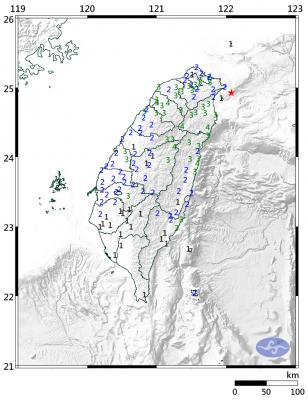
A magnitude 6.1 earthquake struck off the coast of Yilan County at 8:39pm tonight, the Central Weather Administration (CWA) said, with no immediate reports of damage or injuries. The epicenter was 38.7km east-northeast of Yilan County Hall at a focal depth of 98.3km, the CWA’s Seismological Center said. The quake’s maximum intensity, which gauges the actual physical effect of a seismic event, was a level 4 on Taiwan’s 7-tier intensity scale, the center said. That intensity level was recorded in Yilan County’s Nanao Township (南澳), Hsinchu County’s Guansi Township (關西), Nantou County’s Hehuanshan (合歡山) and Hualien County’s Yanliao (鹽寮). An intensity of 3 was

Instead of focusing solely on the threat of a full-scale military invasion, the US and its allies must prepare for a potential Chinese “quarantine” of Taiwan enforced through customs inspections, Stanford University Hoover fellow Eyck Freymann said in a Foreign Affairs article published on Wednesday. China could use various “gray zone” tactics in “reconfiguring the regional and ultimately the global economic order without a war,” said Freymann, who is also a nonresident research fellow at the US Naval War College. China might seize control of Taiwan’s links to the outside world by requiring all flights and ships entering or leaving Taiwan
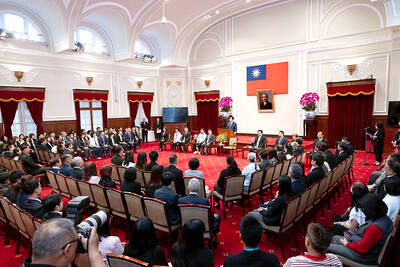
The next minimum wage hike is expected to exceed NT$30,000, President William Lai (賴清德) said yesterday during an award ceremony honoring “model workers,” including migrant workers, at the Presidential Office ahead of Workers’ Day today. Lai said he wished to thank the awardees on behalf of the nation and extend his most sincere respect for their hard work, on which Taiwan’s prosperity has been built. Lai specifically thanked 10 migrant workers selected for the award, saying that although they left their home countries to further their own goals, their efforts have benefited Taiwan as well. The nation’s industrial sector and small businesses lay
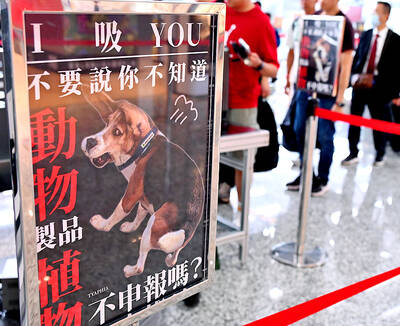
Quarantine awareness posters at Taiwan Taoyuan International Airport have gone viral for their use of wordplay. Issued by the airport branch of the Animal and Plant Health Inspection Agency, the posters feature sniffer dogs making a range of facial expressions, paired with advisory messages built around homophones. “We update the messages for holidays and campaign needs, periodically refreshing materials to attract people’s attention,” quarantine officials said. “The aim is to use the dogs’ appeal to draw focus to quarantine regulations.” A Japanese traveler visiting Taiwan has posted a photo on X of a poster showing a quarantine dog with a


 RSS
RSS