


The coast guard has been monitoring 52 high-threat vessels to protect the undersea cables connecting Taiwan to the world, Ocean Affairs Council Minister Kuan Bi-ling (管碧玲) said yesterday.
Her comments came two days after the Coast Guard Administration (CGA) said that the Hong Tai (宏泰號) — a Togolese Republic-flagged Chinese freighter — was on Sunday detained on suspicion of deliberately cutting a cable linking Penghu County to Taiwan proper.
The CGA has compiled a “blacklist” of identified ships that represents varying levels of threat to the undersea cables in the nation’s near waters, Kuan told a news conference at the headquarters of the CGA’s Southern Branch in Kaohsiung.

Photo: CNA
The Hong Tai is on that list, which classifies it as a moderate risk, she said.
The CGA deploys patrol ships to surveil and deter high-risk ships from sailing into Taiwan’s surrounding waters and other means are utilized to handle lower-level threats, Kuan said.
The Maritime Port Bureau’s smart navigation safety system and patrols by civilian vessels contracted by Chunghwa Telecom have complemented the CGA’s efforts to maintain security of the waters above the cables, she said.
The frequency of undersea cable-cutting has surged this year, but the damage they caused was mitigated by the Ministry of Digital Affairs’ efficient repair system, she said.
Penalties for causing damage to the cables also increased, she said.
Additionally, the CGA recently foiled a series of illegal border crossing attempts by sea that seemingly were aimed at exhausting the agency rather than entering Taiwan proper, she said.
These incidents had not been disclosed to the public until now, she added.
The similarities in these cases of illegal crossings indicate that they are a new form of Chinese gray zone warfare, Kuan said.
The suspects usually bought boats from Internet-based platforms, erased large swathes of their personal history from social media and either did not carry devices or destroyed them before capture, she said.
Nearly every suspect told investigators that they admired the Taiwanese way of life and wanted to live in the country, but did not prepare provisions or supplies on their person or have contacts in Taiwan, she said.
The suspects did not try to evade capture and some sailed in circles until their arrest by the CGA, showing they had intended to be caught, she said.
Taiwan’s legal system holds the prosecution of cases involving alleged Chinese “gray zone” warfare attacks on the cables to high procedural and evidentiary standards as a law-abiding democracy, she said.
The CGA’s detention of Chinese freighters that allegedly sabotaged the Taiwan-Matsu No. 2 and the Taiwan-Penghu No. 3 cables were only possible because the government dealt with the incidents as matters of national security, Kuan said.
CGA personnel must keep the legal requirements of future prosecution in mind when carrying out operations to counter suspected attacks on undersea cables, she said.
Kuan urged more cooperation among the coast guard, prosecutors, police, military police and customs officials, saying better coordination is required in light of China’s use of “gray zone” tactics and changing international factors.
Separately, the CGA yesterday accused the China Coast Guard of “routine harassment” and illegally entering the waters around Kinmen County.
The statement came a day after the China Coast Guard said on a post on Sina Weibo that it has begun routine maritime law enforcement patrols in the seas near Kinmen.
In response, the CGA said that China Coast Guard ships bearing the hull numbers 14602, 14605, 14515 and 14608 simultaneously trespassed into Taiwanese waters from positions southeast of Liaoluo (料羅) and southwest of Jhaishan (翟山).
The CGA dispatched four of its ships to drive them away, it said.
Additional reporting by Lery Hiciano
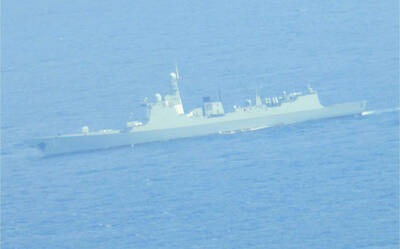
The military has spotted two Chinese warships operating in waters near Penghu County in the Taiwan Strait and sent its own naval and air forces to monitor the vessels, the Ministry of National Defense (MND) said. Beijing sends warships and warplanes into the waters and skies around Taiwan on an almost daily basis, drawing condemnation from Taipei. While the ministry offers daily updates on the locations of Chinese military aircraft, it only rarely gives details of where Chinese warships are operating, generally only when it detects aircraft carriers, as happened last week. A Chinese destroyer and a frigate entered waters to the southwest
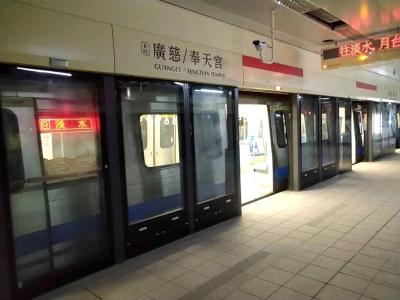
The eastern extension of the Taipei MRT Red Line could begin operations as early as late June, the Taipei Department of Rapid Transit Systems said yesterday. Taipei Rapid Transit Corp said it is considering offering one month of free rides on the new section to mark its opening. Construction progress on the 1.4km extension, which is to run from the current terminal Xiangshan Station to a new eastern terminal, Guangci/Fengtian Temple Station, was 90.6 percent complete by the end of last month, the department said in a report to the Taipei City Council's Transportation Committee. While construction began in October 2016 with an
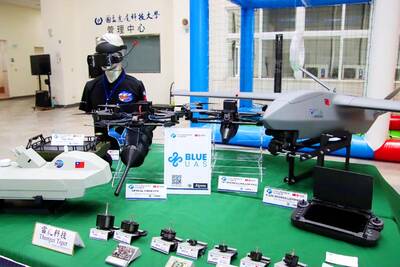
NON-RED SUPPLY: Boosting the nation’s drone industry is becoming increasingly urgent as China’s UAV dominance could become an issue in a crisis, an analyst said Taiwan’s drone exports to Europe grew 41.7-fold from 2024 to last year, with demand from Ukraine’s fight against Russian aggression the most likely driver of growth, a study showed. The Institute for Democracy, Society and Emerging Technology (DSET) in a statement on Wednesday said it found that many of Taiwan’s uncrewed aerial vehicle (UAV) sales were from Poland and the Czech Republic. These countries likely transferred the drones to Ukraine to aid it in its fight against the Russian invasion that started in 2022, it said. Despite the gains, Taiwan is not the dominant drone exporter to these markets, ranking second and fourth
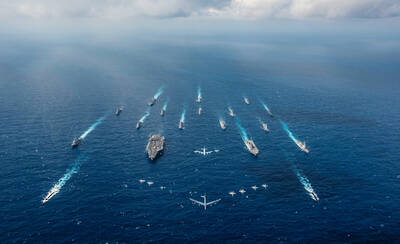
Japanese Prime Minister Sanae Takaichi’s comment last year on Tokyo’s potential reaction to a Taiwan-China conflict has forced Beijing to rewrite its invasion plans, a retired Japanese general said. Takaichi told the Diet on Nov. 7 last year that a Chinese naval blockade or military attack on Taiwan could constitute a “survival-threatening situation” for Japan, potentially allowing Tokyo to exercise its right to collective self-defense. Former Japan Ground Self-Defense Force general Kiyofumi Ogawa said in a recent speech that the remark has been interpreted as meaning Japan could intervene in the early stages of a Taiwan Strait conflict, undermining China’s previous assumptions


 RSS
RSS