


The official Facebook page for the Cobra Gold 2025 military exercise has removed mention of Taiwan or its inclusion in the exercise.
The page, at 6:17pm yesterday, wrote: “Better Together! More than 200 service members from the U.S., Thailand, Japan, Singapore, South Korea, Indonesia, Malaysia and Taiwan gathered on the parade grounds at Camp Suranaree, Thailand, Feb. 25 to usher in the start of Cobra Gold 2025.”
As of 9:15pm, the post was altered, with Taiwan being removed from the list of participating countries.
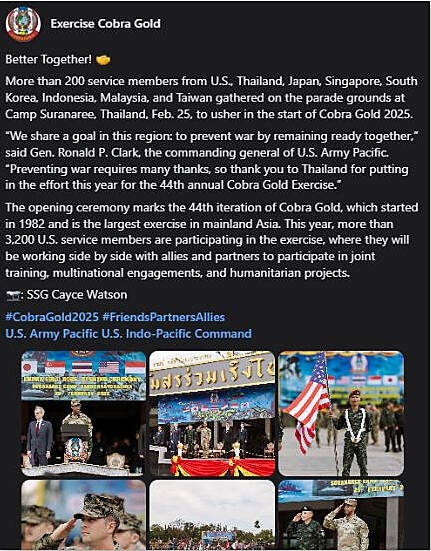
Photo: Screen grab from the Exercise Cobra Gold’s Facebook page
Taiwanese military personnel, along with 200 others from the US, Thailand, Japan, Singapore, South Korea, Indonesia and Malaysia, yesterday attended the Cobra Gold opening ceremony at Camp Suranaree.
“We share a goal in this region: to prevent war by remaining ready together,” said US General Ronald P. Clark, commanding general of the US Army Pacific.
The annual exercise, first held in 1982, is the largest exercise in Asia. While its participants have changed since 2012, Indonesia, Japan, Malaysia, Singapore, South Korea, Thailand and the US are considered its core members.
The 44th Exercise Cobra Gold would last until Friday next week and is focused on joint military operations, multi-national humanitarian efforts and natural disaster prevention, the US embassy in Thailand said.
Cobra Gold is a concrete example of the strong alliance and strategic relationship between the US and Thailand, as well as an example of the strong cooperative relationship with the other participating allies and partners, a Feb. 18 post on the Facebook page said.
Cobra Gold demonstrates the US’ commitment to the region by building interoperability, multilateral cooperative arrangements and advancing common interests through Washington’s commitment to its allies and partners in ensuring a free and open Indo-Pacific, it said.

SECURITY: Starlink owner Elon Musk has taken pro-Beijing positions, and allowing pro-China companies to control Taiwan’s critical infrastructure is risky, a legislator said Starlink was reluctant to offer services in Taiwan because of the nation’s extremely high penetration rates in 4G and 5G services, the Ministry of Digital Affairs said yesterday. The ministry made the comments at a meeting of the legislature’s Transportation Committee, which reviewed amendments to Article 36 of the Telecommunications Management Act (電信管理法). Article 36 bans foreigners from holding more than 49 percent of shares in public telecommunications networks, while shares foreigners directly and indirectly hold are also capped at 60 percent of the total, unless specified otherwise by law. The amendments, sponsored by Chinese Nationalist Party (KMT) Legislator Ko

The military has spotted two Chinese warships operating in waters near Penghu County in the Taiwan Strait and sent its own naval and air forces to monitor the vessels, the Ministry of National Defense (MND) said. Beijing sends warships and warplanes into the waters and skies around Taiwan on an almost daily basis, drawing condemnation from Taipei. While the ministry offers daily updates on the locations of Chinese military aircraft, it only rarely gives details of where Chinese warships are operating, generally only when it detects aircraft carriers, as happened last week. A Chinese destroyer and a frigate entered waters to the southwest

The eastern extension of the Taipei MRT Red Line could begin operations as early as late June, the Taipei Department of Rapid Transit Systems said yesterday. Taipei Rapid Transit Corp said it is considering offering one month of free rides on the new section to mark its opening. Construction progress on the 1.4km extension, which is to run from the current terminal Xiangshan Station to a new eastern terminal, Guangci/Fengtian Temple Station, was 90.6 percent complete by the end of last month, the department said in a report to the Taipei City Council's Transportation Committee. While construction began in October 2016 with an
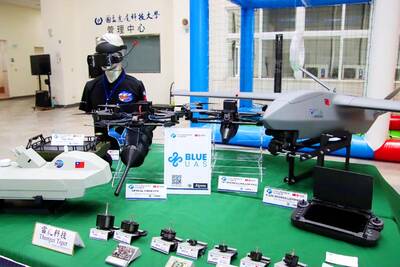
NON-RED SUPPLY: Boosting the nation’s drone industry is becoming increasingly urgent as China’s UAV dominance could become an issue in a crisis, an analyst said Taiwan’s drone exports to Europe grew 41.7-fold from 2024 to last year, with demand from Ukraine’s fight against Russian aggression the most likely driver of growth, a study showed. The Institute for Democracy, Society and Emerging Technology (DSET) in a statement on Wednesday said it found that many of Taiwan’s uncrewed aerial vehicle (UAV) sales were from Poland and the Czech Republic. These countries likely transferred the drones to Ukraine to aid it in its fight against the Russian invasion that started in 2022, it said. Despite the gains, Taiwan is not the dominant drone exporter to these markets, ranking second and fourth


 RSS
RSS