

The Ministry of Education is seeking to discuss inviting Chinese students to study in Taiwan, but there has been no response from Beijing, Mainland Affairs Council (MAC) Minister Chiu Chui-cheng (邱垂正) said today.
Speaking at the National Conference for the University Presidents of Taiwan, Chiu called on China not to use educational exchanges as a tool to push “united front” tactics.
The minister was invited to give a speech on cross-strait relations and policies.

Photo: Yang Mien-chieh, Taipei Times
Since 2004, about 20,000 agreements have been signed between cross-strait educational institutions, and educational exchanges have gradually stabilized following the COVID-19 pandemic, he said.
Last year saw about 2,000 Chinese students coming to Taiwan for short-term study and more than 300 Chinese school presidents or vice presidents visiting Taiwan for exchange, Chiu said.
However, China still seeks to control the number of Chinese students coming to Taiwan, he said.
In 2020, China used the pandemic and political situation to temporarily ban Chinese students from enrolling in Taiwanese institutions, leaving only about 1,500 students in Taiwan last year, he added.
On the other hand, China has been recruiting Taiwanese students to study in China, creating an imbalance in cross-strait academic exchanges, he said.
The Taiwanese government has already implemented 10 policies to encourage Chinese students to study in Taiwan, including recognizing more Chinese qualifications, increasing quotas for admission of Chinese students, and as of February last year, expanding the National Health Insurance system to cover Chinese students, he said.
The ministry is considering plans to increase enrollment of Chinese students from third countries, which the council would cooperate with, he said, adding that more information would be released to the public should the plan reach a later stage.
Minister of Education Cheng Ying-yao (鄭英耀) this week said that Taiwanese institutions would be banned from collaborating with four Chinese institutions due to security concerns: Huaqiao University in Xiamen and Quanzhou, Jinan University in Guangzhou and Beijing Chinese Language and Culture College.
The council would respect the ministry’s decision and cooperate accordingly, Chiu said, adding that Taiwanese students may still attend 154 Chinese universities.
Educational exchanges should be based on reciprocity, respect and fairness, he said, adding that restrictions on Chinese students coming to Taiwan often arise due to strict regulations from Beijing, not from Taipei.
Additional reporting by Yang Mien-chieh
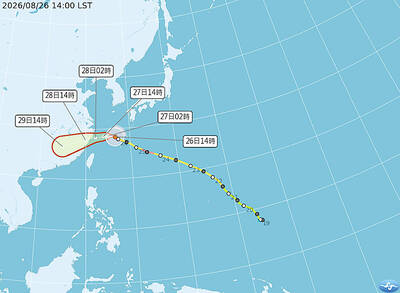
MODERATE TYPHOON: Localized heavy rain is forecast to hit central and southern Taiwan, the CWA said, adding that the storm would likely move away on Saturday A sea warning for Typhoon Saudel, which shifted to a more northerly track as it approached Taiwan, is likely early today, the Central Weather Administration (CWA) said yesterday. As of 2pm yesterday, the center of typhoon was about 630km northeast of Taipei, moving west-northwest at 14kph with maximum wind gusts of up to 162kph, CWA data showed. Saudel is a moderate typhoon and is expected to weaken as it nears Taiwan due to atmospheric and ocean conditions, CWA forecaster Lin Po-tung (林伯東) said. A sea warning indicates hazardous typhoon conditions in waters surrounding Taiwan within 24 hours, Lin said. The storm is forecast to

A Straits Exchange Foundation official today warned that yielding to political pressure in exchange for access to China’s entertainment industry rarely ends well, amid rumors that China is seeking to lure Taiwanese K-pop star Chou Tzu-yu (周子瑜). Chou, more commonly known as Tzuyu, is the only Taiwanese member of the girl group Twice. Her contract with JYP Entertainment is set to expire at the end of this year, and there have been widespread reports that she would not renew it. She is reportedly planning to pursue solo activities under her parents’ agency, Yu Hai Entertainment (瑜海娛樂), although China has also reportedly offered

China is urging its citizens to evacuate Eswatini and warning others not to visit the tiny African kingdom over what it said were safety concerns and scamming risks in Taiwan’s last remaining diplomatic partner on the continent. In a post on WeChat, the Chinese Ministry of Foreign Affairs’ Department of Consular Affairs described Eswatini’s security situation as “complex,” with crimes involving online fraud and illegal gambling “rampant” and the public-security and safety risk “extremely high.” “Chinese citizens and institutions currently in the country are urged to evacuate or relocate to relatively safer areas — such as South Africa — as soon as
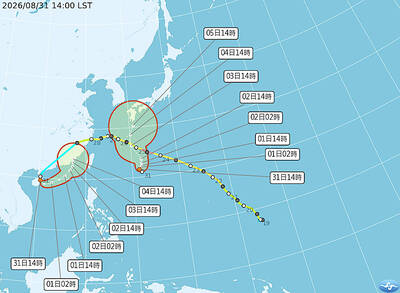
A tropical depression near Hainan that was once Typhoon Saudel may once again strengthen into a tropical storm, the Central Weather Administration (CWA) said yesterday, but a sea warning for waters around Taiwan is unlikely. CWA forecaster Huang En-hung (黃恩鴻) said that Saudel would return to being a weak tropical storm by late yesterday or early this morning. However, as the storm is to gradually weaken again and would head toward China’s Guangdong Province away from Taiwan, the chances that it would affect Taiwan enough for the CWA to issue a sea warning are relatively low,


 RSS
RSS