


Taiwan’s artificial intelligence (AI) industry should provide the public with their energy use plans before demanding the government build a nuclear power plant, climate change campaigners said on Tuesday.
Taiwan’s energy capacity is set to rise to 570 gigawatt-hours (GWh) this year, Taiwan Climate Action Network director Chao Chia-wei (趙家緯) told a climate change conference in Taipei, citing government data.
Using nuclear power to supply 30 percent of that requirement, or 170GWh, means Taiwan must reactivate and expand every mothballed nuclear plant, and possibly build additional reactors in its main industrial zones, he said.
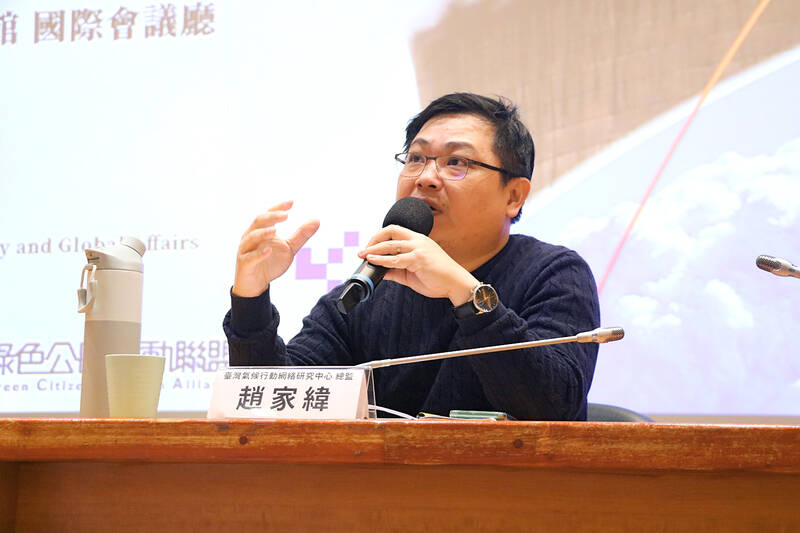
Photo: CNA
Taiwan’s offshore wind and solar projects, if completed according to schedule, would be capable of sustaining Amazon, Google and Nvidia’s data centers in Taiwan on renewables alone, he said.
The priority should be to establish regulations governing the industry’s power consumption and demand data centers submit energy consumption plans to enable the government to anticipate their needs, Chao said.
The event organizers in a news release cited M.V. Ramana, chair of Disarmament, Global and Human Security at the University of British Columbia, as saying that the expectations around small modular reactors (SMR) does not meet the reality of their capabilities
Smaller and less efficient than their conventional counterparts, SMRs generate less electricity while producing more nuclear waste per unit, he was cited as saying.
Microsoft, Amazon and Google’s investments in SMR were minuscule and likely served little function except as a public relations gesture, the event organizers cited Ramana as saying.
The climate change conference came a day after the Chinese Nationalist Party (KMT) on Monday unveiled plans to push for amendments to extend the lifespan of the nation’s nuclear power plants, citing a recent poll indicating that more than 70 percent of Taiwanese support the idea.
A KMT think tank published the poll on Monday, using it to advocate for amendments to several laws the party says restrict energy development under the energy policies of the ruling Democratic Progressive Party (DPP).
According to the poll, 73.6 percent of respondents supported amending existing laws to extend the operational lifespan of nuclear power plants from 40 years to 60 years, while 20.7 percent opposed the idea.
“I believe everyone can see that the DPP’s nuclear-free homeland policy has adversely affected Taiwan’s energy development,” KMT Chairman Eric Chu (朱立倫) said.
“[They] shut down all nuclear plants and replaced them with green energy. Electricity prices will inevitably rise accordingly, and Taiwan Power Co is certain to incur severe losses,” he added.
As part of the DPP’s plan to phase out nuclear power, only 3 percent of Taiwan’s electricity is currently generated by Unit 2 of the Ma-anshan Nuclear Power Plant in Pingtung County — the country’s last remaining operational nuclear reactor — which is scheduled to be decommissioned on May 17.
KMT Legislator Ko Chih-en (柯志恩) said support for extending nuclear power plant operations was highest in Taoyuan, Hsinchu and Miaoli, where 89.3 percent of respondents favored the idea — a trend she attributed to the presence of Hsinchu Science Park.
Potential power shortages could hamper the growth of Taiwan’s AI industry, KMT Legislator Wang Hung-wei (王鴻薇) said.
KMT members said that to ensure stable power supply, the party aims to amend the Electricity Act (電業法), the Nuclear Reactor Facilities Regulation Act (核子反應器設施管制法), the Climate Change Response Act (氣候變遷因應法) and the Basic Environment Act (環境基本法).
Ko also said that Taiwan’s energy policies lack effective oversight, as the Energy Administration under the Ministry of Economic Affairs oversees domestic energy affairs.
She cited polls showing that 77 percent of respondents supported amending the Electricity Act to establish an independent review committee for energy policy, while 12 percent disagreed.
In response to the KMT, the ministry emphasized the importance of dialogue between the opposition and ruling parties while stressing that there could be no compromise on nuclear safety.
As the nuclear power plants were originally designed to be operational for a maximum of 40 years, a comprehensive review of equipment corrosion and maintenance would be necessary if their lifespan is to be extended, the ministry said in a statement.
Defending the Energy Administration’s independence, the ministry said more than half of the members in its review committees and offices handling power-related issues come from outside the agency.

FUKUOKA SITUATION: Japanese media reported that the pathogen is expected to be identified by the summer, while the CDC downplayed the idea that it was hMPV A “mysterious cold-like illness” reported in Japan’s Fukuoka Prefecture does not seem to be a new disease, but Japanese authorities have been asked about the situation, the Centers for Disease Control (CDC) said yesterday. The Fukuoka Prefectural Medical Association on Wednesday told a news conference that a “mystery cold” that has become a hot topic on social media is “highly likely to be caused by some kind of viral infection,” Japan’s KBC News reported. “Many people are experiencing symptoms starting with a sore throat, followed by a runny nose, phlegm and a severe cough,” KBC News reported, citing association officials. Health authorities are

Nvidia Corp CEO Jensen Huang (黃仁勳) arrived in Taiwan yesterday ahead of upcoming AI and technology events, saying he plans to meet with clients and Taiwan Semiconductor Manufacturing Co Chairman C.C. Wei (魏哲家) during his visit. After landing at Taipei Songshan Airport, Huang posed for photos with fans and handed out Yakult drinks to reporters and supporters waiting at the scene, saying he has “a lot to do” during the trip. Asked about reports that Nvidia’s planned headquarters site in Taipei’s Beitou Shilin Technology Park could break ground on May 27, Huang said that if the company holds an event, he would

The Ministry of Finance this afternoon announced the winning numbers for the March-April uniform invoice lottery. The winning number for the NT$10 million (US$318,060) special prize is 19531471, and the winning number for the NT$2 million grand prize is 85941329. Three numbers were drawn for the NT$200,000 first prize: 07225810, 20231230 and 83518781. Those with receipts matching the last seven digits of any of the first-prize numbers will win the NT$40,000 second prize, while those matching the last six digits will win the NT$10,000 third prize. Those whose receipts match the last five digits of the first-prize numbers can claim the NT$4,000 fourth prize,

SIX SUBSIDIES: The monthly allowance for older farmers is to increase to NT$10,000, and NT$5,000 is to be given to homemakers under the national pension system, Lai said The government is to implement major welfare policies for disadvantaged groups, including raising the monthly allowance for older farmers to NT$10,000 and providing homemakers with NT$5,000 per month, President William Lai (賴清德) said yesterday. Lai made the remarks during a visit to Wangling Temple in Chiayi County, saying that the planned increases were being introduced amid economic growth and an increase in tax revenue. Touting a policy, in which the government plans to provide a monthly allowance of NT$5,000 for every child under the age of 18 in a bid to address Taiwan’s low birthrate, Lai said that if received for the


 RSS
RSS