


A group of lawyers have formed a legal defense team to assist civil groups and individuals who say they were harassed or intimidated for participating in petition drives to recall Chinese Nationalist Party (KMT) legislators, the Democratic Progressive Party (DPP) said yesterday.
DPP spokeswoman Han Ying (韓瑩) said the lawyers are seeking to safeguard democracy and people’s constitutional right to recall, and they would also provide advice on gathering evidence and filing judicial complaints against those who impeded recall efforts.
Attorney Huang Di-ying (黃帝穎), director of the Taiwan Forever Society, heads up the eight-member legal team, along with former Social Democratic Party spokesman Chen Yu-hsin (陳又新), former Taiwan Bar Association deputy secretary-general Elisa Fu (傅馨儀) and others, Han said, adding that more lawyers would join in the coming days.

Photo: Tien Yu-hua, Taipei Times
“Numerous people have said they were harassed and received threats after they signed recall petitions. KMT members also tried to interfere by getting local government officials to ban petition stations at certain locations, disseminating fake news and making accusations to smear the recall campaigners,” she said.
While citizen groups initiated recall efforts against KMT legislators because they were fed up with their actions in the Legislative Yuan, the KMT started its recall movement against DPP lawmakers out of retribution, she said.
Huang said that the signatures of two former KMT members appeared on petitions to recall DPP Legislators Su Chiao-hui (蘇巧慧) and Lee Kun-cheng (李坤城), but they did not sign the documents themselves.
He said that someone at the KMT had allegedly copied names from old party lists, which is forgery, adding that he had requested that prosecutors investigate the incidents.
Separately, DPP caucus whip Ker Chien-ming (柯建銘) said that he was confident the recall movement to oust KMT legislators would be successful, as he can see that people want to fight back against KMT and Taiwan People’s Party legislators, who he said are working to sell out Taiwan to China.
Additional reporting by Hsieh Chun-lin

LOUD AND PROUD Taiwan might have taken a drubbing against Australia and Japan, but you might not know it from the enthusiasm and numbers of the fans Taiwan might not be expected to win the World Baseball Classic (WBC) but their fans are making their presence felt in Tokyo, with tens of thousands decked out in the team’s blue, blowing horns and singing songs. Taiwanese fans have packed out the Tokyo Dome for all three of their games so far and even threatened to drown out home team supporters when their team played Japan on Friday. They blew trumpets, chanted for their favorite players and had their own cheerleading squad who dance on a stage during the game. The team struggled to match that exuberance on the field, with
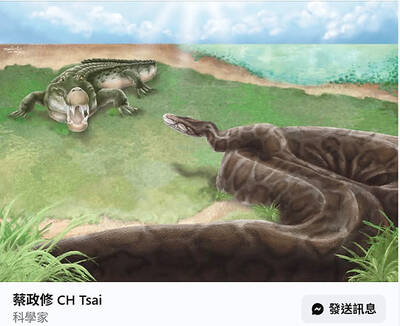
Taiwanese paleontologists have discovered fossil evidence that pythons up to 4m long inhabited Taiwan during the Pleistocene epoch, reporting their findings in the international scientific journal Historical Biology. National Taiwan University (NTU) Institute of Ecology and Evolutionary Biology associate professor Tsai Cheng-hsiu (蔡政修) led the team that discovered the largest snake fossil ever found in Taiwan. The single trunk vertebra was discovered in Tainan at the Chiting Formation, dated to between 400,000 and 800,000 years ago in the Middle Pleistocene, the paper said. The area also produced Taiwan’s first avian fossil, as well as crocodile, mammoth, saber-toothed cat and rhinoceros fossils, it said. Discoveries

Taiwanese paleontologists have discovered fossil evidence that pythons up to 4m long inhabited Taiwan during the Pleistocene epoch, reporting their findings in the international scientific journal Historical Biology. National Taiwan University (NTU) Institute of Ecology and Evolutionary Biology associate professor Tsai Cheng-hsiu (蔡政修) led the team that discovered the largest snake fossil ever found in Taiwan. A single trunk vertebra was discovered in Tainan at the Chiting Formation, dated to between 800,000 to 400,000 years ago in the Middle Pleistocene, the paper said. The area also produced Taiwan’s first avian fossil, as well as crocodile, mammoth, sabre-toothed cat and rhinoceros fossils, it said. Discoveries

Whether Japan would help defend Taiwan in case of a cross-strait conflict would depend on the US and the extent to which Japan would be allowed to act under the US-Japan Security Treaty, former Japanese minister of defense Satoshi Morimoto said. As China has not given up on the idea of invading Taiwan by force, to what extent Japan could support US military action would hinge on Washington’s intention and its negotiation with Tokyo, Morimoto said in an interview with the Liberty Times (sister paper of the Taipei Times) yesterday. There has to be sufficient mutual recognition of how Japan could provide


 RSS
RSS