


Chunghwa Telecom said yesterday that communication via undersea cable between Taiwan and Lienchiang County (Matsu) has been restored after a partial repair of the No. 2 cable, one of two damaged earlier this month.
Chunghwa Telecom, which owns and operates all 10 domestic undersea cables in Taiwan, said in a news release yesterday evening that transmission through the No. 2 undersea cable was restored at 11:40am on Wednesday.
The restoration was achieved following “core wire-by-core wire testing and timely emergency repairs by Chunghwa Telecom staff,” the company said.
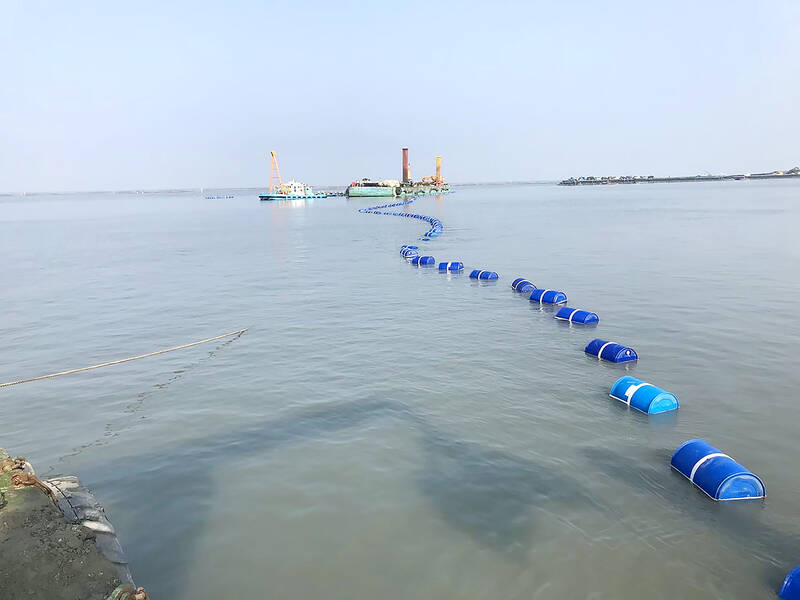
Photo courtesy of Taiwan Power Co via CNA
Microwave communications, in use since that morning, reverted to serving as a backup, Chunghwa Telecom added.
The Taiwan-Matsu No. 2 and No. 3 undersea communication cables, which link Taiwan and the outlying county, became disconnected following “natural deterioration.”
The Ministry of Digital Affairs said the No. 2 cable was severed at about 5am on Wednesday and the No. 3 cable on Jan. 15.
Work to repair the No. 3 cable continues.
To fully repair both cables, the telecom service provider said it was “actively” coordinating with international undersea cable-repair ships to come to Taiwan to inspect and repair them.
“Repairs are expected to be completed in the near term, sea conditions permitting, to provide Matsu with more stable communication service and quality,” said Chunghwa Telecom, which is 35.29 percent owned by the Ministry of Transportation and Communications.
Meanwhile, the international Trans-Pacific Express (TPE) cable, responsible for handling communication traffic between Taiwan and other countries, was repaired on Monday after being cut on Jan. 3, Chunghwa Telecom said.
A Cameroon-flagged, Chinese-operated freighter, Shunxin-39, is suspected of damaging the TPE cable 68.17km from Chunghwa Telecom’s Tamsui (淡水) cable station off Taiwan’s northern coast.
Chunghwa Telecom said that after the incident, the company contacted an agency in Yokohama, Japan, to dispatch a repair ship.
With repairs completed, communication between Taiwan and countries such as the US, Japan and South Korea resumed being funneled through the TPE cable, which is operating normally, the company added.
Taiwan has 14 international undersea communication cables and 10 domestic cables.
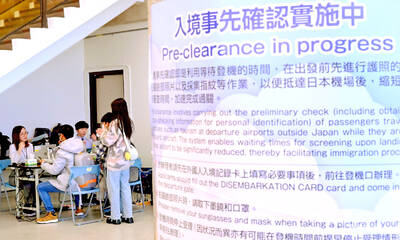
A preclearance service to facilitate entry for people traveling to select airports in Japan would be available from Thursday next week to Feb. 25 at Taiwan Taoyuan International Airport, Taoyuan International Airport Corp (TIAC) said on Tuesday. The service was first made available to Taiwanese travelers throughout the winter vacation of 2024 and during the Lunar New Year holiday. In addition to flights to the Japanese cities of Hakodate, Asahikawa, Akita, Sendai, Niigata, Okayama, Takamatsu, Kumamoto and Kagoshima, the service would be available to travelers to Kobe and Oita. The service can be accessed by passengers of 15 flight routes operated by

Chinese spouse and influencer Guan Guan’s (關關) residency permit has been revoked for repeatedly posting pro-China videos that threaten national security, the National Immigration Agency confirmed today. Guan Guan has said many controversial statements in her videos posted to Douyin (抖音), including “the red flag will soon be painted all over Taiwan” and “Taiwan is an inseparable part of China,” and expressing hope for expedited reunification. The agency last year received multiple reports alleging that Guan Guan had advocated for armed reunification. After verifying the reports, the agency last month issued a notice requiring her to appear and explain her actions. Guan

GIVE AND TAKE: Blood demand continues to rise each year, while fewer young donors are available due to the nation’s falling birthrate, a doctor said Blood donors can redeem points earned from donations to obtain limited edition Formosan black bear travel mugs, the Kaohsiung Blood Center said yesterday, as it announced a goal of stocking 20,000 units of blood prior to the Lunar New Year. The last month of the lunar year is National Blood Donation Month, when local centers seek to stockpile blood for use during the Lunar New Year holiday. The blood demand in southern Taiwan — including Tainan and Kaohsiung, as well as Chiayi, Pingtung, Penghu and Taitung counties — is about 2,000 units per day, the center said. The donation campaign aims to boost
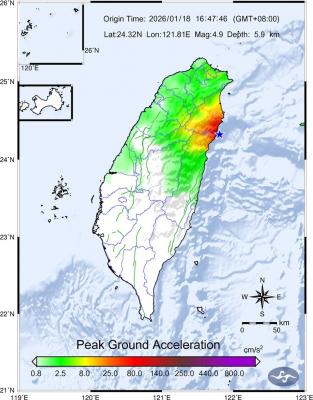
The Central Weather Administration (CWA) said a magnitude 4.9 earthquake that struck off the coast of eastern Taiwan yesterday was an independent event and part of a stress-adjustment process. The earthquake occurred at 4:47pm, with its epicenter at sea about 45.4km south of Yilan County Hall at a depth of 5.9km, the CWA said. The quake's intensity, which gauges the actual effects of a temblor, was highest in several townships in Yilan and neighboring Hualien County, where it measured 4 on Taiwan's seven-tier intensity scale, the CWA said. Lin Po-yu (林柏佑), a division chief at the CWA's Seismological Center, told a news conference


 RSS
RSS