


The Legislative Yuan confirmed yesterday two Fair Trade Commission (FTC) nominees, but rejected two others, including the body’s incumbent chairperson.
The Democratic Progressive Party (DPP) government nominated FTC Chairperson Lee May (李鎂), Vice Chairman Chen Chih-min (陳志民) and Commissioner Hong Tsai-lung (洪財隆) on Oct. 30 last year to continue in their positions after their terms ends on Jan. 31.
Lin Ching-tang (林慶堂), the incumbent head of the FTC’s Department of Service Industry Competition, was also nominated as a new commissioner the same day.

Photo: Tu Chien-jung, Taipei Times
Lawmakers from the DPP, the opposition Chinese Nationalist Party (KMT) and the Taiwan People’s Party (TPP), and two independents voted unanimously yesterday to confirm Chen and Lin to serve four-year terms as commissioners from Feb. 1 to Jan. 31, 2029.
However, Lee and Hong were rejected by lawmakers from the two opposition parties, who together form a majority in the legislative body.
Before the vote, TPP caucus whip Huang Kuo-chang (黃國昌) said his party would reject Hong, because of his actions related to the commission’s consideration of PX Mart Ltd’s (全聯實業) acquisition of RT-Mart International Ltd (大潤發).
Huang said Hong demanded that PX Mart donate NT$300 million (US$9.11 million) to sports and chess events as a precondition for approving the acquisition bid during the review meeting, which Huang said should have focused on consumers’ rights.
The party also rejected Lee, because she stood by and watched Hong make the demands without stopping him, Huang said.
As a result, Lee got 52 votes from DPP lawmakers and Chen Chao-ming (陳超明), an independent who is usually aligned with the KMT, while the remaining lawmakers cast opposing votes.
Similarly, Hong was rejected with 51 votes in support from DPP members, and 62 opposing votes from the KMT (52), the TPP (8) and two independent lawmakers.
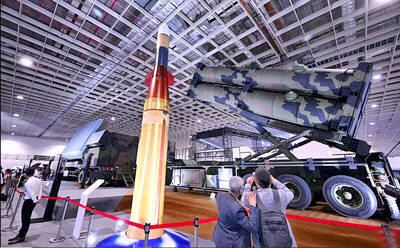
Taiwan is to commence mass production of the Tien Kung (天弓, “Sky Bow”) III, IV and V missiles by the second quarter of this year if the legislature approves the government’s NT$1.25 trillion (US$39.78 billion) special defense budget, an official said yesterday. Commenting on condition of anonymity, a defense official with knowledge of the matter said that the advanced systems are expected to provide crucial capabilities against ballistic and cruise missiles for the proposed “T-Dome,” an advanced, multi-layered air defense network. The Tien Kung III is an air defense missile with a maximum interception altitude of 35km. The Tien Kung IV and V
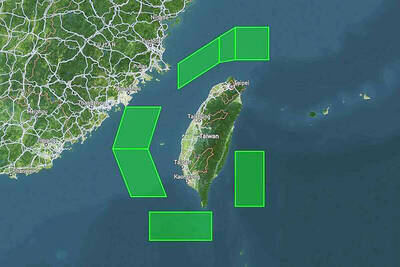
The disruption of 941 flights in and out of Taiwan due to China’s large-scale military exercises was no accident, but rather the result of a “quasi-blockade” used to simulate creating the air and sea routes needed for an amphibious landing, a military expert said. The disruptions occurred on Tuesday and lasted about 10 hours as China conducted live-fire drills in the Taiwan Strait. The Civil Aviation Administration (CAA) said the exercises affected 857 international flights and 84 domestic flights, affecting more than 100,000 travelers. Su Tzu-yun (蘇紫雲), a research fellow at the government-sponsored Institute for National Defense and Security Research, said the air
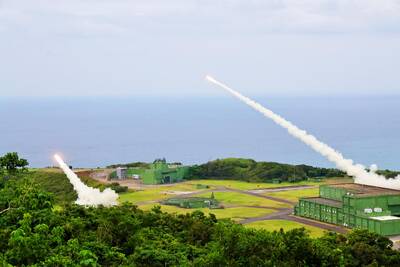
Taiwan lacks effective and cost-efficient armaments to intercept rockets, making the planned “T-Dome” interception system necessary, two experts said on Tuesday. The concerns were raised after China’s military fired two waves of rockets during live-fire drills around Taiwan on Tuesday, part of two-day exercises code-named “Justice Mission 2025.” The first wave involved 17 rockets launched at 9am from Pingtan in China’s Fujian Province, according to Lieutenant General Hsieh Jih-sheng (謝日升) of the Office of the Deputy Chief of the General Staff for Intelligence at the Ministry of National Defense. Those rockets landed 70 nautical miles (129.6km) northeast of Keelung without flying over Taiwan,
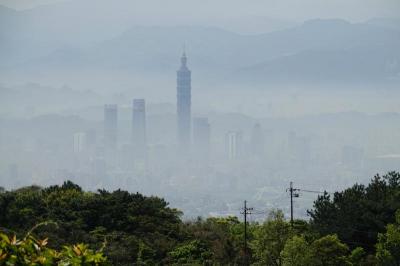
A strong continental cold air mass is to bring pollutants to Taiwan from tomorrow, the Ministry of Environment said today, as it issued an “orange” air quality alert for most of the country. All of Taiwan except for Hualien and Taitung counties is to be under an “orange” air quality alert tomorrow, indicating air quality that is unhealthy for sensitive groups. In China, areas from Shandong to Shanghai have been enveloped in haze since Saturday, the ministry said in a news release. Yesterday, hourly concentrations of PM2.5 in these areas ranged from 65 to 160 micrograms per cubic meter (mg/m³), and pollutants were


 RSS
RSS