


China’s naval fleet has grown to 360 warships, with a potential to grow even further to 400-440 vessels and challenge the US Navy, the Institute for National Defense and Security Research said yesterday.
The think tank published the 2024 edition of its annual Report on the Development of the Chinese Communist Party’s (CCP) military and politics, which included an article on the country’s naval build-up by researcher Chen Liang-chih (陳亮智).
The article cites reports from the US Congressional Research Service, the UK International Institute for Strategic Studies and other sources, to estimate that the Chinese navy has about 360 ships and will continue to grow in the short-term.
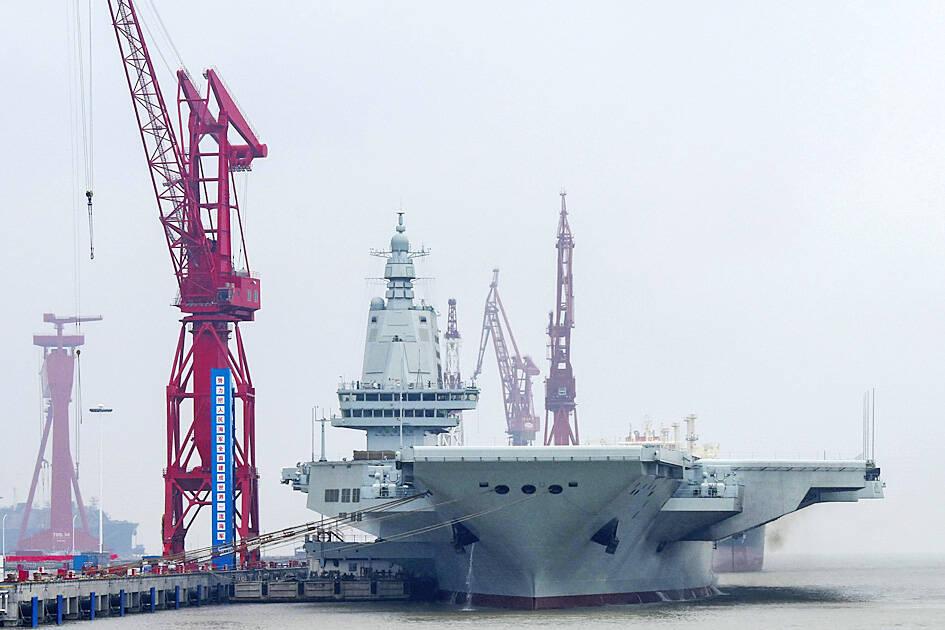
Photo: Xinhua via AP
The main vessels of China’s navy include three aircraft carriers, 45 destroyers, 40 frigates, 70 submarines, 40 amphibious assault ships, and 60 auxiliary vessels, the report said.
This does not include smaller ships such as missile boats or small frigates.
China’s latest warship, an aircraft carrier named Fujian (福建), is currently undergoing sea trials, it said.
It is highly anticipated as it is equipped with an advanced electromagnetic catapult system, something only the US Ford-class aircraft carriers are equipped with, it said.
The Chinese navy already has three Type 075-class amphibious assault ships, and is expected to launch the new more advanced Type 076 model sometime this year, the report said.
The new ships may have the ability to launch fixed-wing aircraft and drones, significantly strengthening the Chinese navy’s ability to carry out amphibious assaults, it said.
Part of the explanation for China’s rapid progress in this field is the CCP’s decision to build several world-class shipyards, the report said.
In the future, competition between the US and Chinese navies is likely to intensify, with larger fleets, more advanced vessels and weapons systems deployed, and larger military exercises, it said.
This competition is likely to have major effects on the Asia-Pacific region, if not the whole world, it said.
The Ministry of National Defense said in recent reports that it has invested in new naval weapons systems to combat the threat posed by China’s navy, including the new domestic submarine program and Hsiung Feng (雄風) cruise missiles, among others.

LOUD AND PROUD Taiwan might have taken a drubbing against Australia and Japan, but you might not know it from the enthusiasm and numbers of the fans Taiwan might not be expected to win the World Baseball Classic (WBC) but their fans are making their presence felt in Tokyo, with tens of thousands decked out in the team’s blue, blowing horns and singing songs. Taiwanese fans have packed out the Tokyo Dome for all three of their games so far and even threatened to drown out home team supporters when their team played Japan on Friday. They blew trumpets, chanted for their favorite players and had their own cheerleading squad who dance on a stage during the game. The team struggled to match that exuberance on the field, with
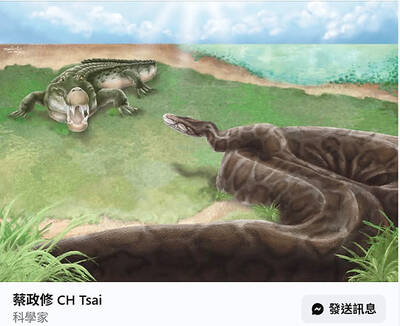
Taiwanese paleontologists have discovered fossil evidence that pythons up to 4m long inhabited Taiwan during the Pleistocene epoch, reporting their findings in the international scientific journal Historical Biology. National Taiwan University (NTU) Institute of Ecology and Evolutionary Biology associate professor Tsai Cheng-hsiu (蔡政修) led the team that discovered the largest snake fossil ever found in Taiwan. The single trunk vertebra was discovered in Tainan at the Chiting Formation, dated to between 400,000 and 800,000 years ago in the Middle Pleistocene, the paper said. The area also produced Taiwan’s first avian fossil, as well as crocodile, mammoth, saber-toothed cat and rhinoceros fossils, it said. Discoveries

Taiwanese paleontologists have discovered fossil evidence that pythons up to 4m long inhabited Taiwan during the Pleistocene epoch, reporting their findings in the international scientific journal Historical Biology. National Taiwan University (NTU) Institute of Ecology and Evolutionary Biology associate professor Tsai Cheng-hsiu (蔡政修) led the team that discovered the largest snake fossil ever found in Taiwan. A single trunk vertebra was discovered in Tainan at the Chiting Formation, dated to between 800,000 to 400,000 years ago in the Middle Pleistocene, the paper said. The area also produced Taiwan’s first avian fossil, as well as crocodile, mammoth, sabre-toothed cat and rhinoceros fossils, it said. Discoveries

Whether Japan would help defend Taiwan in case of a cross-strait conflict would depend on the US and the extent to which Japan would be allowed to act under the US-Japan Security Treaty, former Japanese minister of defense Satoshi Morimoto said. As China has not given up on the idea of invading Taiwan by force, to what extent Japan could support US military action would hinge on Washington’s intention and its negotiation with Tokyo, Morimoto said in an interview with the Liberty Times (sister paper of the Taipei Times) yesterday. There has to be sufficient mutual recognition of how Japan could provide


 RSS
RSS