


The University of Washington (UW) in the US is to offer a new East Asia Studies master of arts degree program from next year that includes a Taiwan Studies track.
The new MA program is "the first Taiwan Studies-related graduate degree at a major university in North America," the university said in a statement on Dec. 19.
"The East Asia MA at the University of Washington offers students the opportunity to develop a substantial understanding of East Asian culture, history, society and contemporary issues while focusing their coursework on China, Japan, Korea or Taiwan," it said.
The inaugural cohort is to begin taking classes at the Seattle-based university in autumn next year, with applications open until Jan. 31, the program's Web site said.
Before the program was announced, the Taiwan Studies MA program at the University of London's School of Oriental and African Studies (SOAS) was the first and only such Taiwan-focused postgraduate degree in the English-speaking world.
UW's new program fills an "academic gap" for students who wish to specialize in Taiwanese studies at the postgraduate level, but who previously would have had to take more general East Asia classes, said James Lin (林于翔), an adjunct assistant professor who teaches in the university's Department of History.
Alongside William Lavely, the director of UW's East Asia Center, Lin has been a major driving force establishing the new Taiwan Studies track.
Although Taiwan-related classes and events have been organized by UW's Henry M Jackson School of International Studies since 2017 under the "Taiwan Studies Program" nomenclature at WU's East Asia Center, UW's announcement this month formalizes the courses into a distinct MA track.
The program has also received "generous support" from Taiwan's Ministry of Education and Ministry of Foreign Affairs, the Chiang Ching-Kuo Foundation for International Scholarly Exchange, and others, according to the program's Web site.

The brilliant blue waters, thick foliage and bucolic atmosphere on this seemingly idyllic archipelago deep in the Pacific Ocean belie the key role it now plays in a titanic geopolitical struggle. Palau is again on the front line as China, and the US and its allies prepare their forces in an intensifying contest for control over the Asia-Pacific region. The democratic nation of just 17,000 people hosts US-controlled airstrips and soon-to-be-completed radar installations that the US military describes as “critical” to monitoring vast swathes of water and airspace. It is also a key piece of the second island chain, a string of
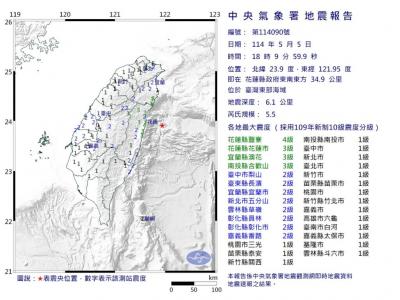
A magnitude 5.9 earthquake that struck about 33km off the coast of Hualien City was the "main shock" in a series of quakes in the area, with aftershocks expected over the next three days, the Central Weather Administration (CWA) said yesterday. Prior to the magnitude 5.9 quake shaking most of Taiwan at 6:53pm yesterday, six other earthquakes stronger than a magnitude of 4, starting with a magnitude 5.5 quake at 6:09pm, occurred in the area. CWA Seismological Center Director Wu Chien-fu (吳健富) confirmed that the quakes were all part of the same series and that the magnitude 5.5 temblor was

Taiwan will now have four additional national holidays after the Legislative Yuan passed an amendment today, which also made Labor Day a national holiday for all sectors. The Chinese Nationalist Party (KMT) and Taiwan People’s Party (TPP) used their majority in the Legislative Yuan to pass the amendment to the Act on Implementing Memorial Days and State Holidays (紀念日及節日實施辦法), which the parties jointly proposed, in its third and final reading today. The legislature passed the bill to amend the act, which is currently enforced administratively, raising it to the legal level. The new legislation recognizes Confucius’ birthday on Sept. 28, the

The Central Weather Administration has issued a heat alert for southeastern Taiwan, warning of temperatures as high as 36°C today, while alerting some coastal areas of strong winds later in the day. Kaohsiung’s Neimen District (內門) and Pingtung County’s Neipu Township (內埔) are under an orange heat alert, which warns of temperatures as high as 36°C for three consecutive days, the CWA said, citing southwest winds. The heat would also extend to Tainan’s Nansi (楠西) and Yujing (玉井) districts, as well as Pingtung’s Gaoshu (高樹), Yanpu (鹽埔) and Majia (瑪家) townships, it said, forecasting highs of up to 36°C in those areas


 RSS
RSS