


Three stages of traffic control are to be implemented for Taipei City’s New Year’s Eve party to be held in front of Taipei City Hall, the Taipei City Police Department’s Traffic Division said today.
City Hall Road, from Songshou Road to Songgao Road, and New Renai Road, is to be blocked starting from today to 6am on Jan. 2 next year, the police said.
On New Year’s Eve, from 7pm to 8pm, vehicles will only be allowed to exit but not to enter the area west of Songren Road, south of Zhongxiao East Road, north of Xinyi Road, and east of Keelung Road and Yixian Road.
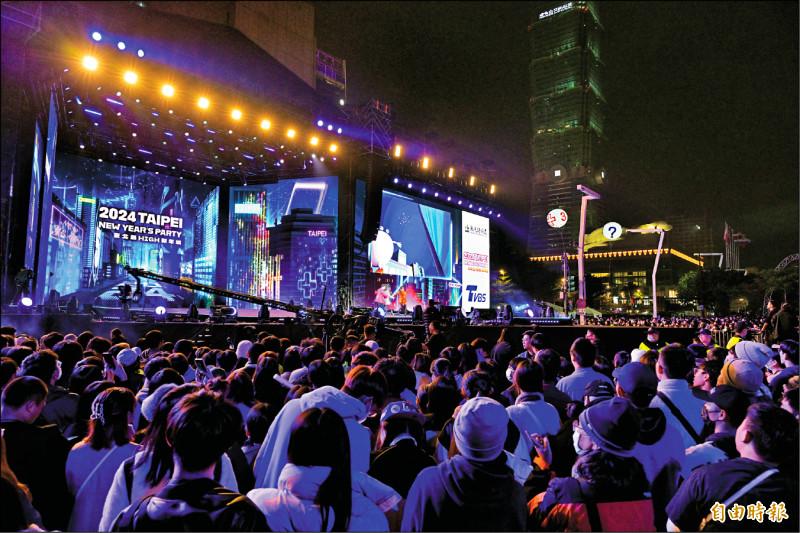
Photo: Chen I-kuan, Taipei Times
From 8pm to 10pm, in addition to the above area, traffic control is to be in place from Yixian Road to Guangfu South Road where vehicles will not be allowed to exit or enter the area. Keelung Road Underpass is also to be placed under traffic controls.
From 10pm to 3am on Jan. 1, vehicles will not be allowed to enter or exit the area east of Guangfu South Road, south of Zhongxiao East Road, north of Xinyi Road and Zhuangjing Road, and the area west of Songren Road, Songde Road and Lane 236 of Section 5 of Zhongxiao East Road.
The police advised people going to the party to use public transport to get to the venue and take the shuttle bus operated by the event’s organizer to leave the venue.
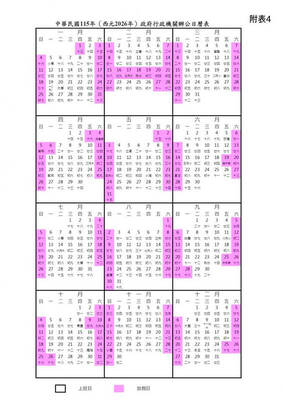
Taiwan is to have nine extended holidays next year, led by a nine-day Lunar New Year break, the Cabinet announced yesterday. The nine-day Lunar New Year holiday next year matches the length of this year’s holiday, which featured six extended holidays. The increase in extended holidays is due to the Act on the Implementation of Commemorative and Festival Holidays (紀念日及節日實施條例), which was passed early last month with support from the opposition Chinese Nationalist Party (KMT) and Taiwan People’s Party. Under the new act, the day before Lunar New Year’s Eve is also a national holiday, and Labor Day would no longer be limited

Taiwan is to extend its visa-waiver program for Philippine passport holders for another year, starting on Aug. 1, Minister of Foreign Affairs Lin Chia-lung (林佳龍) said on Friday. Lin made the announcement during a reception in Taipei marking the 127th anniversary of Philippine independence and the 50th anniversary of the establishment of the Manila Economic and Cultural Office (MECO) in Taiwan, the Ministry of Foreign Affairs said. The decision reflected Taiwan’s commitment to deepening exchanges with the Philippines, the statement cited Lin as saying, adding that it was a key partner under the New Southbound Policy launched in 2016. Lin also expressed hope
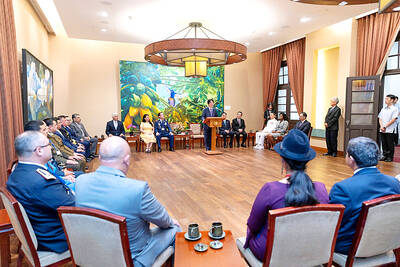
Costa Rica sent a group of intelligence officials to Taiwan for a short-term training program, the first time the Central American country has done so since the countries ended official diplomatic relations in 2007, a Costa Rican media outlet reported last week. Five officials from the Costa Rican Directorate of Intelligence and Security last month spent 23 days in Taipei undergoing a series of training sessions focused on national security, La Nacion reported on Friday, quoting unnamed sources. The Costa Rican government has not confirmed the report. The Chinese embassy in Costa Rica protested the news, saying in a statement issued the same
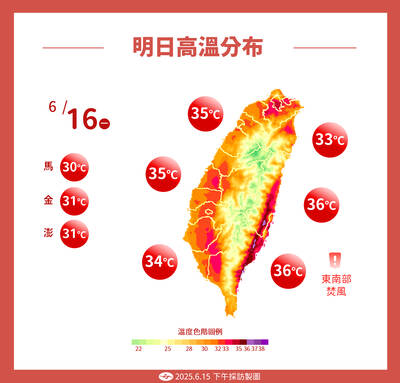
Temperatures in New Taipei City’s Sindian District (新店) climbed past 37°C yesterday, as the Central Weather Administration (CWA) issued heat alerts for 16 municipalities, warning the public of intense heat expected across Taiwan. The hottest location in Taiwan was in Sindian, where the mercury reached 37.5°C at about 2pm, according to CWA data. Taipei’s Shilin District (士林) recorded a temperature of 37.4°C at noon, Taitung County’s Jinfeng Township (金峰) at 12:50 pm logged a temperature of 37.4°C and Miaoli County’s Toufen Township (頭份) reached 36.7°C at 11:40am, the CWA said. The weather agency yesterday issued a yellow level information notice for Taipei, New


 RSS
RSS