


The Tesla Model Y and Honda CR-V secured five-star safety ratings after being evaluated by the Taiwan New Car Assessment Program this quarter, the Vehicle Safety Certification Center said yesterday.
The program, which is funded by the Ministry of Transportation and Communications, evaluates the safety of some of the best-selling vehicles in Taiwan by conducting collision tests using cars procured from retailers by secret buyers.
Results of the collision tests are made public each quarter.
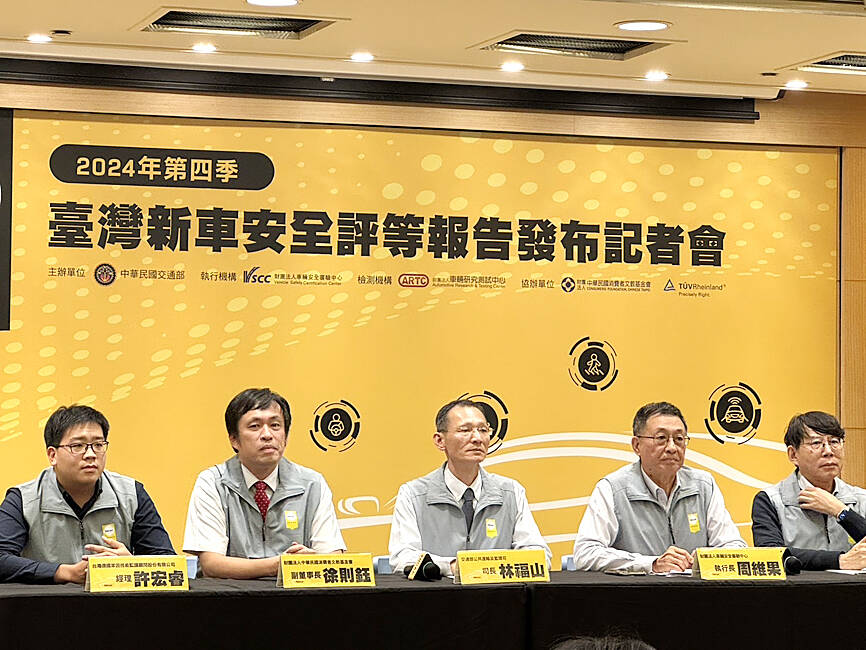
Photo: CNA
This quarter’s report was the first time that the program evaluated an electric vehicle, Department of Public Transportation and Supervision Director-General Lin Fu-shan (林福山) said.
After the Honda CR-V previously secured a three-star rating, the Japanese manufacturer voluntarily underwent the test again and paid for the expenses after upgrading the vehicle, Lin said.
The program is to test the safety of the Tesla Model 3 next year, he said.
The Tesla Model Y scored 97 percent in adult occupant protection, 89 percent in child occupant protection, 78 percent in pedestrian protection and 79 percent in safety assistance, while scores for the Honda CR-V in the four categories were 97 percent, 89 percent, 75 percent and 69 percent respectively, the report showed.
Although Tesla Model Ys sold in Taiwan are equipped with a speed assist system, the system cannot process speed limit information conveyed by some traffic signals in Taiwan, such as a warning sign telling drivers to keep below 40kph due to foggy conditions, the center said.
The Honda CR-V’s safety rating was elevated to five stars from three because it upgraded safety equipment by including driver and front-seat passenger knee-protection airbags, front-seat passenger seat belt reminder devices, rear-seat side-chest-protection airbags, rear-seat belt-reminder devices and seat-belt shoulder height position adjusters, the center said.
Aside from the Tesla Model Y, the center said that it is to test the Honda HR-V, the Nissan Sentra, the Toyota Vios, the Lexus RX, the Hyundai Custin and the Toyota Town Ace, as well as the Hyundai Tucson and MG HS.
The center so far has tested the Toyota Corolla Cross, the Toyota RAV4, the Toyota Corolla Altis, the Toyota Sienta, the Ford Kuga, the Toyota Yaris, the Nissan Kicks, the Lexus NX, the Honda FIT and the Nissan X-Trail.
People can view the complete test results at www.tncap.org.tw.

FUKUOKA SITUATION: Japanese media reported that the pathogen is expected to be identified by the summer, while the CDC downplayed the idea that it was hMPV A “mysterious cold-like illness” reported in Japan’s Fukuoka Prefecture does not seem to be a new disease, but Japanese authorities have been asked about the situation, the Centers for Disease Control (CDC) said yesterday. The Fukuoka Prefectural Medical Association on Wednesday told a news conference that a “mystery cold” that has become a hot topic on social media is “highly likely to be caused by some kind of viral infection,” Japan’s KBC News reported. “Many people are experiencing symptoms starting with a sore throat, followed by a runny nose, phlegm and a severe cough,” KBC News reported, citing association officials. Health authorities are

Nvidia Corp CEO Jensen Huang (黃仁勳) arrived in Taiwan yesterday ahead of upcoming AI and technology events, saying he plans to meet with clients and Taiwan Semiconductor Manufacturing Co Chairman C.C. Wei (魏哲家) during his visit. After landing at Taipei Songshan Airport, Huang posed for photos with fans and handed out Yakult drinks to reporters and supporters waiting at the scene, saying he has “a lot to do” during the trip. Asked about reports that Nvidia’s planned headquarters site in Taipei’s Beitou Shilin Technology Park could break ground on May 27, Huang said that if the company holds an event, he would

The Ministry of Finance this afternoon announced the winning numbers for the March-April uniform invoice lottery. The winning number for the NT$10 million (US$318,060) special prize is 19531471, and the winning number for the NT$2 million grand prize is 85941329. Three numbers were drawn for the NT$200,000 first prize: 07225810, 20231230 and 83518781. Those with receipts matching the last seven digits of any of the first-prize numbers will win the NT$40,000 second prize, while those matching the last six digits will win the NT$10,000 third prize. Those whose receipts match the last five digits of the first-prize numbers can claim the NT$4,000 fourth prize,
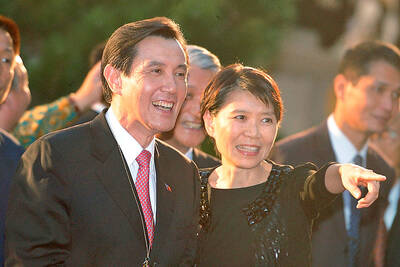
Former president Ma Ying-jeou (馬英九) yesterday expressed “shock and regret” over a statement issued by his wife without his consent, and rejected her assertion that his eldest sister, Ma Yi-nan (馬以南), would manage his medical care or act as his spokesperson amid an ongoing embezzlement probe into his foundation. Ma Ying-jeou in a statement said he was shocked by a statement by his wife, Chou Mei-ching (周美青), regarding his affairs. Ma Yi-nan “must not” be in charge of his healthcare and other personal affairs, nor can she be allowed to represent the Ma family, the former president said. He said he was also


 RSS
RSS