


The addition of US-made M1A2T Abrams tanks would enhance Taiwan’s military capabilities in anti-landing operations, Taiwanese defense experts said following the arrival of the first batch of the advanced armored vehicles in the country on Sunday.
The 38 M1A2T tanks, a variant of the M1 Abrams, were delivered to the Port of Taipei on Sunday. Before this, deliveries of the last type of tank Taiwan received from the US, the M60A3, began in 1994.
The delivery marks the arrival of the first batch of 108 M1A2T tanks and related equipment, which the US government approved for sale to Taiwan in 2019.
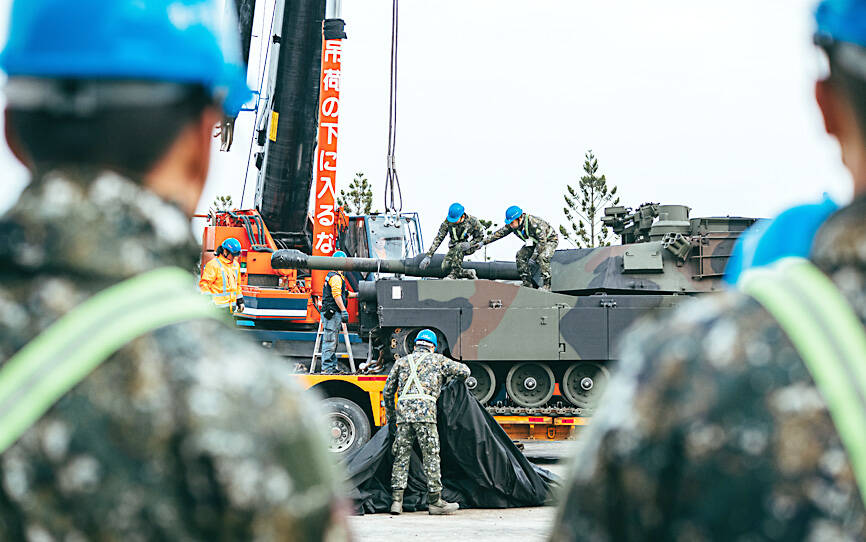
Photo: EPA-EFE
They were transported to the Hsinchu-based Armor Training Command yesterday.
The army previously said that 10 of the tanks would remain at its Armor Training Command and the rest would be deployed to two armored brigades in New Taipei City’s Linkou District (林口) and Hsinchu County’s Hukou Township (湖口) to help defend northern Taiwan.
Chieh Chung (揭仲), a research fellow at the Association of Strategic Foresight, said Taiwan’s army has relied on aging US-made M60A3s and indigenously developed CM11 tanks.
These would be no match for the Chinese People’s Liberation Army’s (PLA) advanced Type 05 amphibious fighting vehicles, he added.
Taiwan’s defense would be at a disadvantage without access to the latest generation of advanced tanks, Chieh said.
Lin Ying-yu (林穎佑), an assistant professor at Tamkang University’s Graduate Institute of International Affairs and Strategic Studies, said Taiwan’s existing tanks — M60A3s and CM11s — have been in service for three decades and would likely be unable to withstand PLA anti-armor firepower.
He said the addition of M1A2Ts would boost Taiwan’s defense.
Su Tzu-yun (蘇紫雲), a research fellow at the military-funded Institute for National Defense and Security Research (INDSR), said that in the event of a PLA landing operation, Taiwan’s first line of defense would be anti-ship missiles, followed by domestic and US-made mobile artillery rocket systems, such as the Thunderbolt-2000 RT/LT-2000, M109 self-propelled howitzer and M142 High Mobility Artillery Rocket Systems.
Combat helicopters such as the AH-64E Apache attack helicopters stand at the third line of defense and coastal defense missiles serve as the fourth line, he said.
The fifth and final line of defense is comprised of tanks, including M1A2Ts and ground forces, he added.
Huang An-hao (黃恩浩), also a research fellow at INDSR, said M1A2Ts and other kinds of tanks play a crucial role in Taiwan’s joint air-ground operations, and would be deployed alongside mechanized infantry troops and with aviation and special forces.
Huang said the combination of M1A2T tanks on the ground and AH-64E helicopters in the air could double Taiwan’s capacity to eliminate invading forces from its beaches and shores.
The M1A2T tanks are equipped with 120mm smoothbore guns that can penetrate 850mm armor and withstand shells fired from most battle tanks.
Their average speed is also significantly faster than Taiwan’s current tanks. The combat vehicle also has a “hunter-killer capacity,” which means it can engage a target while also tracking another.
The armed forces would receive 42 more M1A2Ts next year and 28 in 2026, the Ministry of National Defense’s delivery schedule showed.

FUKUOKA SITUATION: Japanese media reported that the pathogen is expected to be identified by the summer, while the CDC downplayed the idea that it was hMPV A “mysterious cold-like illness” reported in Japan’s Fukuoka Prefecture does not seem to be a new disease, but Japanese authorities have been asked about the situation, the Centers for Disease Control (CDC) said yesterday. The Fukuoka Prefectural Medical Association on Wednesday told a news conference that a “mystery cold” that has become a hot topic on social media is “highly likely to be caused by some kind of viral infection,” Japan’s KBC News reported. “Many people are experiencing symptoms starting with a sore throat, followed by a runny nose, phlegm and a severe cough,” KBC News reported, citing association officials. Health authorities are

Nvidia Corp CEO Jensen Huang (黃仁勳) arrived in Taiwan yesterday ahead of upcoming AI and technology events, saying he plans to meet with clients and Taiwan Semiconductor Manufacturing Co Chairman C.C. Wei (魏哲家) during his visit. After landing at Taipei Songshan Airport, Huang posed for photos with fans and handed out Yakult drinks to reporters and supporters waiting at the scene, saying he has “a lot to do” during the trip. Asked about reports that Nvidia’s planned headquarters site in Taipei’s Beitou Shilin Technology Park could break ground on May 27, Huang said that if the company holds an event, he would

The Ministry of Finance this afternoon announced the winning numbers for the March-April uniform invoice lottery. The winning number for the NT$10 million (US$318,060) special prize is 19531471, and the winning number for the NT$2 million grand prize is 85941329. Three numbers were drawn for the NT$200,000 first prize: 07225810, 20231230 and 83518781. Those with receipts matching the last seven digits of any of the first-prize numbers will win the NT$40,000 second prize, while those matching the last six digits will win the NT$10,000 third prize. Those whose receipts match the last five digits of the first-prize numbers can claim the NT$4,000 fourth prize,
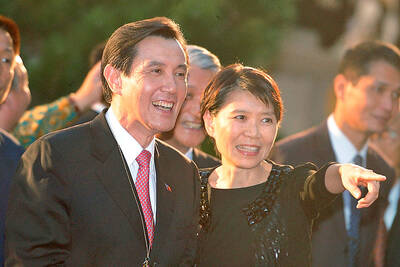
Former president Ma Ying-jeou (馬英九) yesterday expressed “shock and regret” over a statement issued by his wife without his consent, and rejected her assertion that his eldest sister, Ma Yi-nan (馬以南), would manage his medical care or act as his spokesperson amid an ongoing embezzlement probe into his foundation. Ma Ying-jeou in a statement said he was shocked by a statement by his wife, Chou Mei-ching (周美青), regarding his affairs. Ma Yi-nan “must not” be in charge of his healthcare and other personal affairs, nor can she be allowed to represent the Ma family, the former president said. He said he was also


 RSS
RSS