


The Taiwan People’s Party (TPP) central committee yesterday said it had unanimously agreed to extend TPP Chairman Ko Wen-je’s (柯文哲) leave for another three months, as he continues to be detained on corruption charges.
Ko’s initial three-month leave of absence from his party leadership role was to end on Nov. 29, but his detention has been extended to January next year. He is suspected of profiteering involving real-estate developers during his time as Taipei mayor.
According to Article 16 of the party’s charter, if the chair resigns or is unable to perform their duties, the committee must choose an interim chair.

Photo: Chen Yi-kuan, Taipei Times
If the original chair’s remaining term exceeds one year, an election for a new chair must be held within six months.
The committee held a meeting and a subsequent press conference yesterday to discuss Ko’s leave of absence.
Committee members Lin Fu-nan (林富男), Huang Kuo-chang (黃國昌), Wu Chun-cheng (吳春城), Chen Gau-tzu (陳昭姿), Lee Kuo-chang (李國璋) and Hsu Jui-hung (許瑞宏), as well as committee chairman Lee Wei-hua (李偉華) and TPP Secretary-General Vincent Chou (周榆修) were in attendance.
Ko’s leave of absence is to be extended for another three months, until Feb. 28 next year, TPP spokesperson Celina Wu (吳怡萱) told a press conference.
During this time, party affairs would continue to be managed by Lin, Huang and Lee Wei-hua, who are members of the party’s emergency response team, Wu said.
Lin said all 14 committee members unanimously agreed to the two decisions.
The party has established procedures and there is no need to speculate about matters three months from now, Lin said in response to questions about whether Ko’s leave would continue to be extended.
Lin also called on President William Lai (賴清德) to release Ko, emphasizing that the world is watching and questioning how long the Lai administration intends to detain Ko.
The party has protested what they say is Ko’s unfair treatment and politically motivated prosecution.
Lin also said that the party trusts lawyers to inform Ko of the committee’s decision, as he has been prohibited from communicating with others since he was detained on Sept. 5.
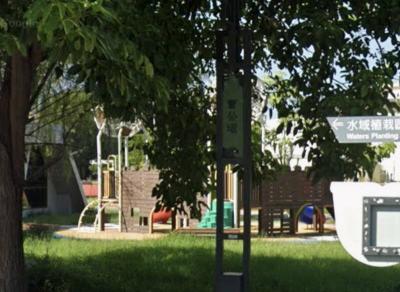
A 72-year-old man in Kaohsiung was sentenced to 40 days in jail after he was found having sex with a 67-year-old woman under a slide in a public park on Sunday afternoon. At 3pm on Sunday, a mother surnamed Liang (梁) was with her child at a neighborhood park when they found the man, surnamed Tsai (蔡), and woman, surnamed Huang (黃), underneath the slide. Liang took her child away from the scene, took photographs of the two and called the police, who arrived and arrested the couple. During questioning, Tsai told police that he had met Huang that day and offered to
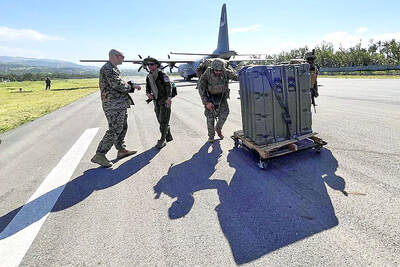
LOOKING NORTH: The base would enhance the military’s awareness of activities in the Bashi Channel, which China Coast Guard ships have been frequenting, an expert said The Philippine Navy on Thursday last week inaugurated a forward operating base in the country’s northern most province of Batanes, which at 185km from Taiwan would be strategically important in a military conflict in the Taiwan Strait. The Philippine Daily Inquirer quoted Northern Luzon Command Commander Lieutenant General Fernyl Buca as saying that the base in Mahatao would bolster the country’s northern defenses and response capabilities. The base is also a response to the “irregular presence this month of armed” of China Coast Guard vessels frequenting the Bashi Channel in the Luzon Strait just south of Taiwan, the paper reported, citing a

BETTER SERVICE QUALITY: From Nov. 10, tickets with reserved seats would only be valid for the date, train and route specified on the ticket, THSRC said Starting on Nov. 10, high-speed rail passengers with reserved seats would be required to exchange their tickets to board an earlier train. Passengers with reserved seats on a specific train are currently allowed to board earlier trains on the same day and sit in non-reserved cars, but as this is happening increasingly often, and affecting quality of travel and ticket sales, Taiwan High-Speed Rail Corp (THSRC) announced that it would be canceling the policy on Nov. 10. It is one of several new measures launched by THSRC chairman Shih Che (史哲) to improve the quality of service, it said. The company also said
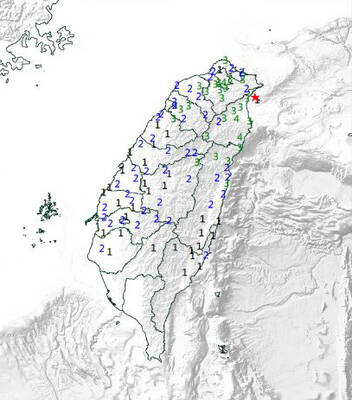
A magnitude 6 earthquake last night at 9:11pm struck off northeastern Yilan County, the Central Weather Administration (CWA) said. The earthquake’s epicenter was located in waters between Toucheng Township (頭城) and Turtle Island (Gueishan Island, 龜山島), about 22.1km northeast of Yilan County Hall at a depth of 112km, CWA data showed. There were no immediate reports of damage. The earthquake’s intensity, which gauges the actual effects of a temblor, was highest in Yilan’s Dongshan (冬山) and Nanao (南澳) townships and Taipei’s Xinyi District (信義), where it measured 4 on Taiwan’s seven-tier intensity scale. It measured 3 in other areas of Yilan and Taipei, as


 RSS
RSS