


Police warned people about fraud on dating sites and social media platforms, citing a recent incident, in which a man was scammed out of NT$700,000.
The man, surnamed Liu (劉), last year signed up for a dating site and was asked to pay to become an “approved member,” the Keelung Police Bureau said.
Then he started chatting with a woman, it said.

Photo copied by Wu Sheng-ju, Taipei Times
“We kept on chatting. Then she asked me to make an online donation to boost her popularity,” Liu was quoted by the bureau as saying.
When Liu requested to meet in person, the woman said he needed to upgrade his membership by paying NT$90,000 so that they can meet up at a hotel room, and he complied, it said.
After that, the dating site’s customer service asked Liu to pay a “safety fee” to guarantee the woman’s safety, and he paid NT$60,000 in additional fees, it said.
Liu booked a hotel room, but nobody showed up, so he called the site’s customer service line to complain, it said.
“The customer service worker laughed and said he could file a lawsuit. They said that the site’s managers were in China,” it said. “Liu realized he was scammed, so he reported the case to police.”
Police made preliminary inquiries, finding that the photo of the woman was taken from the Internet, it said, adding that it would be difficult to identify the people behind the scam.
“It took a great deal of effort to deal with the bank so that they identify Liu as a fraud victim. It took eight months of talks and presenting evidence to successfully return about NT$70,000 to him,” Keelung Police Bureau criminal investigation head Kuo Ching-ju (郭憬融) said.
“Liu is very lucky,” Kuo said. “In most other cases, people do not get any money back.”
“Images of beautiful women can be easily found online and used by criminal groups to deceive people on dating sites,” Kuo said.
In such cases, members of criminal groups often find an excuse to demand that their victims wire some money, Kuo said, urging people to be careful when they use dating Web sites and apps.

Eight restaurants in Taiwan yesterday secured a one-star rating from the Michelin Guide Taiwan for the first time, while three one-star restaurants from last year’s edition were promoted to two stars. Forty-three restaurants were awarded one star this year, including 34 in Taipei, five in Taichung and four in Kaohsiung. Hosu (好嶼), Chuan Ya (川雅), Sushi Kajin (鮨嘉仁), aMaze (心宴), La Vie by Thomas Buhner, Yuan Yi (元一) and Frassi in Taipei and Front House (方蒔) in Kaohsiung received a one-star rating for the first time. Hosu is known for innovative Taiwanese dishes, while Chuan Ya serves Sichuan cuisine and aMaze specializes

Taitung County is to launch charter flights to Malaysia at the end of this year, after setting up flights to Vietnam and Thailand, the Taitung County Government said yesterday. The new charter flight services, provided by low-cost carrier Batik Air Malaysia, would be part of five-day tour packages for visits to Taitung County or Malaysia. The Batik Air charter flight, with about 200 seats, would take Malaysian tourists to Taitung on Dec. 30 and then at 12:35pm return to Kuala Lumpur with Taiwanese tourists. Another charter flight would bring the Taiwanese home on Jan. 3 next year, arriving at 5:30pm, before taking the

Taiwan High Speed Rail Corp. (THSRC) plans to ease strained capacity during peak hours by introducing new fare rules restricting passengers traveling without reserved seats in 2026, company Chairman Shih Che (史哲) said Wednesday. THSRC needs to tackle its capacity issue because there have been several occasions where passengers holding tickets with reserved seats did not make it onto their train in stations packed with individuals traveling without a reserved seat, Shih told reporters in a joint interview in Taipei. Non-reserved seats allow travelers maximum flexibility, but it has led to issues relating to quality of service and safety concerns, especially during
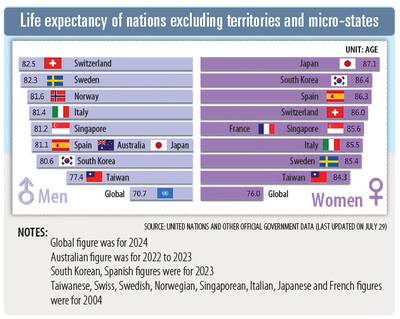
STATS: Taiwan’s average life expectancy of 80.77 years was lower than that of Japan, Singapore and South Korea, but higher than in China, Malaysia and Indonesia Taiwan’s average life expectancy last year increased to 80.77 years, but was still not back to its pre-COVID-19 pandemic peak of 81.32 years in 2020, the Ministry of the Interior said yesterday. The average life expectancy last year increased the 0.54 years from 2023, the ministry said in a statement. For men and women, the average life expectancy last year was 77.42 years and 84.30 years respectively, up 0.48 years and 0.56 years from the previous year. Taiwan’s average life expectancy peaked at 81.32 years in 2020, as the nation was relatively unaffected by the pandemic that year. The metric


 RSS
RSS