


Taiwan People’s Communist Party member Chang Meng-chung (張孟崇) and his wife have been charged with receiving NT$74 million (US$2.32 million) in financial support from the Chinese Communist Party (CCP) to interfere in Taiwan’s elections, prosecutors said today.
The charges come after police and prosecutors conducted four searches between December last year and July and questioned 49 people in the case.
Chang and his wife, surnamed Hung (洪), were formally indicted under Article 4 of the Anti-Infiltration Act (反滲透法), Article 43 of the Presidential and Vice Presidential Election and Recall Act (總統副總統選舉罷免法) and Article 45 of the Public Officials Election and Recall Act (公職人員選舉罷免法), the Chiayi District Prosecutors’ Office said.
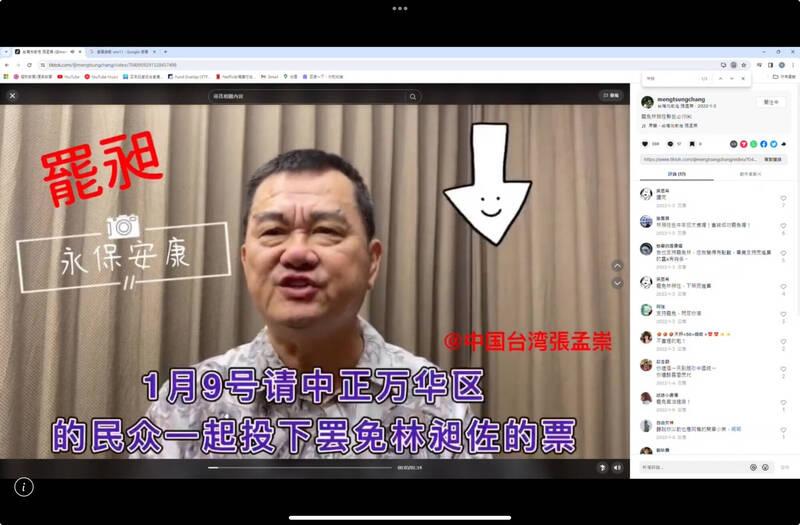
Photo courtesy of the Chiayi District Prosecutors’ Office
The defendants allegedly received financial support and instructions from foreign forces, the office said, adding that the case needed to be announced for the sake of the public and democratic values.
Between 2011 and last year, Chang and Hung allegedly received support from sources such as China’s Taiwan Affairs Office and the Fujian provincial Taiwan Affairs Office amounting to about NT$74 million, prosecutors said.
They then created media content that they promoted on platforms such as Facebook, YouTube and TikTok, promoting positions on candidates, referendum topics and other political issues in an attempt to sway public opinion, prosecutors said.
These efforts included the four referendums in 2021, a 2022 legislator recall vote and this year’s presidential and legislative elections, they said.
The posts also slandered Hong Kong activists and urged the Taiwanese military to surrender in the event of a cross-strait conflict, prosecutors added.
A task force led by Chiayi prosecutor Lin Chung-pin (林仲斌), in collaboration with the Ministry of Justice and the Chiayi City and Pingtung County investigation bureaus, searched 24 locations and seized phones, computers, financial records and other evidence, the office said.
Actions such as these pose a severe threat to national security, it said, adding that prosecutors are fully committed to blocking foreign interference and ensuring that voting remains fair and impartial.

The military has spotted two Chinese warships operating in waters near Penghu County in the Taiwan Strait and sent its own naval and air forces to monitor the vessels, the Ministry of National Defense (MND) said. Beijing sends warships and warplanes into the waters and skies around Taiwan on an almost daily basis, drawing condemnation from Taipei. While the ministry offers daily updates on the locations of Chinese military aircraft, it only rarely gives details of where Chinese warships are operating, generally only when it detects aircraft carriers, as happened last week. A Chinese destroyer and a frigate entered waters to the southwest
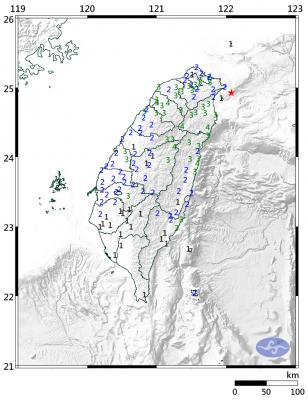
A magnitude 6.1 earthquake struck off the coast of Yilan County at 8:39pm tonight, the Central Weather Administration (CWA) said, with no immediate reports of damage or injuries. The epicenter was 38.7km east-northeast of Yilan County Hall at a focal depth of 98.3km, the CWA’s Seismological Center said. The quake’s maximum intensity, which gauges the actual physical effect of a seismic event, was a level 4 on Taiwan’s 7-tier intensity scale, the center said. That intensity level was recorded in Yilan County’s Nanao Township (南澳), Hsinchu County’s Guansi Township (關西), Nantou County’s Hehuanshan (合歡山) and Hualien County’s Yanliao (鹽寮). An intensity of 3 was

Japanese Prime Minister Sanae Takaichi’s comment last year on Tokyo’s potential reaction to a Taiwan-China conflict has forced Beijing to rewrite its invasion plans, a retired Japanese general said. Takaichi told the Diet on Nov. 7 last year that a Chinese naval blockade or military attack on Taiwan could constitute a “survival-threatening situation” for Japan, potentially allowing Tokyo to exercise its right to collective self-defense. Former Japan Ground Self-Defense Force general Kiyofumi Ogawa said in a recent speech that the remark has been interpreted as meaning Japan could intervene in the early stages of a Taiwan Strait conflict, undermining China’s previous assumptions
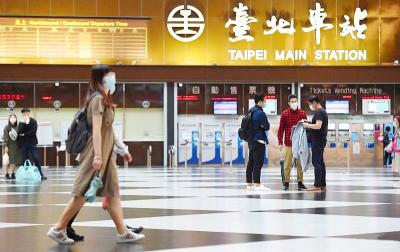
Taiwan Railways Corp (TRC) today announced that Shin Kong Mitsukoshi has been selected as the preferred bidder to operate the Taipei Railway Station shopping mall, replacing the current operator, Breeze Development Co Ltd. Among eight qualified firms that delivered presentations and were evaluated by a review committee, Shin Kong Mitsukoshi was ranked first, while Breeze was named the runner-up, the rail company said in a statement. Contract negotiations are to proceed in accordance with regulations, it said, adding that if negotiations with the top bidder fail, it could invite the second-ranked applicant to enter talks. Breeze in a statement today expressed doubts over


 RSS
RSS