


A “Taiwan Fair” taking place at Keio Department Store Shinjuku in Tokyo, Japan, has reported a sales performance almost as high as the most popular Hokkaido Fair.
In celebration of Keio Department Store Shinjuku’s 60th anniversary, the department store is holding a Taiwan-themed “Keio Taiwan Night Market,” featuring Taiwanese street cuisine, from Thursday last week until tomorrow.
Coinciding with a three-day weekend in Japan, the fair attracted a massive crowd. The organizer said that it had set a sales performance goal of ¥30 million (US$196,136) over six days, but it has made more than ¥20 million in the first three days, and many food stalls are sold out by early evening.
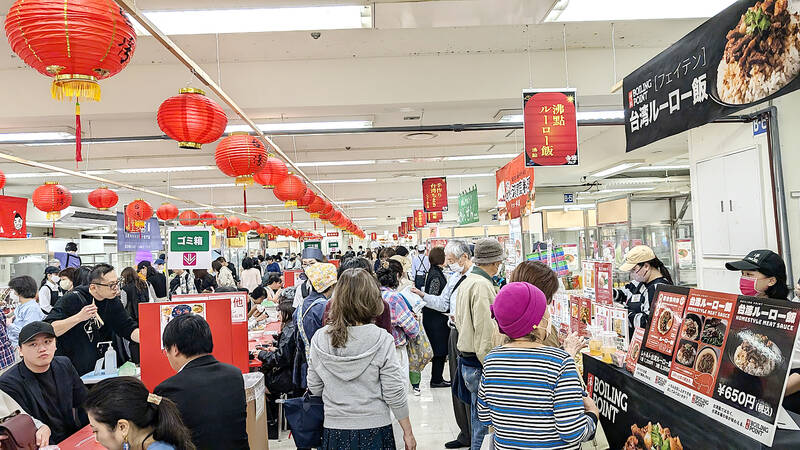
Photo: Lin Tsuei-yi, Taipei Times
The Keio Department Store’s management has in recent years invited many Taiwanese food brands to open up shops in its department stores, including cooperating with a company under Taiwan’s Yummy-Town Group (雅茗天地集團) to open Taiwanese tea shops in Japan.
The department store has a rich experience of holding the Hokkaido Fair and Ekiben (railway bento) Fair annually. This was the first year that the “Taiwan Fair” has been held.
The “Keio Taiwan Night Market” consists of 30 Taiwanese restaurants and retailers, including 25 carefully selected by Lin, such as Uni-President Enterprises Corp (統一企業), Dian Shui Lou (點水樓) restaurant by Namchow Group (南僑集團) and the more than a century-old Len Jen Bakery (連珍) from Keelung.
They also include Di Chun (帝鈞) Pepper Bun from Taichung’s Fengjia Night Market (逢甲夜市), the Happy Lemon (快樂檸檬) beverage chain and the Hung Rui Chen (洪瑞珍) sandwich store, among others. Some have already opened shops in Japan after surviving the low-sales period during the COVID-19 pandemic.
Of the local food fairs held at department stores in Japan, the Hokkaido Fair has always been the most popular and is seen as a guaranteed sales success, so many department stores routinely hold a Hokkaido Fair.
As Taiwanese food has become popular in Japan in recent years, some department stores have tried holding Taiwanese food markets.
Last year, Tobu Department Store held a market that served local food from Taiwan and Hokkaido. The sales performance of the Taiwanese food was almost as high as that of the Hokkaido food.
Yummy-Town Group’s representative in Japan Lin Tai-yi (林太一) said the Taiwan Fair achieved a sales performance of up to ¥21 million in the first three days on Thursday through Saturday.
Although it rained in Tokyo on Saturday, this did not stop customers from visiting the fair, so the sales exceeded ¥8 million, Lin added.
At the fair, many Taiwanese food stalls have launched limited-edition products, such as Happy Lemon’s Taiwanese shaved ice with condensed milk and mango, Len Jen Bakery’s sweet taro Mont Blanc ice cream and Dian Shui Lou’s crispy fried sparerib noodles.

Yangmingshan National Park authorities yesterday urged visitors to respect public spaces and obey the law after a couple was caught on a camera livestream having sex at the park’s Qingtiangang (擎天崗) earlier in the day. The Shilin Police Precinct in Taipei said it has identified a suspect and his vehicle registration number, and would summon him for questioning. The case would be handled in accordance with public indecency charges, it added. The couple entered the park at about 11pm on Thursday and began fooling around by 1am yesterday, the police said, adding that the two were unaware of the park’s all-day live
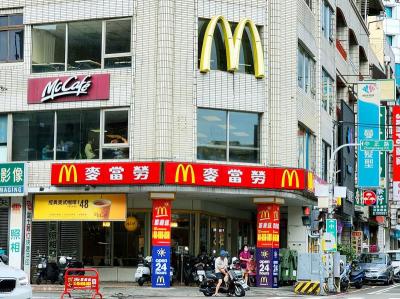
Fast food chain McDonald's is to raise prices by up to NT$5 on some products at its restaurants across Taiwan, starting on Wednesday next week, the company announced today. The prices of all extra value meals and sharing boxes are to increase by NT$5, while breakfast combos and creamy corn soup would go up by NT$3, the company said in a statement. The price of the main items of those meals, if ordered individually, would remain the same. Meanwhile, the price of a medium-sized lemon iced tea and hot cappuccino would rise by NT$3, extra dipping sauces for chicken nuggets would go up
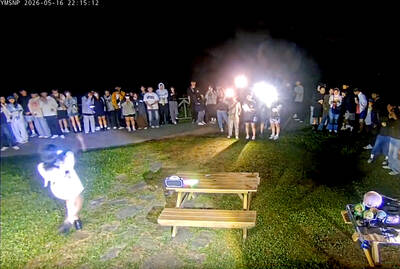
Yangmingshan National Park’s Qingtiangang (擎天崗) nature area has gone viral after a park livestream camera observed a couple in the throes of intimate congress, which was broadcast live on YouTube, drawing large late-night crowds and sparking a backlash over noise, bright lights and disruption to wildlife habitat. The area’s livestream footage appeared to show a couple engaging in sexual activity on a picnic table in the park on Friday last week, with the uncensored footage streamed publicly online. The footage quickly spread across social media, prompting a tide of visitors to travel to the site to “check in” and recreate the

Minister of Digital Affairs Lin Yi-ching (林宜敬) yesterday cited regulatory issues and national security concerns as an expert said that Taiwan is among the few Asian regions without Starlink. Lin made the remarks on Facebook after funP Innovation Group chief executive officer Nathan Chiu (邱繼弘) on Friday said Taiwan and four other countries in Asia — China, North Korea, Afghanistan and Syria — have no access to Starlink. Starlink has become available in 166 countries worldwide, including Ukraine, Malaysia, the Philippines and Vietnam, in the six years since it became commercial, he said. While China and North Korea block Starlink, Syria is not


 RSS
RSS