


Chinese Nationalist Party (KMT) lawmakers yesterday said they would push for an amendment to the Referendum Act (公民投票法) to again allow referendums and national elections to be held on the same day.
KMT Legislator Lo Chih-chiang (羅智強), who proposed the amendments, said that referendums alone could not mobilize as many voters as national elections, which often results in low turnouts for referendums.
For example, only 41 percent of voters turned out for four referendums in 2021, despite bipartisan mobilization, he said.
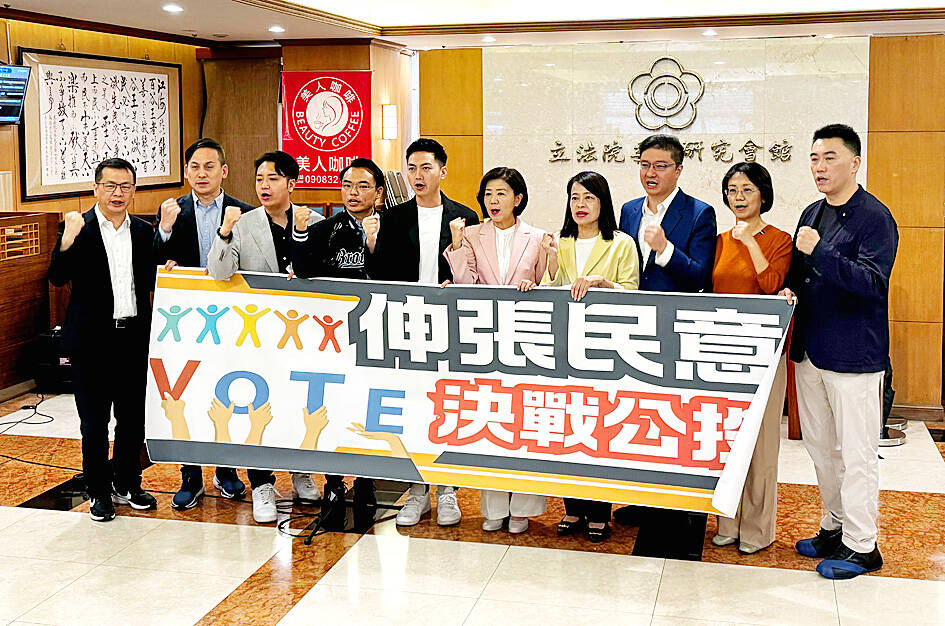
Photo: CNA
That was nearly 2.5 million fewer voters than the 55 percent turnout for 10 referendums in 2018, which were combined with local elections, Lo said.
With a low turnout rate, the outcome of a referendum might not be representative of public opinion, even if passed, which goes against the spirit of direct democracy, he said.
The requirement that referendums be held once every two years infringes upon people’s rights to vote on initiatives and referendums, canceling out the benefits of holding referendums on urgent issues, he said.
With low voter turnout making referendums difficult to pass, civil groups have become unwilling to initiate them, he said.
None of the 2021 referendums passed, Lo said, adding that the referendum system was “virtually put to death” by the Democratic Progressive Party (DPP).
KMT Legislator Hsu Yu-chen (許宇甄) said the separation of referendums from elections has clearly undermined democracy.
The DPP had previously supported the combination of referendums and national elections until they became the ruling party, Lo said.
While a legislator, President William Lai (賴清德) criticized the act for its high voting threshold that virtually put people’s right to referendum in a “birdcage,” he said.
In 2017, an amendment to the act specifying that referendums “shall” be held on the same day as nationwide elections was passed while Lai was premier, Lo added.
He said he admired Lai’s campaign to “set free the caged referendum act” and, based on the DPP’s 2017 proposal to amend the act, he had introduced draft amendments to restore a provision in Article 23 of the act stating that referendums should be held on the same day as nationwide elections.
The KMT’s draft amendments passed the first reading in the previous legislative session, he said, adding that the KMT caucus hoped the bill would be passed as soon as possible to “give the power back to people.”
Additional reporting by CNA

UPGRADE: The Kang Ding-class frigate is replacing its Chaparall missiles with Tien Chien II and Hua Yang VLS, which would provide it with long-range, 360° air defense Taiwan plans to produce 1,200 to 1,376 Hai Chien II missiles (海劍二, Sea Sword II) — also known as TC-2N — to serve as the standard air defense system of the navy’s surface combatant fleet, a source said yesterday. Last week, the Hai Chien II, the naval version of the Tien Kung II missile (天劍二, Sky Sword II), completed a live-fire test in waters off the National Chungshan Institute of Science and Technology’s Jiupeng facility (九鵬) in Pingtung County’s Manjhou Township (滿州). The MIM72 Chaparral and other dated air defense missiles that currently arm Taiwanese ships have inadequate range to combat Chinese

REASONS FOR TRAVEL: An assistant professor said that proposed amendments to penalize drivers if they used drugs overseas would not deter people from traveling People who operate a motor vehicle under the influence of marijuana would have their driver’s license revoked, even if they used the substance while overseas, the Ministry of Transportation and Communications said yesterday, citing proposed amendments to the Road Traffic Management and Penalty Act (道路交通管理處罰條例). The amendments would also authorize the government to revoke the licenses of people determined to have used Category 1 or Category 2 narcotics, even if they were not operating a vehicle while under the influence of drugs, as well as ban them from taking the license test for three years, the ministry said. People aged 18 or
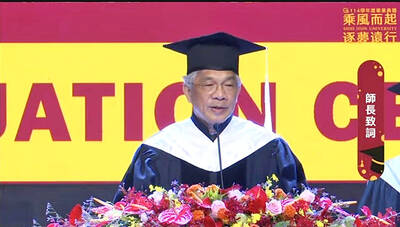
Shih Hsin University President Chen Ching-he (陳清河) yesterday issued a public apology for comments made in his commencement speech last week, stating that he has asked the school to suspend his duties and halt his wages for two months as a show of contrition. At the commencement ceremony on May 30, Chen said, “If you don’t manage your time well, or your own emotions, or your health, then I am telling every one of you — put a quick end to ‘you,’ because the world has no need for ‘you.’” The comments have sparked significant controversy online, and Chen through an open
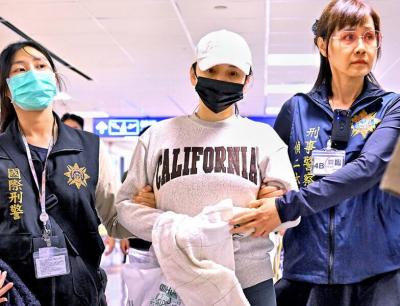
Johanne Liou (劉喬安), a Taiwanese woman who shot to unwanted fame during the Sunflower movement protests in 2014, returned to Taiwan last night after being deported from the US. She is to stand trial in Taiwan for charges involving embezzlement, fraud and drug crimes. The Criminal Investigation Bureau (CIB) said it took her into custody at Taiwan Taoyuan International Airport and would first question her before transferring her to the New Taipei District Prosecutors’ Office. She was arrested upon disembarking a flight from San Francisco that landed shortly before 7pm. Liou absconded to the US in 2019 after jumping bail


 RSS
RSS