


Chinese Nationalist Party (KMT) Legislator Hung Mong-kai (洪孟楷) has proposed amendments to increase penalties for using forged license plates, as their use has skyrocketed to avoid heightened penalties for traffic infractions.
The surge in fake plates followed changes to the Road Traffic Management and Penalty Act (道路交通管理處罰條例) last year, leading to safety issues and other related problems.
Hung proposed an additional NT$60,000 (US$1,864) fine for those who are caught with altered or counterfeit plates more than once, and for the vehicle to be impounded.
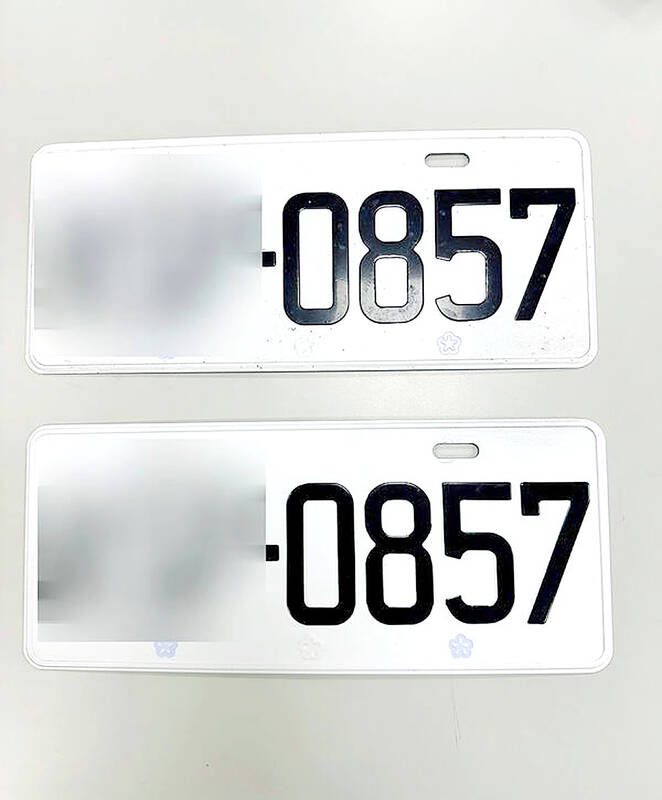
Photo: Hsu Kuo-chen, Taipei Times
Hung urged the Ministry of Justice to review and consider Criminal Code articles 212 and 216, which lay out penalties for forging official documents, to protect the public and reduce the number of counterfeit plates.
Between January and August, the police had 658 cases of counterfeit plates, an increase of more than 301 percent from the 164 cases during the same period last year, the latest National Police Agency statistics showed.
Although there has been progress, a quick search online reveals ads for custom fake license plates that can be modified to suit passenger cars, commercial trucks, motorcycles and more, Hung said.
Some ads even offer to forge vehicle registration certificates if one provides the needed information, Hung added.
Under Article 12 of the act, the penalty for using forged, altered or fraudulently obtained license plates is between NT$3600 and NT$18000, he said.
Given that it is lower than the fine for a speeding ticket, the government is encouraging this type of crime, Hung said.
He proposed that the penalty be changed to NT$10,000 and NT$60,000, along with additional fines and the confiscation of the vehicle for repeat offenders.
The National Police Agency has seen an increase in fake plates over the past two years and has instructed officers to use cameras to scan and investigate suspicious plates in real-time, as well as to trace the source of the counterfeit plates, National Police Agency Traffic Bureau head Chen Ming-chih (陳明志) said.
One-sixth of fake plate cases involve legally registered vehicles being used for illegal or improper purposes, Ministry of Transportation and Communications Department of Public Transportation and Supervision specialist Michael Chao (趙晉緯) said.
The next steps include discussions with police about whether to increase penalties, working with online selling platforms such as Yahoo! and Shopee to remove fake plate listings, as well as investigating sellers on social media, he said.
Customs authorities would also increase their efforts to crack down on fake plate imports, Chao added.
Anti-fraud laws require digital platforms, such as Google, Meta and Line, to verify the identities of individuals before allowing them to place ads on their platform, Ministry of Digital Affairs official Huang Mei-ching (黃美靜) said.
If fraudulent ads are posted, then the platforms must take them down in accordance with the law or face punishment, she said.
These platforms should work with the Ministry of Transportation and Communications to establish lines of communication, Huang added.
There have been many suggestions to increase penalties under Articles 212 and 216, which the ministry would actively discuss and consider future changes to, Ministry of Justice official Lee Ssu-ta (李思達) said.

UPGRADE: The Kang Ding-class frigate is replacing its Chaparall missiles with Tien Chien II and Hua Yang VLS, which would provide it with long-range, 360° air defense Taiwan plans to produce 1,200 to 1,376 Hai Chien II missiles (海劍二, Sea Sword II) — also known as TC-2N — to serve as the standard air defense system of the navy’s surface combatant fleet, a source said yesterday. Last week, the Hai Chien II, the naval version of the Tien Kung II missile (天劍二, Sky Sword II), completed a live-fire test in waters off the National Chungshan Institute of Science and Technology’s Jiupeng facility (九鵬) in Pingtung County’s Manjhou Township (滿州). The MIM72 Chaparral and other dated air defense missiles that currently arm Taiwanese ships have inadequate range to combat Chinese

REASONS FOR TRAVEL: An assistant professor said that proposed amendments to penalize drivers if they used drugs overseas would not deter people from traveling People who operate a motor vehicle under the influence of marijuana would have their driver’s license revoked, even if they used the substance while overseas, the Ministry of Transportation and Communications said yesterday, citing proposed amendments to the Road Traffic Management and Penalty Act (道路交通管理處罰條例). The amendments would also authorize the government to revoke the licenses of people determined to have used Category 1 or Category 2 narcotics, even if they were not operating a vehicle while under the influence of drugs, as well as ban them from taking the license test for three years, the ministry said. People aged 18 or

Johanne Liou (劉喬安), a Taiwanese woman who shot to unwanted fame during the Sunflower movement protests in 2014, returned to Taiwan last night after being deported from the US. She is to stand trial in Taiwan for charges involving embezzlement, fraud and drug crimes. The Criminal Investigation Bureau (CIB) said it took her into custody at Taiwan Taoyuan International Airport and would first question her before transferring her to the New Taipei District Prosecutors’ Office. She was arrested upon disembarking a flight from San Francisco that landed shortly before 7pm. Liou absconded to the US in 2019 after jumping bail

Shih Hsin University President Chen Ching-he (陳清河) yesterday issued a public apology for comments made in his commencement speech last week, stating that he has asked the school to suspend his duties and halt his wages for two months as a show of contrition. At the commencement ceremony on May 30, Chen said, “If you don’t manage your time well, or your own emotions, or your health, then I am telling every one of you — put a quick end to ‘you,’ because the world has no need for ‘you.’” The comments have sparked significant controversy online, and Chen through an open


 RSS
RSS