


A government program to promote solar panel deployment on farmland and fish farms has overlooked its environmental and economic costs on local communities, Citizen of the Earth, Taiwan said yesterday.
The group’s comments came a month after the government unveiled proposed guidelines for the use of land for electricity generation as part of the policy’s public consultation period concluding next week.
The solar power industry has a myriad of external costs that must be controlled, including predatory behavior of energy contractors and potentially negative impact on the local landscape, environment and livelihood, said Tai Hsing-sheng (戴興盛), a natural resources and environmental studies professor at National Dong Hwa University.
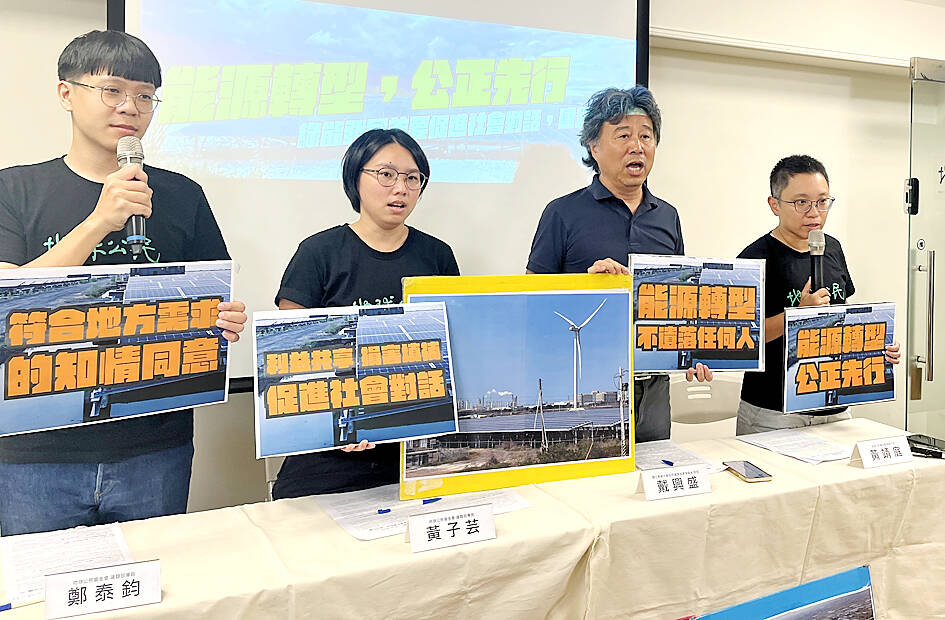
Photo: Chen Chia-yi, Taipei Times
The Ministry of Economic Affairs’ photovoltaic installation projects often failed to factor in these costs to the detriment of the environment, the regional economy and the livelihoods of farmers and aquaculturists, he said.
The ministry should lean into the potential for solar power generation to be distributed across the grid by encouraging social acceptance of the technology, not fixating on specific areas, Tai said.
The quality of solar power projects should take precedence over quantity, he said.
The government has no formal mechanism for discussing solar energy projects with the local communities they would affect, a shortcoming that must be addressed to protect the public’s right to participate in policymaking, he said.
The ministry’s guidelines stipulate that photovoltaic facilities must be at least 1,000m2 — far larger than the 300m2 recommended by environmental groups, Citizen of the Earth member Cheng Tai-chin (鄭泰鈞) said.
The economics ministry should pay more attention to encouraging the installation of rooftop solar panels, a policy it could pursue by cooperating with the Ministry of the Interior, he said.
The absence of a clear energy policy vision has compromised the public trust that is crucial for promoting solar power, group member Huang Tzu-yun (黃子芸) said.
The Energy Administration should create an online platform on energy policy to give the public the information it needs to make informed decisions on solar power, she said.

Actor Darren Wang (王大陸) was sentenced to six months in prison, commutable to a fine, by the New Taipei District Court today for contravening the Personal Data Protection Act (個人資料保護法) in a case linked to an alleged draft-dodging scheme. Wang allegedly paid NT$3.6 million (US$114,380) to an illegal group to help him evade mandatory military service through falsified medical documents, prosecutors said. He transferred the funds to Chen Chih-ming (陳志明), the alleged mastermind of a draft-evasion ring, although he lost contact with him as he was already in detention on fraud charges, they said. Chen is accused of helping a

SECURITY: Starlink owner Elon Musk has taken pro-Beijing positions, and allowing pro-China companies to control Taiwan’s critical infrastructure is risky, a legislator said Starlink was reluctant to offer services in Taiwan because of the nation’s extremely high penetration rates in 4G and 5G services, the Ministry of Digital Affairs said yesterday. The ministry made the comments at a meeting of the legislature’s Transportation Committee, which reviewed amendments to Article 36 of the Telecommunications Management Act (電信管理法). Article 36 bans foreigners from holding more than 49 percent of shares in public telecommunications networks, while shares foreigners directly and indirectly hold are also capped at 60 percent of the total, unless specified otherwise by law. The amendments, sponsored by Chinese Nationalist Party (KMT) Legislator Ko

NON-RED SUPPLY: Boosting the nation’s drone industry is becoming increasingly urgent as China’s UAV dominance could become an issue in a crisis, an analyst said Taiwan’s drone exports to Europe grew 41.7-fold from 2024 to last year, with demand from Ukraine’s fight against Russian aggression the most likely driver of growth, a study showed. The Institute for Democracy, Society and Emerging Technology (DSET) in a statement on Wednesday said it found that many of Taiwan’s uncrewed aerial vehicle (UAV) sales were from Poland and the Czech Republic. These countries likely transferred the drones to Ukraine to aid it in its fight against the Russian invasion that started in 2022, it said. Despite the gains, Taiwan is not the dominant drone exporter to these markets, ranking second and fourth

The eastern extension of the Taipei MRT Red Line could begin operations as early as late June, the Taipei Department of Rapid Transit Systems said yesterday. Taipei Rapid Transit Corp said it is considering offering one month of free rides on the new section to mark its opening. Construction progress on the 1.4km extension, which is to run from the current terminal Xiangshan Station to a new eastern terminal, Guangci/Fengtian Temple Station, was 90.6 percent complete by the end of last month, the department said in a report to the Taipei City Council's Transportation Committee. While construction began in October 2016 with an


 RSS
RSS