


The Ministry of Education has proposed to increase its budget next year by NT$27.8 billion (US$869.78 million) to a record NT$362.3 billion, with more funds allocated to digital technology education, Deputy Minister of Education Chang Liao Wan-chien (張廖萬堅) said on Saturday.
The additional NT$27.8 billion would be spent on four new projects, he said.
NT$5.9 billion would be used to subsidize the electricity costs for schools as their preferential electricity price program is to be suspended, NT$2.8 billion would be for on-campus housing subsidies for university students, while NT$1 billion would be used to support students traveling abroad for education and exchanges, Chang Liao said.

Photo: Liao Chen-huei, Taipei Times
NT$1.2 billion would be allocated for long service bonuses for teachers working in rural areas in accordance with the Act for Education Development of Schools in Remote Areas (偏遠地區學校教育發展條例) and NT$2.2 billion would be allocated to the education practitioners’ pension fund, he said.
NT$4.9 billion would be allocated to the sub-replacement fertility response program; NT$2.2 billion would be used to subsidize personnel expenses for military, public and education personnel due to their 3 percent salary raise; NT$2 billion would be used to fund the second phase of the Higher Education Sprout Project; and NT$900 million would be used to increase the salary of doctoral students who teach in universities, Chang Liao said.
To promote education on artificial intelligence, the ministry’s Department of Information and Technology Education increased its budget for next year to NT$7.25 billion, which includes NT$2.7 billion for the facilitation of digital learning at elementary and high schools; NT$990 million for interdisciplinary technology education projects; NT$460 million for enhancing the academic network’s computer information services and basic network operations nationwide; NT$410 million for promoting the incorporation of information technology into teaching; and NT$200 million for the digital empowerment program in rural areas, he said.
Meanwhile, the budget for physical education would be increased by NT$2.1 billion to NT7.5 billion next year, Chang Liao said.
For example, an additional budget of between NT$1.14 billion and NT$1.36 billion would be used to enhance public sports facilities and environments while NT$2.81 billion would be used to improve national sports infrastructure, he said.
Every cent of the budget comes from taxpayers and would be wisely invested in education, Minister of Education Cheng Ying-yao (鄭英耀) said on Saturday.
Commenting on the ministry’s proposed budgets, National Federation of Teachers’ Unions president Hou Chun-liang (侯俊良) said that refined education is imperative due to sub-replacement fertility.
The ministry has so far only lowered the student-teacher ratio in kindergartens, he said, adding that the ratio should also be decreased in high schools, and teachers’ wages and the resources for special education should be increased.
It is good for the government to allocate more resources to education, but the budget should be spent as planned to actually benefit teachers and students, National Parent Education Volunteer Association’s Think Bank CEO Wu Fu-pin (吳福濱) said.

Yangmingshan National Park authorities yesterday urged visitors to respect public spaces and obey the law after a couple was caught on a camera livestream having sex at the park’s Qingtiangang (擎天崗) earlier in the day. The Shilin Police Precinct in Taipei said it has identified a suspect and his vehicle registration number, and would summon him for questioning. The case would be handled in accordance with public indecency charges, it added. The couple entered the park at about 11pm on Thursday and began fooling around by 1am yesterday, the police said, adding that the two were unaware of the park’s all-day live

A former soldier and an active-duty army officer were yesterday indicted for allegedly selling classified military training materials to a Chinese intelligence operative for a total of NT$79,440. The Taipei District Prosecutors’ Office indicted Chen Tai-yin (陳泰尹) and Lee Chun-ta (李俊達) for contravening the National Security Act (國家安全法) and the Anti-Corruption Act (貪污治罪條例). Chen left the military in September 2013 after serving alongside then-staff sergeant Lee, now an army lieutenant, at the 21st Artillery Command of the army’s Sixth Corps from 2011 to 2013, according to the indictment. Chen met a Chinese intelligence operative identified as “Wang” (王) through a friend in November

Minister of Digital Affairs Lin Yi-ching (林宜敬) yesterday cited regulatory issues and national security concerns as an expert said that Taiwan is among the few Asian regions without Starlink. Lin made the remarks on Facebook after funP Innovation Group chief executive officer Nathan Chiu (邱繼弘) on Friday said Taiwan and four other countries in Asia — China, North Korea, Afghanistan and Syria — have no access to Starlink. Starlink has become available in 166 countries worldwide, including Ukraine, Malaysia, the Philippines and Vietnam, in the six years since it became commercial, he said. While China and North Korea block Starlink, Syria is not
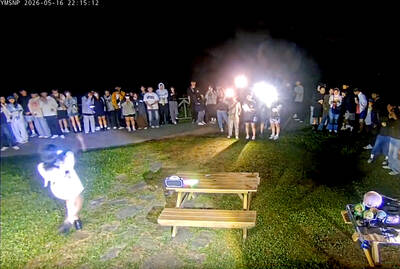
Yangmingshan National Park’s Qingtiangang (擎天崗) nature area has gone viral after a park livestream camera observed a couple in the throes of intimate congress, which was broadcast live on YouTube, drawing large late-night crowds and sparking a backlash over noise, bright lights and disruption to wildlife habitat. The area’s livestream footage appeared to show a couple engaging in sexual activity on a picnic table in the park on Friday last week, with the uncensored footage streamed publicly online. The footage quickly spread across social media, prompting a tide of visitors to travel to the site to “check in” and recreate the


 RSS
RSS