


Beijing is entrenching its business and economic interests in Eswatini in an increasingly successful courtship of Taiwan’s only diplomatic ally in Africa, Semafor Africa said in a report on Tuesday.
The kingdom of Eswatini has long supported Taiwan and was the only one of Africa’s 54 nations to decline to attend last week’s triennial China-Africa summit in Beijing, the media outlet said.
Yet, the southern African nation is “quietly warming to China” as an influx of Chinese “enterprises, businesspeople and even state actors” dig “deep roots in Eswatini’s economy,” it said, citing sources in the local business community.
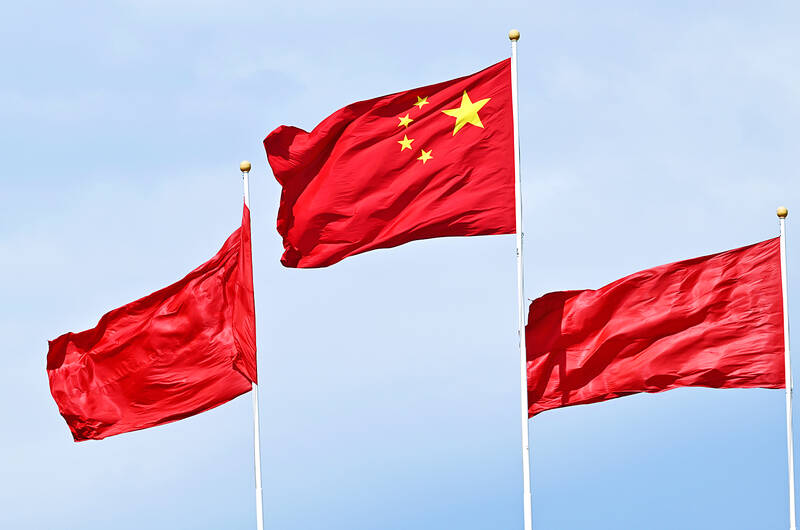
Photo: AP
Ambassador to Eswatini Jeremy Liang (梁洪昇) was cited as saying that a “significant number of Chinese nationals” flowing into Eswatini, a nation of 1.2 million people, would eventually “undermine” Taiwan’s diplomatic mission.
In another indication of strengthening ties, Eswatini mines authority head Guduza Dlamini and a high-profile local entrepreneur led a delegation late year, allegedly to talk with Chinese investors and pave the way for establishing diplomatic relations, it said.
Eswatini government spokesman Alpheous Nxumalo had denied that the delegation’s mission was to initiate dialogue about the kingdom switching diplomatic recognition from Taiwan to China, the report said.
That statement is belied by Eswatini’s awarding of a US$165 million project to build the Mpakeni Embankment Dam to Beijing-owned ChinaPower, the outlet said.
The Eswatini government said at the time that even though the kingdom has “yet to establish formal diplomatic relations” with China, it recognizes ChinaPower’s “brand influence in the southern African region.”
Taiwan established an embassy at Mbabane, the capital of Eswatini, in 1968, the year it declared its independence from the UK.
So far, Eswatini has resisted Beijing’s calls for it to cut ties with Taiwan, including threats to sever all economic ties. The kingdom is one of the Taiwan’s 12 diplomatic allies.
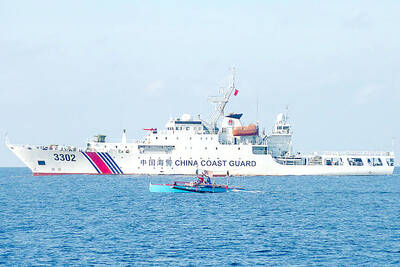
EXPANSIONIST: China deploys an average of 40 to 50 warships and coast guard vessels daily in the South China Sea, despite pledges not to militarize the region, an official said China is attempting to expand its influence across the First Island Chain and increase pressure on Japan by sending coast guard vessels into waters off of Taiwan under the pretext of maritime negotiations with Japan and the Philippines, a national security official said yesterday. China’s recent actions in the waters east of Taiwan and Japan and the Philippines’ exclusive economic zones (EEZ) are attempts to establish dominance in First Island Chain waters, said the official who declined to be named, adding that this is “expansion disguised as law enforcement.” Framing China’s actions solely as a cross-strait issue is a serious misjudgment that
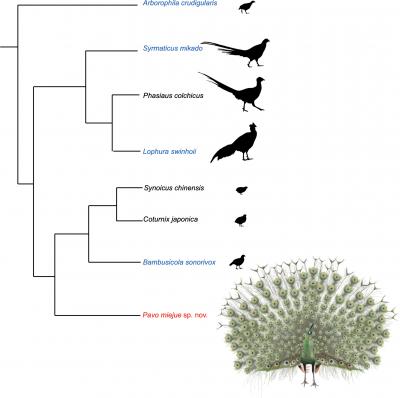
Through analyzing fossil evidence, a research team at National Taiwan University (NTU) discovered the largest endemic bird to have lived in Taiwan, naming it Pavo miejue, or extinct peafowl (滅絕孔雀). The Mikado pheasant, which is printed on the back of the NT$1,000 bank note, was previously believed to be the biggest endemic bird to Taiwan. The research team’s findings suggest that Pavo miejue lived during the Pleistocene epoch tens of thousands of years ago. It is the first endemic extinct bird species discovered and formally named in Taiwan. The study was coauthored by NTU Institute of Ecology and Evolutionary Biology professor Tsai Cheng-hsiu (蔡政修),
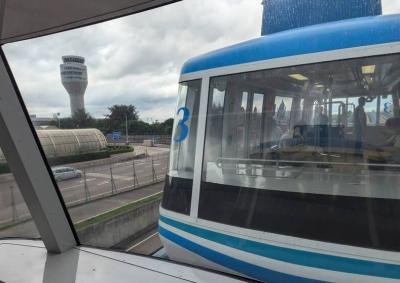
Taiwan Taoyuan International Airport is to suspend its automated Skytrain service connecting Terminal 1 and Terminal 2 starting on July 1 to facilitate connection works for the upcoming Terminal 3, the airport operator said today. Passengers and staff who need to travel between the two terminals after the suspension can instead use the Taoyuan MRT or the airport's 24-hour shuttle bus service, Taoyuan International Airport Corp said. The Taoyuan MRT Airport Line directly links the two terminals, while the shuttle buses are to operate around the clock, the company added. The Skytrain provides free transportation between the airport’s two terminals for travelers and
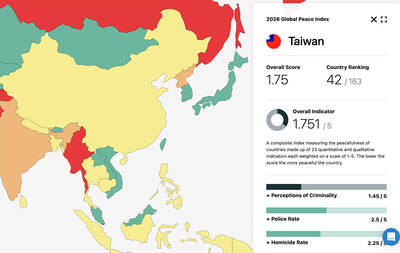
Taiwan ranked 42nd in terms of peacefulness among 163 countries, down five places from last year, according to this year’s Global Peace Index. With an overall score of 1.751, Taiwan dropped from 37th last year, the report published by the global Institute for Economics and Peace showed. The overall score measures a country’s level of peacefulness using 23 quantitative and qualitative indicators across three domains — ongoing domestic and international conflict, societal safety and security, and militarization. While Taiwan ranked 42nd worldwide, it was listed in ninth place among the 19 Asian-Pacific countries in the report, after New Zealand, Singapore, Japan, Malaysia,


 RSS
RSS