


Japan’s Happiness Realization Party (HRP) has drafted a Japanese version of the US’ Taiwan Relations Act (TRA) to cement bilateral strategic cooperation against totalitarian threats from China, HRP Secretary-General Masatoshi Enatsu said yesterday in Taipei.
Enatsu, along with the Taiwan Association of University Professors (TAUP), Taiwan Solidarity Union (TSU), Taiwan Statebuilding Party (TSP) and World United Formosans for Independence (WUFI), convened a news conference at the Legislative Yuan to explain the significance of the Japanese version of the TRA, calling on the Japanese government to legalize its relations with Taiwan via national laws.
Security in the Asia-Pacific region is being threatened by the coalition of China, Russia and North Korea, especially as Moscow has been alienated from Western countries because of the Russia-Ukraine war, he said.
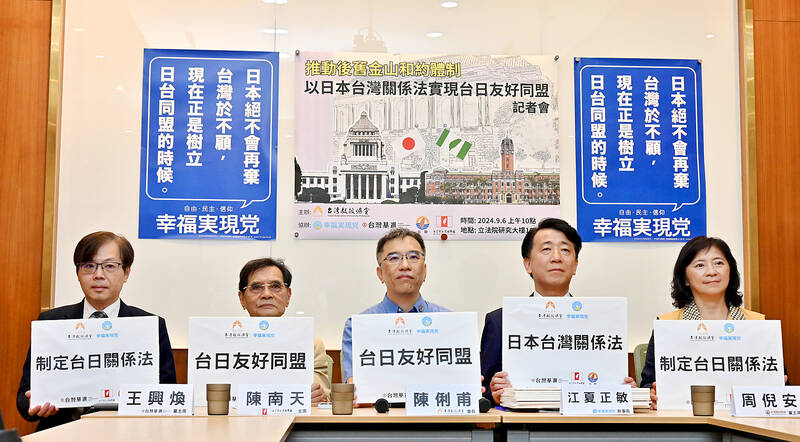
Photo: George Tsorng, Taipei Times
If China establishes a regional hegemony, Taiwan would face an even greater crisis, Enatsu said, adding that Japan should restore diplomatic relations with Taiwan and form a bilateral alliance.
TAUP deputy chairman Chen Li-fu (陳俐甫) said China has been suppressing Taiwan’s international status and stopping it from building military alliances with other nations, but the US has nonetheless maintained its military cooperation with Taiwan via the TRA.
Taiwan should follow the US example and form similar legal frameworks with other countries, especially Japan, he said, adding that Japan’s TRA could strengthen and supplement the joint defense among Taiwan, Japan and the US against China’s expansion in East Asia.
WUFI chairman Chen Nan-tien (陳南天) lauded the HRP’s advocacy for a TRA in Japan, saying it would allow Japan’s Self-Defense Forces to lawfully interfere when Taiwan is involved in conflicts.
The Japanese version of the act would not only help counter totalitarianism in China, but also help democratize the country, he said.
TSU Chairperson Chou Ni-an (周倪安) said Taiwan and Japan should enhance bilateral cooperation at the governmental level as western Pacific democratic partners, and increase their military collaboration against joint threats posed by China, Russia and North Korea.
TSP Chairman Wang Hsing-huan (王興煥) said a Japanese version of the TRA would hammer home the alliance between Taiwan and Japan, as well as promote bilateral economic and cultural cooperation.
Taiwan’s economic development has long been supported by Japan’s funding and technology, and safe supply chains independent of China should be established to ensure national and economic security on both sides, he added.
The news conference was held to mark 73rd anniversary of the signing of the San Francisco Peace Treaty tomorrow. Signed by Japan and 48 other nations in 1951, the treaty says “Japan has renounced all right, title and claim to Taiwan,” without specifying Taiwan’s sovereignty after renunciation.

Fast food chain McDonald's is to raise prices by up to NT$5 on some products at its restaurants across Taiwan, starting on Wednesday next week, the company announced today. The prices of all extra value meals and sharing boxes are to increase by NT$5, while breakfast combos and creamy corn soup would go up by NT$3, the company said in a statement. The price of the main items of those meals, if ordered individually, would remain the same. Meanwhile, the price of a medium-sized lemon iced tea and hot cappuccino would rise by NT$3, extra dipping sauces for chicken nuggets would go up

Yangmingshan National Park’s Qingtiangang (擎天崗) nature area has gone viral after a park livestream camera observed a couple in the throes of intimate congress, which was broadcast live on YouTube, drawing large late-night crowds and sparking a backlash over noise, bright lights and disruption to wildlife habitat. The area’s livestream footage appeared to show a couple engaging in sexual activity on a picnic table in the park on Friday last week, with the uncensored footage streamed publicly online. The footage quickly spread across social media, prompting a tide of visitors to travel to the site to “check in” and recreate the

Minister of Digital Affairs Lin Yi-ching (林宜敬) yesterday cited regulatory issues and national security concerns as an expert said that Taiwan is among the few Asian regions without Starlink. Lin made the remarks on Facebook after funP Innovation Group chief executive officer Nathan Chiu (邱繼弘) on Friday said Taiwan and four other countries in Asia — China, North Korea, Afghanistan and Syria — have no access to Starlink. Starlink has become available in 166 countries worldwide, including Ukraine, Malaysia, the Philippines and Vietnam, in the six years since it became commercial, he said. While China and North Korea block Starlink, Syria is not
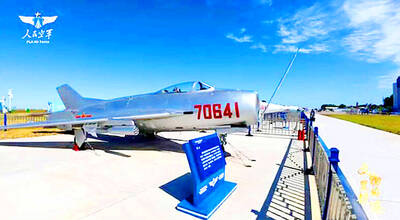
GROUNDED: A KMT lawmaker proposed eliminating drone development programs and freezing funding for counterdrone systems, despite China’s adoption of the technology China has deployed attack drones at air bases near the Taiwan Strait in a strategy aimed at overwhelming Taiwan’s air defense systems through saturation attacks, the Mainland Affairs Council (MAC) said. The council’s latest quarterly report on China said that satellite imagery and open-source intelligence indicate that the Chinese People’s Liberation Army (PLA) had converted retired J-6 fighter jets into J-6W drones, which the PLA has stationed at six air bases near Taiwan, five in China’s Fujian Province and one in Guangdong Province. The report cited J. Michael Dahm, a senior fellow at the US-based Mitchell Institute, as saying that China has


 RSS
RSS