


The Taiwan People’s Party (TPP) yesterday said it would “mobilize the entire party” to defend party Chairman Ko Wen-je’s (柯文哲) innocence, one day after the Taipei District Court ordered his detention in connection with an anti-corruption probe.
Ko has been named a suspect in a Taipei District Prosecutors’ Office investigation into alleged kickbacks related to a project during his tenure as Taipei mayor to build an office complex on the site of a demolished mall in Songshan District (松山).
The TPP is united in support of Ko’s efforts to prove his innocence in court, said TPP caucus whip Huang Kuo-chang (黃國昌), who also heads a task force dealing with the chairman’s arrest.
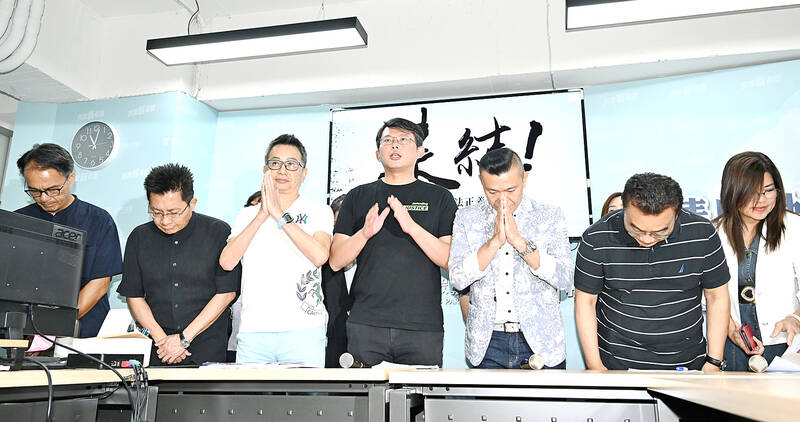
Photo: Lo Pei-de, Taipei Times
TPP Secretary-General Chou Yu-hsiu (周榆修) is to lead the party’s day-to-day affairs in Ko’s stead, Huang told a news conference.
Starting tomorrow, the TPP is to mobilize the entire party to hold talks across the nation to protest Ko’s unfair treatment and politically motivated prosecution at the hands of President William Lai (賴清德), Huang said.
The party denounces the prosecution’s use of deliberate leaks, disinformation and manipulation of the media, he said.
“This matter concerns not only Ko’s innocence, but also the continued preservation of Taiwanese democracy, the rule of law, and a fair and just legal process,” Huang said, adding that the party would bolster its legal team ahead of Ko’s trial.
“The new green dictatorship has shackled Ko’s life-saving hands, but handcuffs will never break his spirit,” Huang said.
The TPP gives its deepest gratitude to its supporters for their commitment, with the understanding that the fight to come is “a marathon, not a sprint,” he said, adding that party has a “long and hard road ahead.”
The party is to hold the first of many protests tomorrow evening outside the Legislative Yuan in Taipei and begin work strengthening its legal defense team, Huang said.
Chinese Nationalist Party (KMT) Secretary-General Lin Szu-ming (林思銘) said the KMT hopes fellow opposition legislators would put their best foot forward in the upcoming legislative session.
“All forces in opposition should cooperate to serve the common good where their values align,” he said, adding that the two parties can cooperate in the deliberation of any bill, budget or confirmation hearings.
A KMT lawmaker said on condition of anonymity that the KMT is willing to collaborate with the TPP on nominating conveners for standing legislative committees, but would insist on its due.
“Conveners are important positions to the scheduling of bills and should not be yielded out of courtesy to a party with fewer votes,” the lawmaker said.
On Thursday, Ko called on his supporters to “keep pushing forward.”
In a pre-recorded video uploaded to his Facebook page, Ko apologized to his supporters for causing them “concern.”
“The best way to help me is to take good care of yourselves,” Ko said. “Live each day with purpose and happiness. Keep kindness in your heart and always do your best.”
“Let’s keep pushing forward,” he said to his supporters, clenching his right fist in the video, which the TPP said was recorded on Thursday morning and released later in the day after the court ruling.
In an interview with Nikkei Asia hours before he was detained again, Ko said the government was attempting to “suppress” opponents.
“What I find most disappointing is that Taiwan spent 30 years overthrowing the KMT party state only to have ... [most of] the judiciary and the media being the government’s political tools,” Ko told the paper.
Regarding a separate campaign finance scandal, he said that “we dare not say that we are absolutely not wrong,” but added that “media hype” had “magnified” mistakes, the paper reported.
Additional reporting by CNA


UPGRADE: The Kang Ding-class frigate is replacing its Chaparall missiles with Tien Chien II and Hua Yang VLS, which would provide it with long-range, 360° air defense Taiwan plans to produce 1,200 to 1,376 Hai Chien II missiles (海劍二, Sea Sword II) — also known as TC-2N — to serve as the standard air defense system of the navy’s surface combatant fleet, a source said yesterday. Last week, the Hai Chien II, the naval version of the Tien Kung II missile (天劍二, Sky Sword II), completed a live-fire test in waters off the National Chungshan Institute of Science and Technology’s Jiupeng facility (九鵬) in Pingtung County’s Manjhou Township (滿州). The MIM72 Chaparral and other dated air defense missiles that currently arm Taiwanese ships have inadequate range to combat Chinese

REASONS FOR TRAVEL: An assistant professor said that proposed amendments to penalize drivers if they used drugs overseas would not deter people from traveling People who operate a motor vehicle under the influence of marijuana would have their driver’s license revoked, even if they used the substance while overseas, the Ministry of Transportation and Communications said yesterday, citing proposed amendments to the Road Traffic Management and Penalty Act (道路交通管理處罰條例). The amendments would also authorize the government to revoke the licenses of people determined to have used Category 1 or Category 2 narcotics, even if they were not operating a vehicle while under the influence of drugs, as well as ban them from taking the license test for three years, the ministry said. People aged 18 or
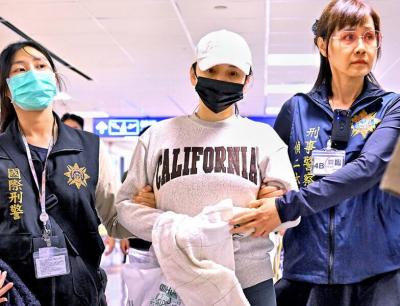
Johanne Liou (劉喬安), a Taiwanese woman who shot to unwanted fame during the Sunflower movement protests in 2014, returned to Taiwan last night after being deported from the US. She is to stand trial in Taiwan for charges involving embezzlement, fraud and drug crimes. The Criminal Investigation Bureau (CIB) said it took her into custody at Taiwan Taoyuan International Airport and would first question her before transferring her to the New Taipei District Prosecutors’ Office. She was arrested upon disembarking a flight from San Francisco that landed shortly before 7pm. Liou absconded to the US in 2019 after jumping bail
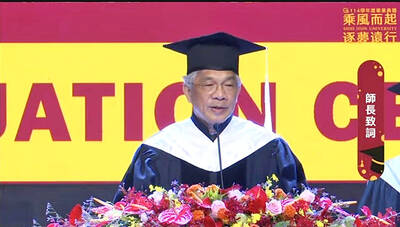
Shih Hsin University President Chen Ching-he (陳清河) yesterday issued a public apology for comments made in his commencement speech last week, stating that he has asked the school to suspend his duties and halt his wages for two months as a show of contrition. At the commencement ceremony on May 30, Chen said, “If you don’t manage your time well, or your own emotions, or your health, then I am telling every one of you — put a quick end to ‘you,’ because the world has no need for ‘you.’” The comments have sparked significant controversy online, and Chen through an open


 RSS
RSS