


Thirty-five people have sought medical treatment for acute symptoms after allegedly eating banh mi (Vietnamese sandwiches) from a vendor in Jhubei City (竹北), the Hsinchu County Public Health Bureau said yesterday.
The bureau said that since Saturday, it has received several reports of suspected food poisoning from hospitals.
The vendor has been ordered to temporarily suspend its business, it said, adding that tests were being conducted to determine whether the people had food poisoning, with results expected in about two weeks.
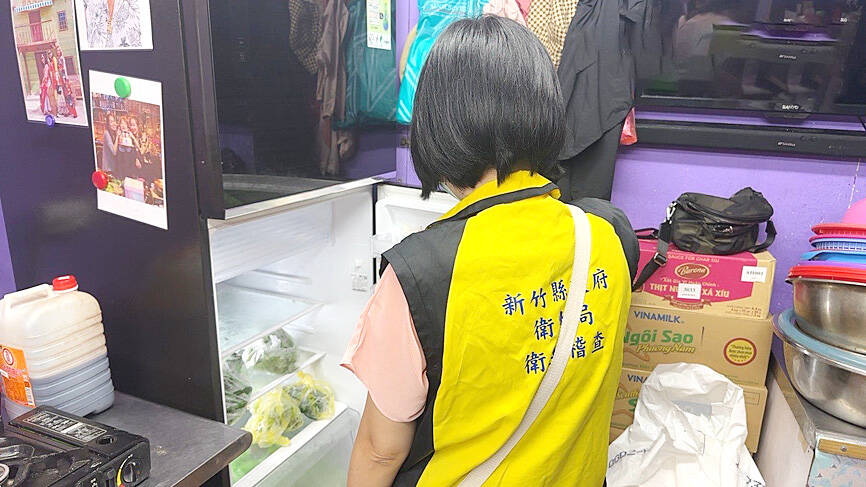
Photo courtesy of the Hsinchu County Government
A preliminary investigation showed that the people who sought treatment had recently eaten banh mi at a vendor at a retail market in Jhubei, it said.
Of the 35 cases, 14 were reported by Ton Yen General Hospital, 12 reported by China Medical University Hsinchu Hospital, four by National Taiwan University Hospital’s Hsinchu Branch and two by Mackay Memorial Hospital Hsinchu Branch, while three sought treatment at other healthcare facilities, it said.
The people reported vomiting, abdominal cramps, abdominal pain, diarrhea, fever and dizziness, the bureau said, adding that five people were still hospitalized.
Bureau inspectors checked the hygiene processes and conditions at the vendor and collected specimens of ham and butter, as well as swabs from cutting boards, trays and the hands of workers, it said.
The inspection found some flaws, including indications of a possible vector of transmission for pathogens, ingredients that had been repackaged without an expiration date, and ingredients, seasonings and kitchenware stored on the floor, it said.
The vendor has been ordered to improve the issues, it said, adding that if it fails to address them, it would face a fine of NT$60,000 to NT$200 million (US$1,879 to US$6.26 million) as stipulated by the Act Governing Food Safety and Sanitation (食品安全衛生管理法).
In other news, the Taipei Department of Health said that 24 percent of produce items failed pesticide residue testing.
Food and Drug Division Director Lin Kuan-chen (林冠蓁) said that the department last month randomly sampled 50 fresh vegetable and fruit items at markets, supermarkets, hypermarkets and restaurants.
Twelve items had one or two pesticide residue levels exceeding the maximum allowable limits, Lin said.
The failed items were four samples of basil, three samples of lychees, and one each of passionfruit, white radish, coriander, longan and jackfruit, she said.
Aside from one item for which the vendor could not identify the origin, the department has informed the local health departments about the items that failed the inspection, she said, adding that the local departments can fine growers if it is verified that pesticide regulations were contravened.

NATIONAL SECURITY: Authorities are working to confirm the identities of the military personnel involved and investigating possible illegal conduct and regulatory violations Authorities are probing possible national security implications after Kinmen police and immigration officers on Sunday found a Chinese woman allegedly posing as a tourist while engaging in prostitution involving more than 10 military personnel. The woman, surnamed Chen (陳), has since been deported, authorities said, adding that investigators are still working to confirm the identities of those implicated, as the records only listed code names and aliases. The case stemmed from a report received by the Kinmen District Prosecutors’ Office on Friday last week from the Jinhu Precinct of the Kinmen County Police Bureau. On Sunday, police, along with the National Immigration

GLOBALGIVING: ‘ Caving to external pressure is not acceptable for an organization that has cultivated justice reform and human rights for 30 years,’ one NGO said A slew of non-government organizations (NGOs) have withdrawn from the GlobalGiving fundraising platform after it announced it would use “Chinese Taipei” instead of “Taiwan” from next month. The Taiwan Good Rice Association wrote on Facebook on Friday that it was informed on April 28 via a teleconference call of the change, which was made because the platform wanted to operate in China. Taiwan Good Rice is to terminate all cooperative relationships with GlobalGiving in response to the platform’s “unilateral and non-negotiable” decision to remove references to Taiwan, the NGO said. “Taiwan is in the official name of Taiwan Good Rice Association and the

HEAVY WEATHER: Typhoon Jangmi is due to crash straight into the Ryukyus as airlines look to shift flights to larger aircraft or cancel flights to Okinawa entirely Taiwan’s international air carriers announced flight adjustments over the weekend as Typhoon Jangmi is forecast to hit the Ryukyu Islands today and tomorrow. The Central Weather Administration (CWA) upgraded Jangmi from a tropical storm to a typhoon at 8am yesterday, with the eye located 580km south of Naha city. It was moving north at 19kph. Today, China Airlines’ CI-120, CI-121, CI-122 and CI-123 flights between Taoyuan and Naha, Okinawa, have been canceled as well as CI-132 and CI-133 between Kaohsiung and Naha. EVA Air’s BR-112, BR-113, BR-186 and BR-185 flights between Taoyuan and Naha are also canceled. Low-cost carrier Tigerair Taiwan canceled IT-230,

Chinese Nationalist Party (KMT) Chairwoman Cheng Li-wun (鄭麗文) yesterday briefed her party’s Central Standing Committee regarding her scheduled visit to the US between Monday next week and June 16, saying that her purpose would be to persuade the US that the Republic of China (ROC) Constitution was a “one China” constitution that would foster stable and peaceful cross-strait relations. The ROC Constitution is the most important defense for all Taiwanese citizens, as it upholds our democracy and has contributed to our robust economy, which aligns with international and US interests, she said. “We would not be troublemakers and drag the US under,”


 RSS
RSS