


Drills involving 304 Chinese military aircraft and 162 ships had been detected around Taiwan during the Paris Olympics, the Mainland Affairs Council (MAC) said yesterday, condemning China for undermining regional peace.
From July 26 to Aug. 11, a total of 304 warplanes and drones flew near Taiwan, averaging 12.3 flights per day, while 209 aircraft crossed the median line of the Taiwan Strait, with some flying as close as 37 nautical miles (68.5km) from Oluanpi (鵝鑾鼻), Taiwan’s southernmost tip, MAC data showed.
A total of 162 Chinese ships had been detected around Taiwan in the same period, averaging 9.5 per day, and some of them carried helicopters, the MAC said.
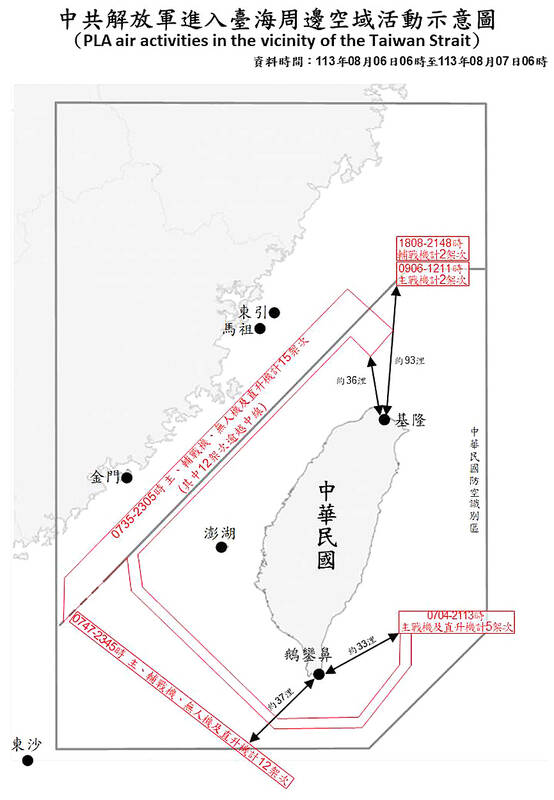
Photo courtesy of the Ministry of National Defense
The modern Olympic Games were founded by Pierre de Coubertin to promote international solidarity, peace and friendship, and the Olympic spirit requires “mutual understanding with a spirit of friendship, solidarity and fair play,” it said, citing the Olympic Charter.
However, China undermined regional peace and stability by sending military aircraft and ships to harass Taiwan irrespective of the Olympic spirit and its own ailing economy, the MAC said.
Beijing organized Chinese to “monitor” Taiwanese spectators and snatch signs with the word “Taiwan” on them at the Olympic badminton venue, an official who is familiar with cross-strait issues and chose to remain anonymous said yesterday.
Such actions violate freedom of expression, the official said.
Beijing said it “hopes to deliver Chinese’s vision of world peace” when it sent torchbearers to the Olympic torch relay, but soon after that it deployed military aircraft and ships near Taiwan and to the South China Sea during the Summer Olympics, they said.
Meanwhile, a Chinese influencer recorded a video to criticize the Paris branch of the Evergreen Laurel Hotel — a hospitality subsidiary of Taiwan’s Evergreen Group — for not including the Chinese flag on its Olympic decor.
The influencer called on Chinese Internet users to boycott the hotel after it allegedly refused to display the Chinese flag.
Some Chinese hotel booking platforms, such as Trip.com and Meituan, removed the hotel.
The management of Evergreen Laurel Hotel last week apologized.
The MAC said that it deplores nationalistic interventions targeting commercial activities, and that the influencer exploited nationalism to raise their profile online, but only made China look aggressive.
Additional reporting by CNA

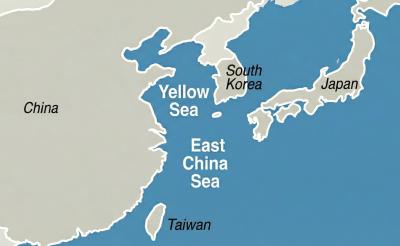
China has reserved offshore airspace in the Yellow Sea and East China Sea from March 27 to May 6, issuing alerts usually used to warn of military exercises, although no such exercises have been announced, the Wall Street Journal (WSJ) reported yesterday. Reserving such a large area for 40 days without explanation is an “unusual step,” as military exercises normally only last a few days, the paper said. These alerts, known as Notice to Air Missions (Notams), “are intended to inform pilots and aviation authorities of temporary airspace hazards or restrictions,” the article said. The airspace reserved in the alert is

South Korea is planning to revise its controversial electronic arrival card, a step Taiwanese officials said prompted them to hold off on planned retaliatory measures, a South Korean media report said yesterday. A Yonhap News Agency report said that the South Korean Ministry of Foreign Affairs is planning to remove the “previous departure place” and “next destination” fields from its e-arrival card system. The plan, reached after interagency consultations, is under review and aims to simplify entry procedures and align the electronic form with the paper version, a South Korean ministry official said. The fields — which appeared only on the electronic form

A bipartisan group of US senators has introduced a bill to enhance cooperation with Taiwan on drone development and to reduce reliance on supply chains linked to China. The proposed Blue Skies for Taiwan Act of 2026 was introduced by Republican US senators Ted Cruz and John Curtis, and Democratic US senators Jeff Merkley and Andy Kim. The legislation seeks to ease constraints on Taiwan-US cooperation in uncrewed aerial systems (UAS), including dependence on China-sourced components, limited access to capital and regulatory barriers under US export controls, a news release issued by Cruz on Wednesday said. The bill would establish a "Blue UAS
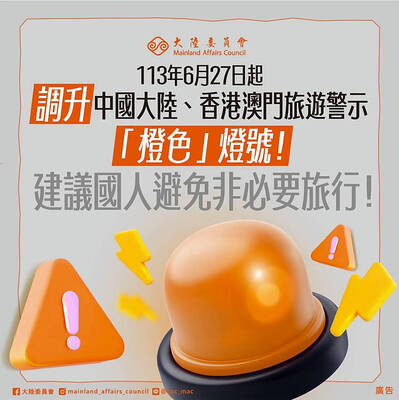
More than 6,000 Taiwanese students have participated in exchange programs in China over the past two years, despite the Mainland Affairs Council’s (MAC) “orange light” travel advisory, government records showed. The MAC’s publicly available registry showed that Taiwanese college and university students who went on exchange programs across the Strait numbered 3,592 and 2,966 people respectively. The National Immigration Agency data revealed that 2,296 and 2,551 Chinese students visited Taiwan for study in the same two years. A review of the Web sites of publicly-run universities and colleges showed that Taiwanese higher education institutions continued to recruit students for Chinese educational programs without


 RSS
RSS