


China has lodged a complaint with the WTO over the EU’s decision to impose anti-subsidy duties on Chinese electric vehicles (EV), escalating a dispute that is straining their already fraught relationship.
Beijing brought the case to the WTO’s dispute settlement mechanism yesterday, the Chinese Ministry of Commerce said.
The aim is to “safeguard the development rights and interests” of the EV industry, it added.
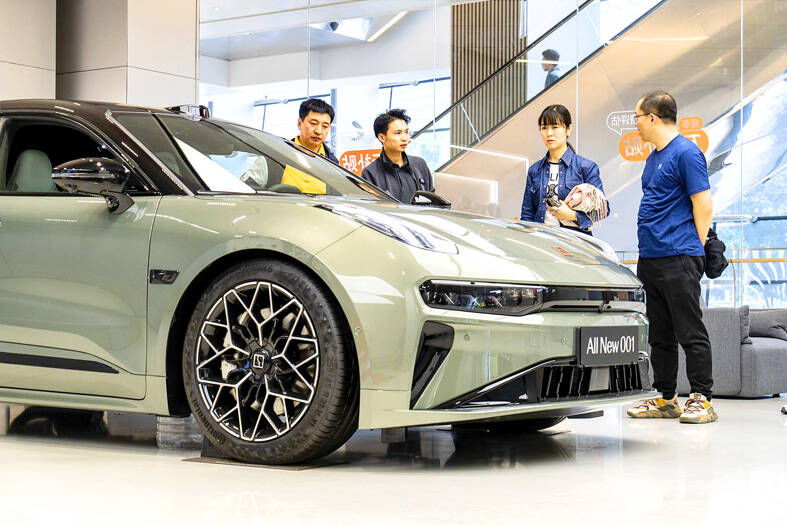
Photo: Bloomberg
“Judgment in the EU’s provisional conclusion lacks factual and legal foundation,” a ministry spokesperson said. “It severely violated WTO rules and undermined the global cooperation on dealing with climate change.”
“We urge the EU to immediately correct its wrongdoing, and together safeguard China-EU economic and trade cooperation as well as the stability of EV supply chain,” the spokesperson added.
Beijing’s relationship with the EU has hit fresh lows in recent months, as the bloc brings its China policy closer to that of the US. The EU last month imposed provisional tariffs on some car imports from China that would raise rates to as high as 48 percent after a months-long probe into Chinese state aid to EV makers.
The move drew swift condemnation from Beijing. China has already threatened retaliation against European farmers and plane makers, and launched an anti-dumping probe targeting the French spirits industry.
Chinese state-owned automaker SAIC Motor Corp (上海汽車集團) is subject to the highest tariff of 37.6 percent on top of an existing 10 percent rate, while Geely Holding Group Co (吉利) and BYD Co (比亞迪) have been hit with added charges of 19.9 percent and 17.4 percent, respectively.
The EV sector has increasingly been caught up in tensions over trade and geopolitics as the world transitions away from the internal combustion engine. China has become a world leader, partly by investing lots of money after identifying EVs as crucial for the environment and the economy.
The US has also sought to limit the entry of Chinese-made EVs, levying tariffs of more than 100 percent, as it said that Beijing is flooding the world with cheap goods, particularly in new green industries. Canada is also considering similar steps.
China has filed a WTO complaint over the US’s own subsidies for EVs, saying the rules are discriminatory. The administration of US President Joe Biden imposed restrictions that mean vehicles containing battery components or raw materials sourced from “foreign entities of concern” would no longer qualify for purchase tax credits of as much as US$7,500.

SECOND-RATE: Models distilled from US products do not perform the same as the original and undo measures that ensure the systems are neutral, the US’ cable said The US Department of State has ordered a global push to bring attention to what it said are widespread efforts by Chinese companies, including artificial intelligence (AI) start-up DeepSeek (深度求索), to steal intellectual property from US AI labs, according to a diplomatic cable. The cable, dated Friday and sent to diplomatic and consular posts around the world, instructs diplomatic staff to speak to their foreign counterparts about “concerns over adversaries’ extraction and distillation of US AI models.” Distillation is the process of training smaller AI models using output from larger, more expensive ones to lower the costs of training a powerful new
Shares of Taiwan Semiconductor Manufacturing Co (TSMC, 台積電) have repeatedly hit new highs, but an equity analyst said the stock’s valuation remains within a reasonable range and any pullback would likely be technical. The contract chipmaker’s historical price-to-earnings (P/E) ratio has ranged between 20 and 30, Cathay Futures Consultant Co (國泰證期) analyst Tsai Ming-han (蔡明翰) told Central News Agency. With market consensus projecting that TSMC would post earnings per share of about NT$100 (US$3.17) this year, supported by strong global demand for artificial intelligence (AI) applications, and the stock currently trading at a P/E ratio of below 25, Tsai said the valuation
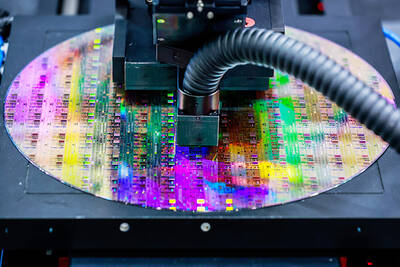
The artificial intelligence (AI) boom has triggered a seismic reshuffling of global equity markets, with Taiwan and South Korea muscling past European nations one by one. With its stock market now valued at nearly US$4.3 trillion, Taiwan surpassed the UK, Europe’s biggest market, earlier this month, data compiled by Bloomberg showed. South Korea is about US$140 billion away from doing the same. The tech-heavy Asian markets have shot past Germany and France in the past seven months. The shift is largely down to massive gains in shares of three companies that provide essential hardware for AI: Taiwan Semiconductor Manufacturing Co (TSMC, 台積電),
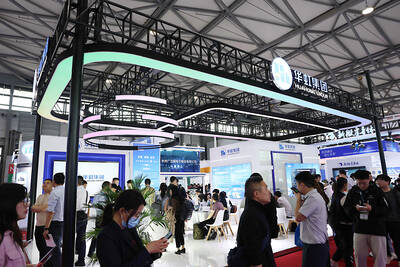
The US Department of Commerce last week ordered multiple chip equipment companies to halt shipments of certain tools to China’s second-largest chipmaker, Hua Hong Semiconductor Ltd (華虹半導體), its latest action to slow the country’s development of advanced chips, two people familiar with the matter said. The department sent letters to at least a handful of companies informing them of restrictions on tools and other materials destined for two Hua Hong facilities US officials believe make China’s most sophisticated chips, the people said. Top US chip equipment companies Lam Research Corp, Applied Materials Inc and KLA Corp, each of which has significant


 RSS
RSS