


Facebook parent Meta Platforms has removed more than 46,500 fraudulent advertisements from its services in the past three months, the Criminal Investigation Bureau (CIB) said on Sunday.
The bureau has been working with Meta and other technology firms such as Google to crack down on investment fraud and related scams.
In the second quarter, Meta took down more than 46,500 ads targeting people in Taiwan, while Google removed 1,466 ads determined to be fraudulent — 623 on YouTube and 843 on other Google platforms, the bureau said in a news release.
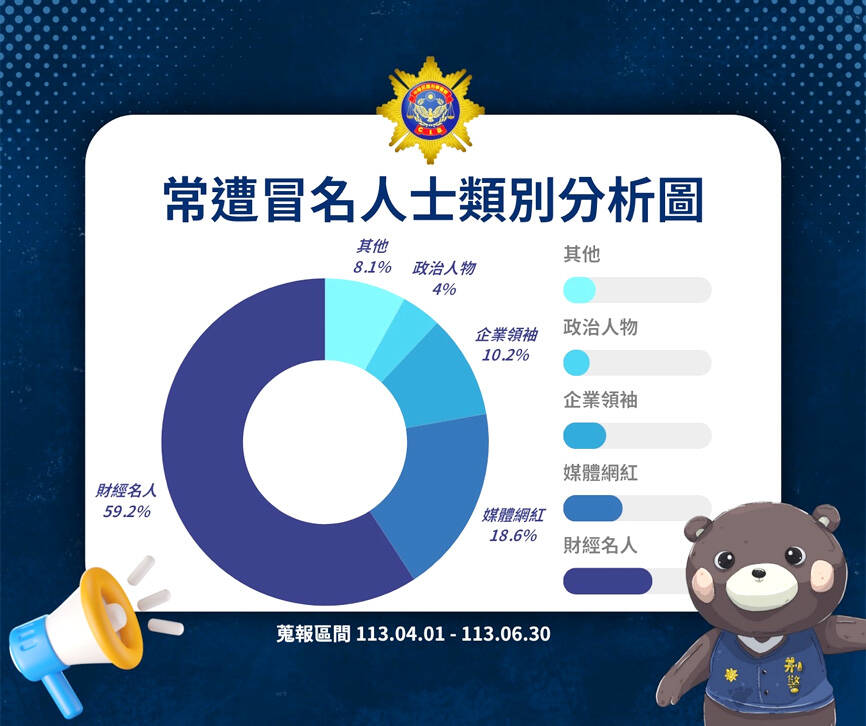
Photo courtesy of the Criminal Investigation Bureau
In the past few years, social media users in Taiwan have been targeted by numerous ads promising high returns on investments, schemes that are often affiliated with criminal organizations, CIB officials said.
Many of the ads feature celebrities, politicians, financial experts and famous business leaders who appear to be endorsing the product involved in the schemes, which typically involve people wiring money to fraudsters believing they are making an investment.
Several well-known figures whose image has been used in the ads with statements attributed to them that they never made have filed complaints with the police.
With the ads’ rise in prevalence, people have demanded the government take action, which led to the CIB’s collaboration with Meta, Google and other online services. The bureau has set up communication channels with the companies and requires that they remove known fraudulent investment ads within a set period.
So far this year, more than 3 million phishing and fraud text messages have been blocked from mobile phones, while more than 130,000 “zombie accounts” used by criminal groups have been taken down, CIB officials said.
More than 25,000 fraudulent Web sites that attempt to redirect users who believe they have clicked a link from known or trusted sites have been invalidated after being flagged by Domain Name System servers, they said.
The bureau said it has more tools to combat online fraud after lawmakers last month approved amendments to the Money Laundering Control Act (洗錢防制法), the Fraud Crime Prevention Act (詐欺犯罪危害防制條例), the Criminal Code and the Communication Security and Surveillance Act (通訊保障及監察法).
The amendments enable the CIB to set up monitoring mechanisms to scrutinize online advertisements, and require Internet service providers and social media platforms to verify an ad’s content, it said.
More cooperation is needed between the public and private sectors to combat investment fraud and scams, and for law enforcement agencies to take tougher action against them, it said.
CIB officials urged people to be cautious about clicking online advertisements.
People should look for indications that it is an investment scam, such as statements about insider information on company shares expected to rapidly rise in value, “limited-time offers,” promises of high returns, free gifts and giveaways, they said.
People can call the 165 anti-fraud hotline to report suspected incidents of fraud.

NATIONAL SECURITY: Authorities are working to confirm the identities of the military personnel involved and investigating possible illegal conduct and regulatory violations Authorities are probing possible national security implications after Kinmen police and immigration officers on Sunday found a Chinese woman allegedly posing as a tourist while engaging in prostitution involving more than 10 military personnel. The woman, surnamed Chen (陳), has since been deported, authorities said, adding that investigators are still working to confirm the identities of those implicated, as the records only listed code names and aliases. The case stemmed from a report received by the Kinmen District Prosecutors’ Office on Friday last week from the Jinhu Precinct of the Kinmen County Police Bureau. On Sunday, police, along with the National Immigration

REASONS FOR TRAVEL: An assistant professor said that proposed amendments to penalize drivers if they used drugs overseas would not deter people from traveling People who operate a motor vehicle under the influence of marijuana would have their driver’s license revoked, even if they used the substance while overseas, the Ministry of Transportation and Communications said yesterday, citing proposed amendments to the Road Traffic Management and Penalty Act (道路交通管理處罰條例). The amendments would also authorize the government to revoke the licenses of people determined to have used Category 1 or Category 2 narcotics, even if they were not operating a vehicle while under the influence of drugs, as well as ban them from taking the license test for three years, the ministry said. People aged 18 or

GLOBALGIVING: ‘ Caving to external pressure is not acceptable for an organization that has cultivated justice reform and human rights for 30 years,’ one NGO said A slew of non-government organizations (NGOs) have withdrawn from the GlobalGiving fundraising platform after it announced it would use “Chinese Taipei” instead of “Taiwan” from next month. The Taiwan Good Rice Association wrote on Facebook on Friday that it was informed on April 28 via a teleconference call of the change, which was made because the platform wanted to operate in China. Taiwan Good Rice is to terminate all cooperative relationships with GlobalGiving in response to the platform’s “unilateral and non-negotiable” decision to remove references to Taiwan, the NGO said. “Taiwan is in the official name of Taiwan Good Rice Association and the

HEAVY WEATHER: Typhoon Jangmi is due to crash straight into the Ryukyus as airlines look to shift flights to larger aircraft or cancel flights to Okinawa entirely Taiwan’s international air carriers announced flight adjustments over the weekend as Typhoon Jangmi is forecast to hit the Ryukyu Islands today and tomorrow. The Central Weather Administration (CWA) upgraded Jangmi from a tropical storm to a typhoon at 8am yesterday, with the eye located 580km south of Naha city. It was moving north at 19kph. Today, China Airlines’ CI-120, CI-121, CI-122 and CI-123 flights between Taoyuan and Naha, Okinawa, have been canceled as well as CI-132 and CI-133 between Kaohsiung and Naha. EVA Air’s BR-112, BR-113, BR-186 and BR-185 flights between Taoyuan and Naha are also canceled. Low-cost carrier Tigerair Taiwan canceled IT-230,


 RSS
RSS