


Four suspects have been arrested for allegedly defrauding victims out of more than NT$16 million (US$487,344) via “self-help programs,” the Criminal Investigation Bureau said on Friday.
The bureau said it launched an investigation in April after reports that a 66-year-old woman named Chang Shu-chun (張淑珺) was allegedly defrauding her students.
Chang, her husband and two assistants were handed over to the Taipei District Prosecutors’ Office on suspicion of fraud and extortion, police said.
Screen grab from the Bureau’s Facebook page
Four students, who had allegedly beaten their fellow students under Chang’s instructions, were also sent to the prosecutors’ office on suspicion of causing bodily harm, they added.
Chang graduated from National Taipei College of Business, which is now known as the National Taipei University of Business, and has published two self-help books, police said.
She said she had trained in spiritual mentoring and set up “the cleansing academy of new heart human futurology” at a rented space in New Taipei City’s Sindian District (新店) in 2009.
The facility operated along with a cafe and a massage parlor, and was aimed at people who were seeking therapy for issues such as cancer or workplace problems, or those who were eager to make a fortune, police said.
Chang allegedly said that the academy could cure diseases forever and help students earn a NT$10 million annual income, providing self-help or immersive English programs that cost NT$700,000 to NT$1 million each, they said.
Three students said Chang defrauded them of more than NT$16 million in total, police said.
Chang allegedly demanded that students obey her “unreasonable instructions,” including getting married to monitor each other or committing obscene acts in front of other students, police said, adding that students who refused would reportedly have to slap themselves in the face or kneel in apology, otherwise they would be beaten.
She also allegedly ordered students to work for her cafe and massage parlor when they could not afford the tuition and fined them for not washing a cup or sweeping leaves on the floor, police said.
Chang has denied the accusations that her programs were illicit, saying her instructions were part of the programs and the students had consented, adding that they could have left whenever they were unwilling to continue.
Police said Chang and her accomplices exploited the students for money and used peer pressure to form a closed group in the academy, where the students, stressed out and frightened, lost their sense of good judgement and could not escape their control.
Asked about the case, Taipei Counseling Psychologists Association chairperson Lan Yi-feng (藍挹丰) on Friday said there are only four different mental healthcare professionals in Taiwan: psychiatrists, counseling psychologists, clinical psychologists and social workers.
If someone says they are a mental therapy professional or that they can perform therapies despite their suspicious job titles, people could consult the Ministry of Health and Welfare’s “query system for medical personnel and facilities” or request relevant license numbers to check the truthfulness of their claims, she said.
It is normal to become mentally fragile in the face of diseases and life struggles, and to fall victim to deceitful remedies or therapies, Lan said, calling on those suffering not to blame themselves.
Additional reporting by CNA

REASONS FOR TRAVEL: An assistant professor said that proposed amendments to penalize drivers if they used drugs overseas would not deter people from traveling People who operate a motor vehicle under the influence of marijuana would have their driver’s license revoked, even if they used the substance while overseas, the Ministry of Transportation and Communications said yesterday, citing proposed amendments to the Road Traffic Management and Penalty Act (道路交通管理處罰條例). The amendments would also authorize the government to revoke the licenses of people determined to have used Category 1 or Category 2 narcotics, even if they were not operating a vehicle while under the influence of drugs, as well as ban them from taking the license test for three years, the ministry said. People aged 18 or
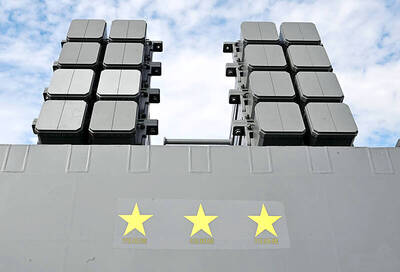
UPGRADE: The Kang Ding-class frigate is replacing its Chaparall missiles with Tien Chien II and Hua Yang VLS, which would provide it with long-range, 360° air defense Taiwan plans to produce 1,200 to 1,376 Hai Chien II missiles (海劍二, Sea Sword II) — also known as TC-2N — to serve as the standard air defense system of the navy’s surface combatant fleet, a source said yesterday. Last week, the Hai Chien II, the naval version of the Tien Kung II missile (天劍二, Sky Sword II), completed a live-fire test in waters off the National Chungshan Institute of Science and Technology’s Jiupeng facility (九鵬) in Pingtung County’s Manjhou Township (滿州). The MIM72 Chaparral and other dated air defense missiles that currently arm Taiwanese ships have inadequate range to combat Chinese

GLOBALGIVING: ‘ Caving to external pressure is not acceptable for an organization that has cultivated justice reform and human rights for 30 years,’ one NGO said A slew of non-government organizations (NGOs) have withdrawn from the GlobalGiving fundraising platform after it announced it would use “Chinese Taipei” instead of “Taiwan” from next month. The Taiwan Good Rice Association wrote on Facebook on Friday that it was informed on April 28 via a teleconference call of the change, which was made because the platform wanted to operate in China. Taiwan Good Rice is to terminate all cooperative relationships with GlobalGiving in response to the platform’s “unilateral and non-negotiable” decision to remove references to Taiwan, the NGO said. “Taiwan is in the official name of Taiwan Good Rice Association and the

HEAVY WEATHER: Typhoon Jangmi is due to crash straight into the Ryukyus as airlines look to shift flights to larger aircraft or cancel flights to Okinawa entirely Taiwan’s international air carriers announced flight adjustments over the weekend as Typhoon Jangmi is forecast to hit the Ryukyu Islands today and tomorrow. The Central Weather Administration (CWA) upgraded Jangmi from a tropical storm to a typhoon at 8am yesterday, with the eye located 580km south of Naha city. It was moving north at 19kph. Today, China Airlines’ CI-120, CI-121, CI-122 and CI-123 flights between Taoyuan and Naha, Okinawa, have been canceled as well as CI-132 and CI-133 between Kaohsiung and Naha. EVA Air’s BR-112, BR-113, BR-186 and BR-185 flights between Taoyuan and Naha are also canceled. Low-cost carrier Tigerair Taiwan canceled IT-230,


 RSS
RSS