


Typhoon Gaemi has brought about 970 million tonnes of rainfall into Taiwan’s reservoirs over the past two days, the Water Resources Agency (WRA) said.
From 7am on Tuesday to 7am yesterday, a total of 973.77 million tonnes of water poured into reservoirs across the nation, agency data showed.
Reservoirs in central Taiwan collectively received 373 million tonnes of rainwater from the typhoon, more than any other region in Taiwan, the data showed.
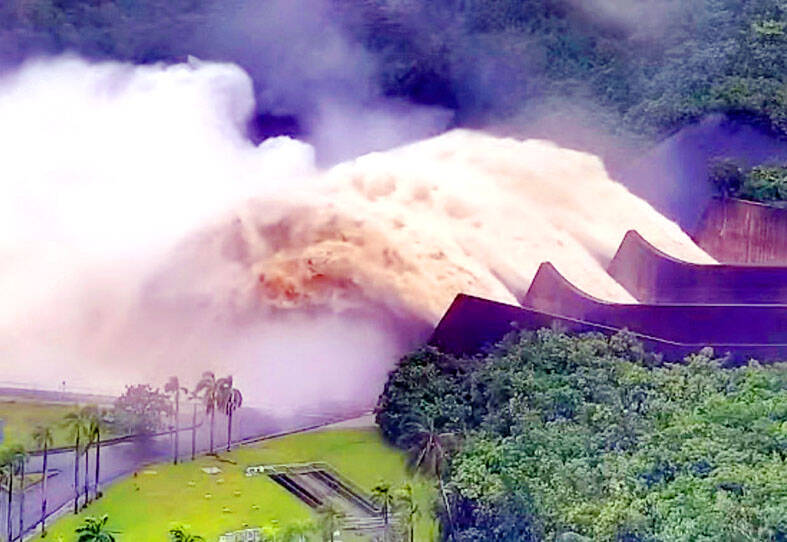
Photo courtesy of the Water Resources Agency’s Southern Region Water Resources Office
Most of the rainwater in central Taiwan, approximately 150 million tonnes, went into the Deji Reservoir (德基水庫) in Taichung, followed by the Wushe Reservoir (霧社水庫) and its downstream water body Sun Moon Lake (日月潭) in Nantou County with 80 million tonnes, it said.
The rainwater inflow to reservoirs in southern Taiwan was the second-highest among all regions, totaling 337.5 million tonnes, with most of it, approximately 300 million tonnes, pouring into the Zengwen Reservoir (曾文水庫) and Wushantou Reservoir (烏山頭水庫) in Tainan, the data showed.
The Zengwen Reservoir was about 50 percent full between Tuesday and Wednesday before it received a massive boost from Gaemi to 74.01 percent as of 7am yesterday, while the water level at the Wushantou Reservoir rose to 92.28 percent during the same period, it showed.
Reservoirs in northern Taiwan collected a total of 263.2 million tonnes of rainwater, with the Shihmen Reservoir (石門水庫) in Taoyuan seeing the largest inflow of 182.6 million tonnes, the data showed.
It was followed by the Feitsui Reservoir (翡翠水庫) in New Taipei City, with 59.8 million tonnes, while the Baoshan Reservoir (寶山水庫) and the Baoshan Second Reservoir (寶二水庫) in Hsinchu County collectively received 9.8 million tonnes.
The agency also captured data on storage rates at the reservoirs across the nation as of 10am yesterday.
In northern Taiwan, the Sinshan Reservoir (新山水庫) in Keelung was 85.28 percent full, followed by the Baoshan Second Reservoir at 83.97 percent, the Shihmen Reservoir at 81.36 percent and the Feitsui Reservoir at 72.21 percent.
In central Taiwan, the Liyutan Reservoir (鯉魚潭水庫) in Miaoli County was 97.91 percent full, while the Deji Reservoir and the Sun Moon Lake reservoir were 91.56 percent and 98.93 percent full respectively, the data showed.
Southern Taiwan’s Nanhua Reservoir (南化水庫) in Tainan was 100 percent full, while the Zengwen Reservoir and the Wushantou Reservoir were refilled to 77.25 percent and 94.36 percent respectively, the data showed.
The agency also published the latest information on disaster prevention, with the following discharging water to avoid overflows: New Taipei City’s Shihmen Reservoir, Cingtan Weir (青潭堰) and Jhihtan Dam (直潭壩); Taichung’s Deji Reservoir and Shihgang Dam (石岡壩); Nantou County’s Wushe Reservoir and Jiji Weir (集集攔河堰); Yunlin County’s Hushan Reservoir (湖山水庫); Chiayi County’s Neipuzih Reservoir (內埔子水庫); Tainan’s Baihe Reservoir (白河水庫), Deyuanpi Reservoir (德元埤水庫), Wushantou Reservoir, Zengwen Reservoir, Nanhua Reservoir, Jingmian Reservoir (鏡面水庫), Hutoupi Reservoir (虎頭埤水庫) and Yanshueipi (鹽水埤水庫); Kaohsiung’s Agongdian Reservoir (阿公店水庫); and Pingtung County’s Mudan Reservoir (牡丹水庫).

FUKUOKA SITUATION: Japanese media reported that the pathogen is expected to be identified by the summer, while the CDC downplayed the idea that it was hMPV A “mysterious cold-like illness” reported in Japan’s Fukuoka Prefecture does not seem to be a new disease, but Japanese authorities have been asked about the situation, the Centers for Disease Control (CDC) said yesterday. The Fukuoka Prefectural Medical Association on Wednesday told a news conference that a “mystery cold” that has become a hot topic on social media is “highly likely to be caused by some kind of viral infection,” Japan’s KBC News reported. “Many people are experiencing symptoms starting with a sore throat, followed by a runny nose, phlegm and a severe cough,” KBC News reported, citing association officials. Health authorities are

Nvidia Corp CEO Jensen Huang (黃仁勳) arrived in Taiwan yesterday ahead of upcoming AI and technology events, saying he plans to meet with clients and Taiwan Semiconductor Manufacturing Co Chairman C.C. Wei (魏哲家) during his visit. After landing at Taipei Songshan Airport, Huang posed for photos with fans and handed out Yakult drinks to reporters and supporters waiting at the scene, saying he has “a lot to do” during the trip. Asked about reports that Nvidia’s planned headquarters site in Taipei’s Beitou Shilin Technology Park could break ground on May 27, Huang said that if the company holds an event, he would

The Ministry of Finance this afternoon announced the winning numbers for the March-April uniform invoice lottery. The winning number for the NT$10 million (US$318,060) special prize is 19531471, and the winning number for the NT$2 million grand prize is 85941329. Three numbers were drawn for the NT$200,000 first prize: 07225810, 20231230 and 83518781. Those with receipts matching the last seven digits of any of the first-prize numbers will win the NT$40,000 second prize, while those matching the last six digits will win the NT$10,000 third prize. Those whose receipts match the last five digits of the first-prize numbers can claim the NT$4,000 fourth prize,

SIX SUBSIDIES: The monthly allowance for older farmers is to increase to NT$10,000, and NT$5,000 is to be given to homemakers under the national pension system, Lai said The government is to implement major welfare policies for disadvantaged groups, including raising the monthly allowance for older farmers to NT$10,000 and providing homemakers with NT$5,000 per month, President William Lai (賴清德) said yesterday. Lai made the remarks during a visit to Wangling Temple in Chiayi County, saying that the planned increases were being introduced amid economic growth and an increase in tax revenue. Touting a policy, in which the government plans to provide a monthly allowance of NT$5,000 for every child under the age of 18 in a bid to address Taiwan’s low birthrate, Lai said that if received for the


 RSS
RSS