


The government is scheduled to reopen parts of Taroko National Park to tourists by end of the year, after an earthquake that measured 7.2 on the Richter scale struck Hualien on April 3 and severely damaged some parts of the park, Minister of Transportation and Communications Li Meng-yen (李孟諺) said yesterday.
“Closing Taroko National Park to tourists affects not only Hualien County, but also the motivation of international tourists to come to Taiwan, as it is considered the Grand Canyon of Asia and many foreigners visit Taiwan just to see it,” Li said.
“We have set a goal of repairing the section from east of Changchun Shrine (長春祠) to Taroko Arch Gate before the end of this year. It is a less risky and safer section, and the road access can be repaired and reopened. Hualien simply cannot survive without Taroko National Park,” he added.
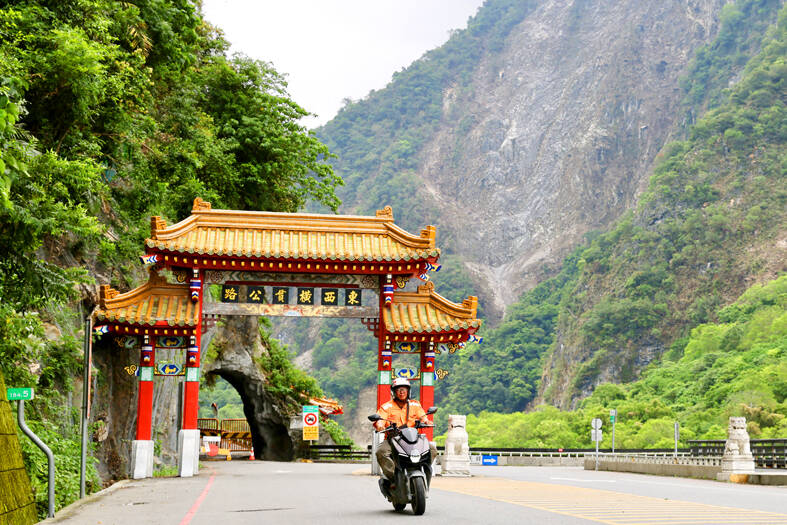
Photo: Ritchie B. Tongo, EPA-EFE
Aside from Taroko Gorge, the ministry might also promote other tourist attractions in Hualien that might appeal to domestic tourists, such as Chisingtan (七星潭), Liyu Lake (鯉魚潭) as well as Fuli (富里), Yuli (玉里) and Dongli (東里) townships, Li said.
“The three townships are known as the home of artists and creative industry workers, and railway tourism. They have yet to become famous among international tourists, but they could be tourist attractions for domestic travelers,” Li said.
On whether the ministry should stop working on fragile highways in mountainous areas, Li said that some of them need to be fixed in a short period, as they are access roads for residents of villages nearby.
Farmers need to access these roads to deliver their agricultural products, he said.
“However, many of these roads were constructed by cutting through slopes and river valleys, and could collapse through years for various reasons,” Li said. “In the long run, we need to find safer routes, but for now we need to bolster the safety of existing routes and reduce casualties, either by building tunnels or reinforcing slopes.”
Meanwhile, Li said the ministry would step up efforts to attract international tourists in the second half of this year.
A total of 4.1 million international tourists have visited the nation so far this year, he said.
Before the COVID-19 pandemic, the nation attracted approximately 11 million international visitors per year, including those from China.
“We hope that China could soon lift the ban on group tours to Taiwan, and they could begin by allowing group travelers to visit Kinmen and Lienchiang counties,” Li said.
Due to a nationwide economic downturn, China asked its people to travel within the country and hoped that Taiwanese tourists would go there to boost its economy, Li said.

Considering that most countries issue more than five denominations of banknotes, the central bank has decided to redesign all five denominations, the bank said as it prepares for the first major overhaul of the banknotes in more than 24 years. Central bank Governor Yang Chin-lung (楊金龍) is expected to report to the Legislative Yuan today on the bank’s operations and the redesign’s progress. The bank in a report sent to the legislature ahead of today’s meeting said it had commissioned a survey on the public’s preferences. Survey results showed that NT$100 and NT$1,000 banknotes are the most commonly used, while NT$200 and NT$2,000

The Centers for Disease Control (CDC) yesterday reported the first case of a new COVID-19 subvariant — BA.3.2 — in a 10-year-old Singaporean girl who had a fever upon arrival in Taiwan and tested positive for the disease. The girl left Taiwan on March 20 and the case did not have a direct impact on the local community, it said. The WHO added the BA.3.2 strain to its list of Variants Under Monitoring in December last year, but this was the first imported case of the COVID-19 variant in Taiwan, CDC Deputy Director-General Lin Ming-cheng (林明誠) said. The girl arrived in Taiwan on

South Korea is planning to revise its controversial electronic arrival card, a step Taiwanese officials said prompted them to hold off on planned retaliatory measures, a South Korean media report said yesterday. A Yonhap News Agency report said that the South Korean Ministry of Foreign Affairs is planning to remove the “previous departure place” and “next destination” fields from its e-arrival card system. The plan, reached after interagency consultations, is under review and aims to simplify entry procedures and align the electronic form with the paper version, a South Korean ministry official said. The fields — which appeared only on the electronic form

The Ministry of Foreign Affairs (MOFA) is suspending retaliation measures against South Korea that were set to take effect tomorrow, after Seoul said it is updating its e-arrival system, MOFA said today. The measures were to be a new round of retaliation after Taiwan on March 1 changed South Korea's designation on government-issued alien resident certificates held by South Korean nationals to "South Korea” from the "Republic of Korea," the country’s official name. The move came after months of protests to Seoul over its listing of Taiwan as "China (Taiwan)" in dropdown menus on its new online immigration entry system. MOFA last week


 RSS
RSS