


The Taiwan People’s Party (TPP) and Chinese Nationalist Party (KMT) caucuses would invite President William Lai (賴清德) to give a state of the nation address at the legislature following pre-legislative reform bill rules, opposition leaders said yesterday.
Their comments came one day after the Constitutional Court issued an injunction against a part of the controversial revisions to the Act Governing the Legislative Yuan’s Power (立法院職權行使法) and the Criminal Code, which were passed in late May, was signed by the president on June 24 and came into effect on June 26.
The President, the Executive Yuan, the Control Yuan and the Democratic Progressive Party (DPP) legislative caucus separately filed for a constitution interpretation and injunction to halt the implementation of the amended laws.
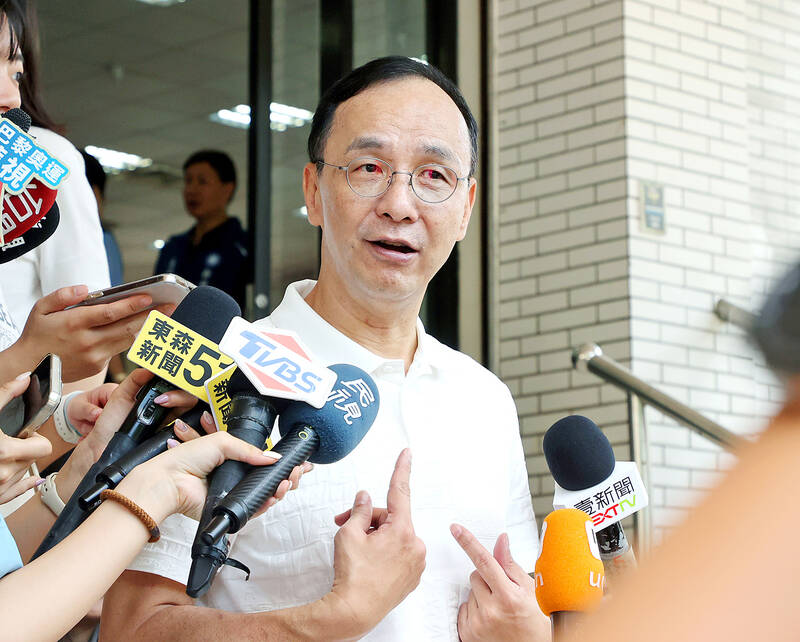
Photo: CNA
The DPP caucus said the opposition should heed the court’s warning, but added that Legislative Speaker Han Kuo-yu (韓國瑜) is entitled to negotiate the matter at the Legislative Yuan.
Earlier that day, TPP caucus whip Huang Kuo-chang (黃國昌) said the court’s ruling on amendments to Article 15 of the act did not abolish the right of lawmakers to request the president’s presence.
This means the Legislative Yuan can ask questions that the president may choose to respond to, he said, adding that Lai should make good on the promises he made on the campaign trail to work with lawmakers.
Huang also accused the government of judicial impropriety, saying: “The Constitutional Court trampled the law to serve the DPP.”
That DPP spokesman Justin Wu (吳崢) knew the court would issue an injunction and when it would happen showed there was a breach of confidentiality rules, he said.
The court’s decision went against the precedent established by Constitutional Interpretation No. 585, he added.
The grand justices’ ruling failed to address the standing issue raised by the Legislative Yuan during the statement of opinion, showing the decision had been pre-prepared, Huang said.
On the sidelines of a panel on legislative reform in New Taipei City, KMT Chairman Eric Chu (朱立倫) said the DPP’s foreknowledge of the ruling was evidence of impropriety.
The power to investigate and call witnesses to hearings is the same right and privilege enjoyed by lawmakers in democracies around the world, he said.
Asked about Chu and Huang’s comments, DPP caucus secretary-general Rosalia Wu (吳思瑤) said the DPP party anticipated the court’s ruling because hundreds of lawyers said the bill amounted to an unconstitutional power grab.
The timing of the decision was transparent to anyone with a passing familiarity of the court’s schedule, she said.
On the TPP and KMT’s proposed invitation, Wu said the court’s injunction permits lawmakers to invite the president to the legislature, but not to dictate the terms of the exchange.
“The ruling flashed a stop sign that the opposition should do well to heed before charging headlong across the railroad,” she said.

Taiwan has received more than US$70 million in royalties as of the end of last year from developing the F-16V jet as countries worldwide purchase or upgrade to this popular model, government and military officials said on Saturday. Taiwan funded the development of the F-16V jet and ended up the sole investor as other countries withdrew from the program. Now the F-16V is increasingly popular and countries must pay Taiwan a percentage in royalties when they purchase new F-16V aircraft or upgrade older F-16 models. The next five years are expected to be the peak for these royalties, with Taiwan potentially earning
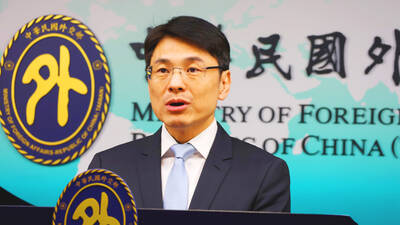
STAY IN YOUR LANE: As the US and Israel attack Iran, the ministry has warned China not to overstep by including Taiwanese citizens in its evacuation orders The Ministry of Foreign Affairs (MOFA) yesterday rebuked a statement by China’s embassy in Israel that it would evacuate Taiwanese holders of Chinese travel documents from Israel amid the latter’s escalating conflict with Iran. Tensions have risen across the Middle East in the wake of US and Israeli airstrikes on Iran beginning Saturday. China subsequently issued an evacuation notice for its citizens. In a news release, the Chinese embassy in Israel said holders of “Taiwan compatriot permits (台胞證)” issued to Taiwanese nationals by Chinese authorities for travel to China — could register for evacuation to Egypt. In Taipei, the ministry yesterday said Taiwan

‘LIKE-MINDED PARTNER’: Tako van Popta said it would be inappropriate to delay signing the deal with Taiwan because of China, adding he would promote the issue Canadian senators have stressed Taiwan’s importance for international trade and expressed enthusiasm for ensuring the Taiwan-Canada trade cooperation framework agreement is implemented this year. Representative to Canada Harry Tseng (曾厚仁) in an interview with the Central News Agency (CNA) said he was increasingly uneasy about Ottawa’s delays in signing the agreement, especially as Ottawa has warmed toward Beijing. There are “no negotiations left. Not only [is it] initialed, we have three versions of the text ready: English, French and Mandarin,” Tseng said. “That tells you how close we are to the final signature.” Tseng said that he hoped Canadian Prime Minister Mark Carney
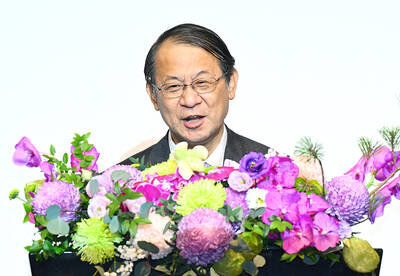
POSITIVE DEVELOPMENT: Japan and the US are expected to hold in-depth discussions on Taiwan-related issues during the meeting next month, Japanese sources said The holding of a Japan-US leaders’ meeting ahead of US President Donald Trump’s visit to China is positive news for Taiwan, former Japan-Taiwan Exchange Association representative Hiroyasu Izumi said yesterday. After the Liberal Democratic Party’s landslide victory in Japan’s House of Representatives election, Japanese Prime Minister Sanae Takaichi is scheduled to visit the US next month, where she is to meet with Trump ahead of the US president’s planned visit to China from March 31 to April 2 for a meeting with Chinese President Xi Jinping (習近平). Japan and the US are expected to hold in-depth discussions on Taiwan-related issues during the


 RSS
RSS