


Taiwanese break dancer Sun Chen (孫振) on Sunday secured his place as Taiwan’s first B-boy to compete in Olympic breakdancing after taking part in the second leg of the discipline’s qualifier series in Budapest, Hungary.
With breakdancing making its debut as an event at the quadrennial summer Olympics, a two-part Olympic Qualifier Series was held in Shanghai, China, and Budapest to finalize the competitors in four “urban sports” disciplines announced by the International Olympic Committee
The other three events were BMX freestyle, skateboarding and sport climbing, all of which debuted at the Olympics after 2000.
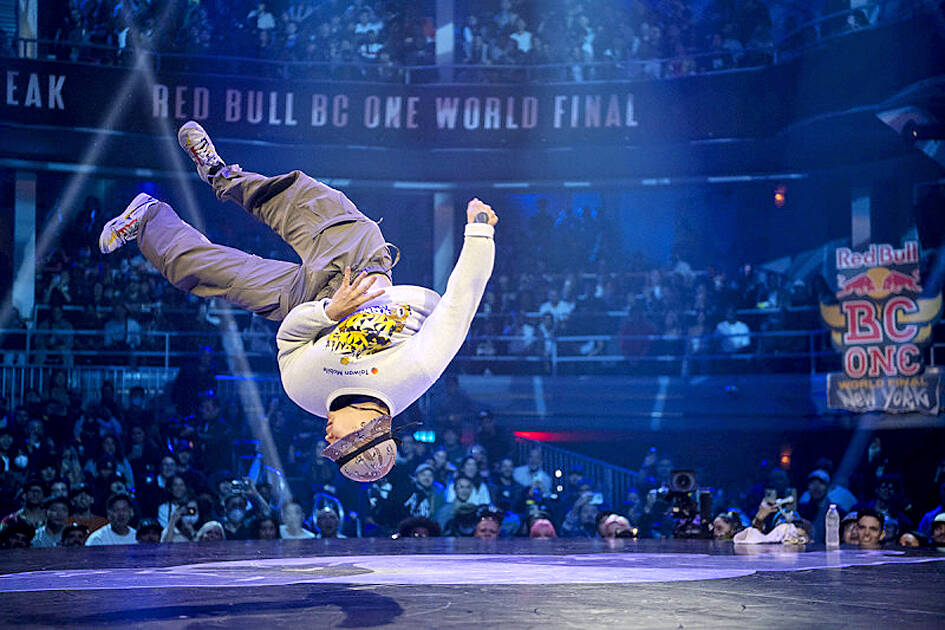
Photo courtesy of Red Bull
After a two-year selection process and competitive events, 40 B-boys (male break dancers) and 40 B-girls (female break dancers) were chosen to compete against each other from May 16 to May 19 in Shanghai, followed by the most recent dance-off from Thursday last week to Sunday in Budapest, to vie for a chance to compete in the inaugural breakdancing event at the Olympics.
Breakers placing in the top seven from the combined rankings in Shanghai and Budapest qualified to compete in Paris next month.
Taiwan’s Sun, better known as “B-boy Quake,” placed 10th overall.
He first placed seventh when competing with a leg injury last month in Shanghai, taking painkillers to help dance through the pain.
However, after reaching the quarter-finals, Sun was outdanced by China’s Qi Xiangyu (亓祥宇).
In Budapest, after dancing his way into the round-of-16, Sun on Sunday competed against other B-boys from the US, the Netherlands and Ukraine, but was unable to make it into the quarter-finals and placed 15th.
With a combined score of 60 out of 100, Sun took 10th place, securing his qualification for Paris.
The National Olympic Committees placed a limit of two dancers from each country in the qualifiers, which ensured Sun’s inclusion after Japan and the US exceeded their quota.
Sun released a statement through his agency saying he is honored to represent Taiwan next month, adding that he would do his best to do justice to his dream of competing at the Olympics.
Born on Sept. 21, 1999 — the day Taiwan was hit by a major earthquake measuring magnitude 7.3 on the Richter scale which caused widespread destruction and killed 2,456 people while injuring 10,718 — the character of Sun’s first name means “vibrate” in Mandarin. His English nickname is Quake.
Sun’s coach Su Chih-peng (蘇志鵬) said Quake was under a lot of pressure before Budapest as he had just recovered from his leg injury.
Su added that after Sun’s qualification, he hoped the nation would begin to value breakdancing as a sport and do more to cultivate it.
“There are many countries in the world, and yet Taiwan was able to make it to the Olympics,” he said.
“The achievement was not easy, but it also allows the world to see Taiwan’s breaking and the sport could be further cultivated, so one day maybe more people can represent Taiwan,” he added.

SECURITY: Starlink owner Elon Musk has taken pro-Beijing positions, and allowing pro-China companies to control Taiwan’s critical infrastructure is risky, a legislator said Starlink was reluctant to offer services in Taiwan because of the nation’s extremely high penetration rates in 4G and 5G services, the Ministry of Digital Affairs said yesterday. The ministry made the comments at a meeting of the legislature’s Transportation Committee, which reviewed amendments to Article 36 of the Telecommunications Management Act (電信管理法). Article 36 bans foreigners from holding more than 49 percent of shares in public telecommunications networks, while shares foreigners directly and indirectly hold are also capped at 60 percent of the total, unless specified otherwise by law. The amendments, sponsored by Chinese Nationalist Party (KMT) Legislator Ko

The military has spotted two Chinese warships operating in waters near Penghu County in the Taiwan Strait and sent its own naval and air forces to monitor the vessels, the Ministry of National Defense (MND) said. Beijing sends warships and warplanes into the waters and skies around Taiwan on an almost daily basis, drawing condemnation from Taipei. While the ministry offers daily updates on the locations of Chinese military aircraft, it only rarely gives details of where Chinese warships are operating, generally only when it detects aircraft carriers, as happened last week. A Chinese destroyer and a frigate entered waters to the southwest
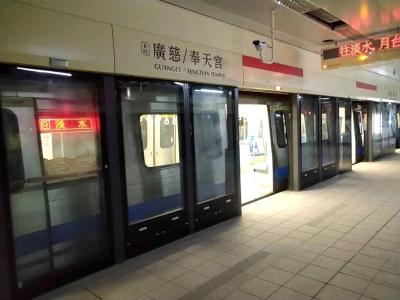
The eastern extension of the Taipei MRT Red Line could begin operations as early as late June, the Taipei Department of Rapid Transit Systems said yesterday. Taipei Rapid Transit Corp said it is considering offering one month of free rides on the new section to mark its opening. Construction progress on the 1.4km extension, which is to run from the current terminal Xiangshan Station to a new eastern terminal, Guangci/Fengtian Temple Station, was 90.6 percent complete by the end of last month, the department said in a report to the Taipei City Council's Transportation Committee. While construction began in October 2016 with an
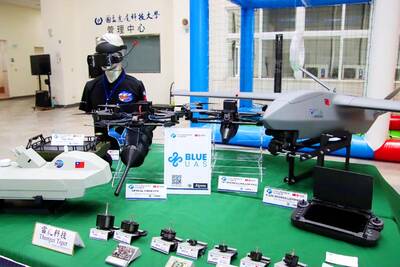
NON-RED SUPPLY: Boosting the nation’s drone industry is becoming increasingly urgent as China’s UAV dominance could become an issue in a crisis, an analyst said Taiwan’s drone exports to Europe grew 41.7-fold from 2024 to last year, with demand from Ukraine’s fight against Russian aggression the most likely driver of growth, a study showed. The Institute for Democracy, Society and Emerging Technology (DSET) in a statement on Wednesday said it found that many of Taiwan’s uncrewed aerial vehicle (UAV) sales were from Poland and the Czech Republic. These countries likely transferred the drones to Ukraine to aid it in its fight against the Russian invasion that started in 2022, it said. Despite the gains, Taiwan is not the dominant drone exporter to these markets, ranking second and fourth


 RSS
RSS