


The US and China resumed semi-official nuclear arms talks in March for the first time in five years, with Beijing’s representatives telling their US counterparts that they would not resort to atomic threats over Taiwan, two American delegates who attended said.
The Chinese representatives offered reassurances after their US interlocutors raised concerns that China might use, or threaten to use, nuclear weapons if it faced defeat in a conflict over Taiwan.
“They told the US side that they were absolutely convinced that they are able to prevail in a conventional fight over Taiwan without using nuclear weapons,” said academic David Santoro, the US organizer of the Track Two talks.
Participants in Track Two talks are generally former officials and academics who can speak with authority on their government’s position, even if they are not directly involved with setting it. Government-to-government negotiations are known as Track One. Washington was represented by about half a dozen delegates, including former officials and academics at the two-day discussions, which took place in a Shanghai hotel conference room.
Beijing sent a delegation of academics and analysts, which included several former Chinese People’s Liberation Army officers.
A US Department of State spokesperson said in response to Reuters’ questions that Track Two talks could be “beneficial.” The department did not participate in the March meeting although it was aware of it, the spokesperson said. Such discussions cannot replace formal negotiations “that require participants to speak authoritatively on issues that are often highly compartmentalized within [Chinese] government circles,” the spokesperson said.
Members of the Chinese delegation and Beijing’s Ministry of National Defense did not respond to requests for comment. The informal discussions between the nuclear-armed powers took place with the US and China at odds over major economic and geopolitical issues, with leaders in Washington and Beijing accusing each other of dealing in bad faith.
The two countries briefly resumed Track One talks over nuclear arms in November last year, but those negotiations have since stalled, with a top US official publicly expressing frustration at China’s responsiveness. The Pentagon, which estimates that Beijing’s nuclear arsenal increased by more than 20 percent between 2021 and last year, said in October that China “would also consider nuclear use to restore deterrence if a conventional military defeat in Taiwan” threatened the Chinese Communist Party’s rule.
The Track Two talks are part of a two-decade nuclear weapons and posture dialogue that stalled after former US president Donald Trump’s administration pulled funding in 2019.
After the COVID-19 pandemic, semi-official discussions resumed on broader security and energy issues, but only the Shanghai meeting dealt in detail with nuclear weapons and posture.
Nuclear policy analyst William Alberque of the Henry Stimson Centre think-tank, who was not involved in the March discussions, said the Track Two negotiations were useful at a time of glacial US-Chinese relations.
When nuclear arms are at issue, “it’s important to continue talking with China with absolutely no expectations,” he said.
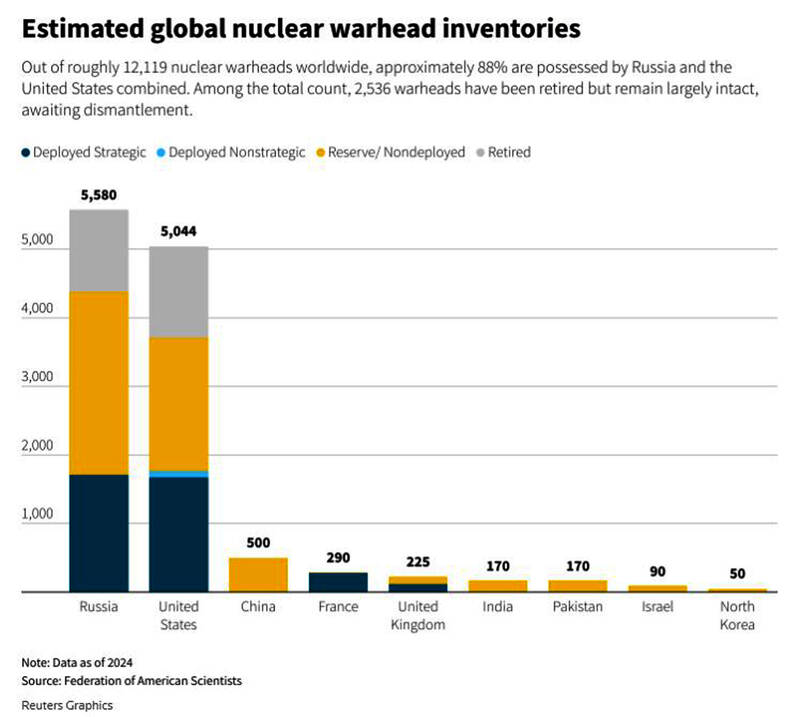
The US Department of Defense estimated last year that Beijing has 500 operational nuclear warheads and would probably field more than 1,000 by 2030.
That compares to 1,770 and 1,710 operational warheads deployed by the US and Russia respectively. The Pentagon said that by 2030, much of Beijing’s weapons would likely be held at higher readiness levels. Since 2020, China has also modernized its arsenal, starting production of its next-generation ballistic missile submarine, testing hypersonic glide vehicle warheads and conducting regular nuclear-armed sea patrols. Weapons on land, in the air and at sea give China the “nuclear triad” — a hallmark of a major nuclear power.
A key point the US side wanted to discuss was whether China still stood by its no-first-use and minimal deterrence policies, which date from the creation of its first nuclear bomb in the early 1960s, Santoro said.
Minimal deterrence refers to having just enough atomic weapons to dissuade adversaries. China is also one of two nuclear powers — the other being India — to have pledged not to initiate a nuclear exchange. Chinese military analysts have speculated that the no-first-use policy is conditional — and that nuclear arms could be used against Taiwan’s allies — but it remains Beijing’s stated stance.
Santoro said the Chinese delegates told US representatives that Beijing maintained these policies and that “’we are not interested in reaching nuclear parity with you, let alone superiority.’”
“‘Nothing has changed, business as usual, you guys are exaggerating,’” Santoro said in summarizing Beijing’s position.
His description of the discussions was corroborated by fellow US delegate Lyle Morris, a security academic at the Asia Society Policy Institute. A report on the discussions is being prepared for the US government, but would not be made public, Santoro said.
Top US arms control official Bonnie Jenkins told the US Congress last month that China had not responded to nuclear weapons risk reduction proposals that Washington raised during last year’s formal talks.
China has yet to agree to further government-to-government meetings.
Beijing’s “refusal to substantively engage” in discussions over its nuclear build-up raises questions around its “already ambiguous stated “no-first-use” policy and its nuclear doctrine more broadly,” the State Department spokesperson told Reuters.
China’s Track Two delegation did not discuss specifics about Beijing’s modernization effort, Santoro and Morris said.
Alberque said that China relied heavily on “risk and opacity” to mitigate US nuclear superiority and there was “no imperative” for Beijing to have constructive discussions.
China’s expanded arsenal — which includes anti-ship cruise missiles, bombers, intercontinental ballistic missiles and submarines — exceeded the needs of a state with a minimal deterrence and no-first-use policy, Alberque said.
Chinese talking points revolved around the “survivability” of Beijing’s nuclear weapons if it suffered a first strike, said Morris.
The US delegates said the Chinese described their efforts as a deterrence-based modernization program to cope with developments such as improved US missile defenses, better surveillance capabilities and strengthened alliances. The US, the UK and Australia last year signed a deal to share nuclear-powered submarine technology and develop a new class of boats, while Washington is now working with Seoul to coordinate responses to a potential atomic attack.
Washington’s policy on nuclear weapons includes the possibility of using them if deterrence fails, although the Pentagon says it would only consider that in extreme circumstances. It did not provide specifics.
One Chinese delegate “pointed to studies that said Chinese nuclear weapons were still vulnerable to US strikes — their second-strike capability was not enough,” Morris said.

LOUD AND PROUD Taiwan might have taken a drubbing against Australia and Japan, but you might not know it from the enthusiasm and numbers of the fans Taiwan might not be expected to win the World Baseball Classic (WBC) but their fans are making their presence felt in Tokyo, with tens of thousands decked out in the team’s blue, blowing horns and singing songs. Taiwanese fans have packed out the Tokyo Dome for all three of their games so far and even threatened to drown out home team supporters when their team played Japan on Friday. They blew trumpets, chanted for their favorite players and had their own cheerleading squad who dance on a stage during the game. The team struggled to match that exuberance on the field, with
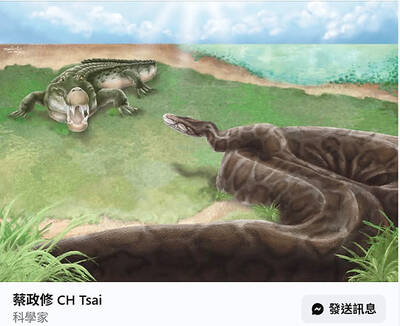
Taiwanese paleontologists have discovered fossil evidence that pythons up to 4m long inhabited Taiwan during the Pleistocene epoch, reporting their findings in the international scientific journal Historical Biology. National Taiwan University (NTU) Institute of Ecology and Evolutionary Biology associate professor Tsai Cheng-hsiu (蔡政修) led the team that discovered the largest snake fossil ever found in Taiwan. The single trunk vertebra was discovered in Tainan at the Chiting Formation, dated to between 400,000 and 800,000 years ago in the Middle Pleistocene, the paper said. The area also produced Taiwan’s first avian fossil, as well as crocodile, mammoth, saber-toothed cat and rhinoceros fossils, it said. Discoveries

Taiwanese paleontologists have discovered fossil evidence that pythons up to 4m long inhabited Taiwan during the Pleistocene epoch, reporting their findings in the international scientific journal Historical Biology. National Taiwan University (NTU) Institute of Ecology and Evolutionary Biology associate professor Tsai Cheng-hsiu (蔡政修) led the team that discovered the largest snake fossil ever found in Taiwan. A single trunk vertebra was discovered in Tainan at the Chiting Formation, dated to between 800,000 to 400,000 years ago in the Middle Pleistocene, the paper said. The area also produced Taiwan’s first avian fossil, as well as crocodile, mammoth, sabre-toothed cat and rhinoceros fossils, it said. Discoveries
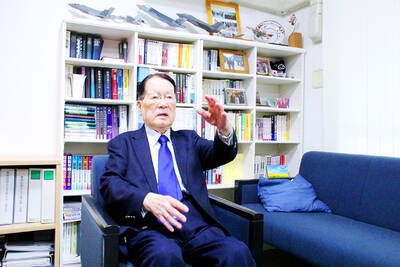
Whether Japan would help defend Taiwan in case of a cross-strait conflict would depend on the US and the extent to which Japan would be allowed to act under the US-Japan Security Treaty, former Japanese minister of defense Satoshi Morimoto said. As China has not given up on the idea of invading Taiwan by force, to what extent Japan could support US military action would hinge on Washington’s intention and its negotiation with Tokyo, Morimoto said in an interview with the Liberty Times (sister paper of the Taipei Times) yesterday. There has to be sufficient mutual recognition of how Japan could provide


 RSS
RSS