


Amendments to expand access to priority seats would be proposed as a separate bill to expedite its passage, Minister of Health and Welfare Chiu Tai-yuan (邱泰源) said on Friday.
The People with Disabilities Rights Protection Act (身心障礙者權益保障法) currently states that priority seats on public transportation should be set aside for “the disabled, elderly, women and children.”
The Ministry of Health and Welfare has repeatedly stated over the years that it would like to add the phrase “people in genuine need” to expand eligibility, rather than removing the seats entirely as some have advocated.
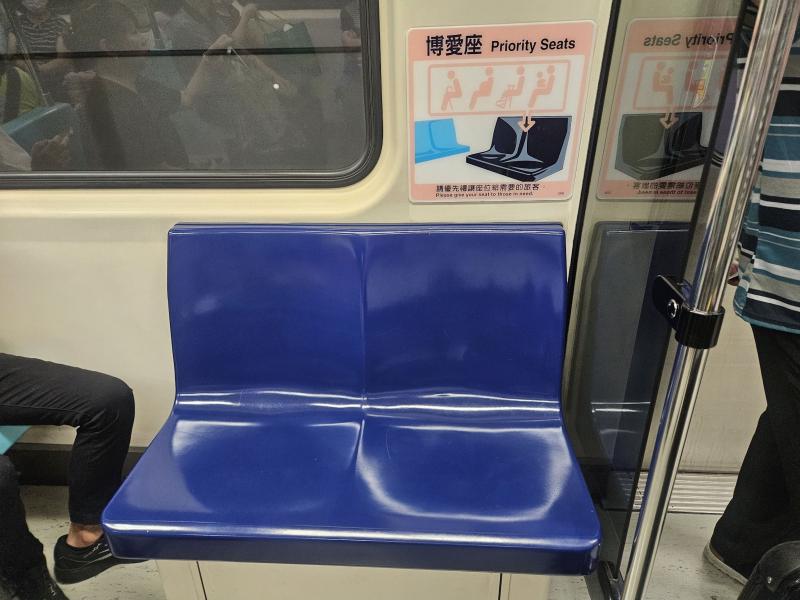
Photo: CNA
Drafts were submitted to the legislature in 2022 and in September last year, but as they were paired with other, more complicated changes, lawmakers have been unable to reach a consensus.
With the start of the new legislature earlier this year, any bills that failed to pass from the previous session must be resubmitted.
The ministry therefore plans to propose the priority seating changes as a separate bill in the hopes that it could be passed sooner, Chiu told reporters following a news conference in Taipei on Friday.
It is to submit a draft to the legislature as soon as possible, he added.
The announcement is the latest regarding controversy around priority seating following two violent incidents on the Taipei MRT in the past two weeks.
On Tuesday last week, a 25-year-old woman on the MRT Red Line refused to yield her seat to an 80-year-old woman, contending that she was exhausted after a 12-hour shift.
The woman then physically assaulted another elderly passenger, an 80-year-old man, who attempted to intervene.
After MRT staff mediation, the man agreed not to seek legal action if the woman apologized, which she did when the three passengers involved in the incident alighted at the next station.
On Tuesday, a 29-year-old man on the MRT Green Line, who claimed that he had diarrhea, was slapped by a 75-year-old man for refusing to yield his seat.
The incident sparked further quarrels among passengers, including one who shouted "You don't have many years left to live” to the older passenger.
The two incidents were among 22 reported disputes between passengers over priority seats this year.

The military has spotted two Chinese warships operating in waters near Penghu County in the Taiwan Strait and sent its own naval and air forces to monitor the vessels, the Ministry of National Defense (MND) said. Beijing sends warships and warplanes into the waters and skies around Taiwan on an almost daily basis, drawing condemnation from Taipei. While the ministry offers daily updates on the locations of Chinese military aircraft, it only rarely gives details of where Chinese warships are operating, generally only when it detects aircraft carriers, as happened last week. A Chinese destroyer and a frigate entered waters to the southwest
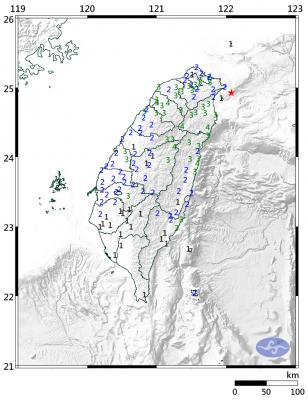
A magnitude 6.1 earthquake struck off the coast of Yilan County at 8:39pm tonight, the Central Weather Administration (CWA) said, with no immediate reports of damage or injuries. The epicenter was 38.7km east-northeast of Yilan County Hall at a focal depth of 98.3km, the CWA’s Seismological Center said. The quake’s maximum intensity, which gauges the actual physical effect of a seismic event, was a level 4 on Taiwan’s 7-tier intensity scale, the center said. That intensity level was recorded in Yilan County’s Nanao Township (南澳), Hsinchu County’s Guansi Township (關西), Nantou County’s Hehuanshan (合歡山) and Hualien County’s Yanliao (鹽寮). An intensity of 3 was
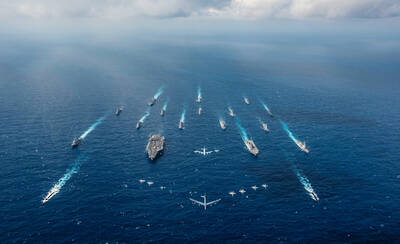
Japanese Prime Minister Sanae Takaichi’s comment last year on Tokyo’s potential reaction to a Taiwan-China conflict has forced Beijing to rewrite its invasion plans, a retired Japanese general said. Takaichi told the Diet on Nov. 7 last year that a Chinese naval blockade or military attack on Taiwan could constitute a “survival-threatening situation” for Japan, potentially allowing Tokyo to exercise its right to collective self-defense. Former Japan Ground Self-Defense Force general Kiyofumi Ogawa said in a recent speech that the remark has been interpreted as meaning Japan could intervene in the early stages of a Taiwan Strait conflict, undermining China’s previous assumptions
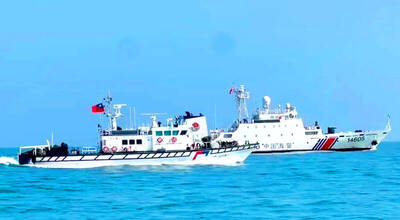
Instead of focusing solely on the threat of a full-scale military invasion, the US and its allies must prepare for a potential Chinese “quarantine” of Taiwan enforced through customs inspections, Stanford University Hoover fellow Eyck Freymann said in a Foreign Affairs article published on Wednesday. China could use various “gray zone” tactics in “reconfiguring the regional and ultimately the global economic order without a war,” said Freymann, who is also a nonresident research fellow at the US Naval War College. China might seize control of Taiwan’s links to the outside world by requiring all flights and ships entering or leaving Taiwan


 RSS
RSS