


Human rights organizations yesterday presented their demands to safeguard the rights of immigrants and migrant workers.
More than 10 groups demonstrated in front of the Executive Yuan in Taipei, including the TransAsia Sisters Association Taiwan, the Taiwan Immigration Youth Alliance and the Serve the People Association.
The groups demanded that a draft bill proposed by the Executive Yuan include blue-collar migrant workers in its definition of new residents.
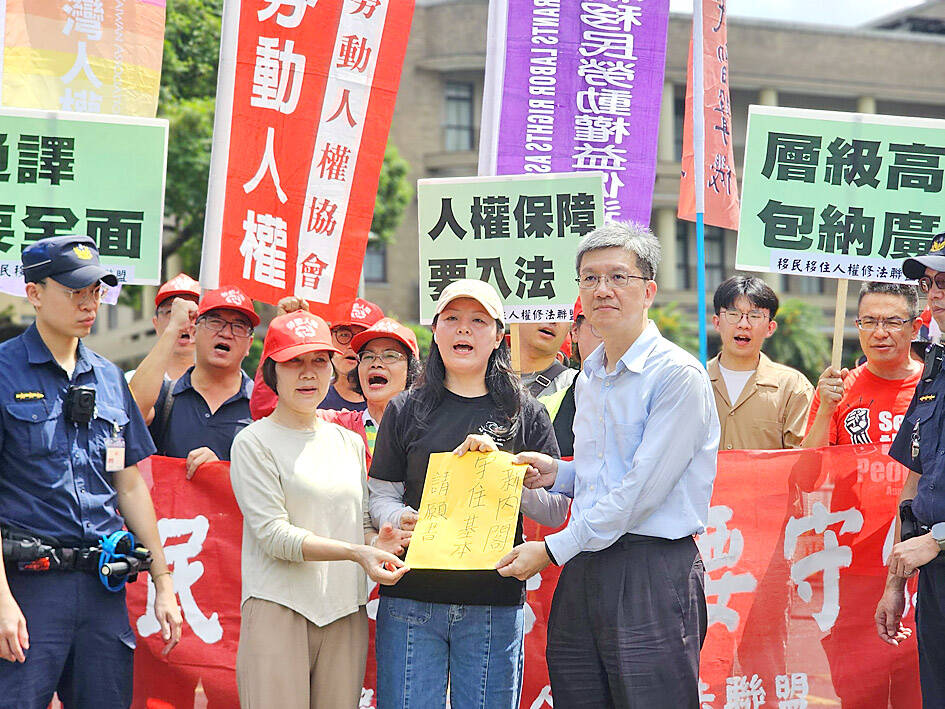
Photo Courtesy of TransAsia Sisters Association Taiwan
They also called for a system to train interpreters in relevant fields, provisions for combating discrimination against migrant workers and a second-level government unit within the Executive Yuan to take charge of immigration policy and the rights and interests of new residents.
“It is gratifying that the Legislative Yuan passes a draft bill on the protection of new residents’ rights,” one group said. “However, the two most critical provisions have not yet been finalized, namely, the definition of new residents, and the level and responsibilities of the competent authority for new resident affairs.”
“The National Immigration Agency, which is the current unit responsible for migrant workers’ affairs, is a third-level unit, and there is no overall immigration policy,” TransAsia Sisters Association Taiwan chairwoman Hung Man-chih (洪滿枝) said. “If there is no second-level agency handling these things, then nothing will change in terms of policy.”
The groups said that only white-collar migrant workers and foreign professionals were included in seven separate bills proposed by lawmakers, they said.
“Migrant workers have made significant contributions to Taiwan’s economy and society. There is no reason to exclude blue-collar migrant workers from this bill,” the groups said. “This is obvious discrimination.”
Immigrant rights activist Liu Chun-liang (劉俊良) said that during a preliminary review of the draft bills by the Legislative Yuan on Wednesday last week, one of the articles that legislators across party lines agreed on was that the government should provide new resident families with consultation services covering family, marriage and childcare.
“However, the government still has not provided substantive protections regarding immigrants’ rights, including access to legal counsel, psychological services and social welfare benefits,” he said.
The establishment of an interpreter training system and services, which would be the basis for the effective implementation of many policies and services for immigrants, was also ignored in the committee discussions, he said.
“This makes us seriously doubt the forward-looking nature of this draft law for new residents,” he said.
The groups would consult with committee members involved in the proposal’s discussion next week, hoping to express concerns and ask that the bill not be passed hastily, he said.
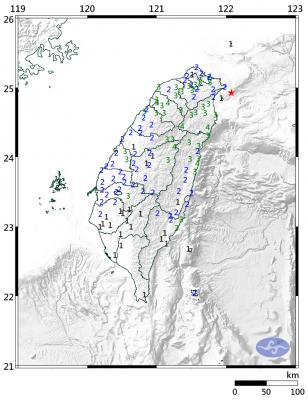
A magnitude 6.1 earthquake struck off the coast of Yilan County at 8:39pm tonight, the Central Weather Administration (CWA) said, with no immediate reports of damage or injuries. The epicenter was 38.7km east-northeast of Yilan County Hall at a focal depth of 98.3km, the CWA’s Seismological Center said. The quake’s maximum intensity, which gauges the actual physical effect of a seismic event, was a level 4 on Taiwan’s 7-tier intensity scale, the center said. That intensity level was recorded in Yilan County’s Nanao Township (南澳), Hsinchu County’s Guansi Township (關西), Nantou County’s Hehuanshan (合歡山) and Hualien County’s Yanliao (鹽寮). An intensity of 3 was
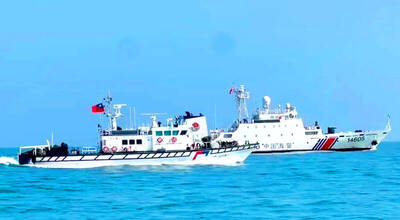
Instead of focusing solely on the threat of a full-scale military invasion, the US and its allies must prepare for a potential Chinese “quarantine” of Taiwan enforced through customs inspections, Stanford University Hoover fellow Eyck Freymann said in a Foreign Affairs article published on Wednesday. China could use various “gray zone” tactics in “reconfiguring the regional and ultimately the global economic order without a war,” said Freymann, who is also a nonresident research fellow at the US Naval War College. China might seize control of Taiwan’s links to the outside world by requiring all flights and ships entering or leaving Taiwan
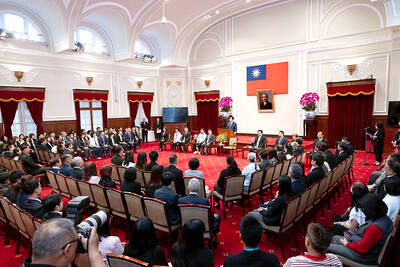
The next minimum wage hike is expected to exceed NT$30,000, President William Lai (賴清德) said yesterday during an award ceremony honoring “model workers,” including migrant workers, at the Presidential Office ahead of Workers’ Day today. Lai said he wished to thank the awardees on behalf of the nation and extend his most sincere respect for their hard work, on which Taiwan’s prosperity has been built. Lai specifically thanked 10 migrant workers selected for the award, saying that although they left their home countries to further their own goals, their efforts have benefited Taiwan as well. The nation’s industrial sector and small businesses lay
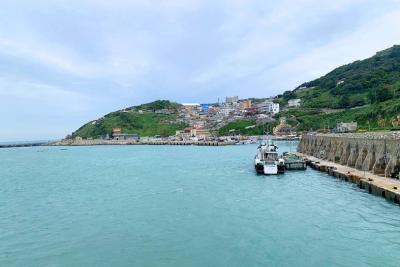
Taiwan has activated backup communications for its northernmost territory, the remote and strategically located island of Dongyin (東引), after poor weather conditions apparently shifted the wreckage of a ship onto an undersea cable causing it to break. The vulnerability of undersea communication cables linking Taiwan with its outlying islands has been a persistent cause of concern for Taipei, whose government has on several occasions blamed Chinese ships for intentionally causing damage. Dongyin, home to about 1,500 people, sits in a strategic position at the top of the Taiwan Strait and the island has a heavy military presence. It does not have an


 RSS
RSS