


The Hsinchu District Court on Thursday last week ruled against a woman who sought compensation from an amusement park after her daughter died of a stroke shortly after taking a ride in its free-fall drop tower.
In its verdict, the court said the Leofoo Village Theme Park does not owe the woman’s family compensation.
The ruling can still be appealed.
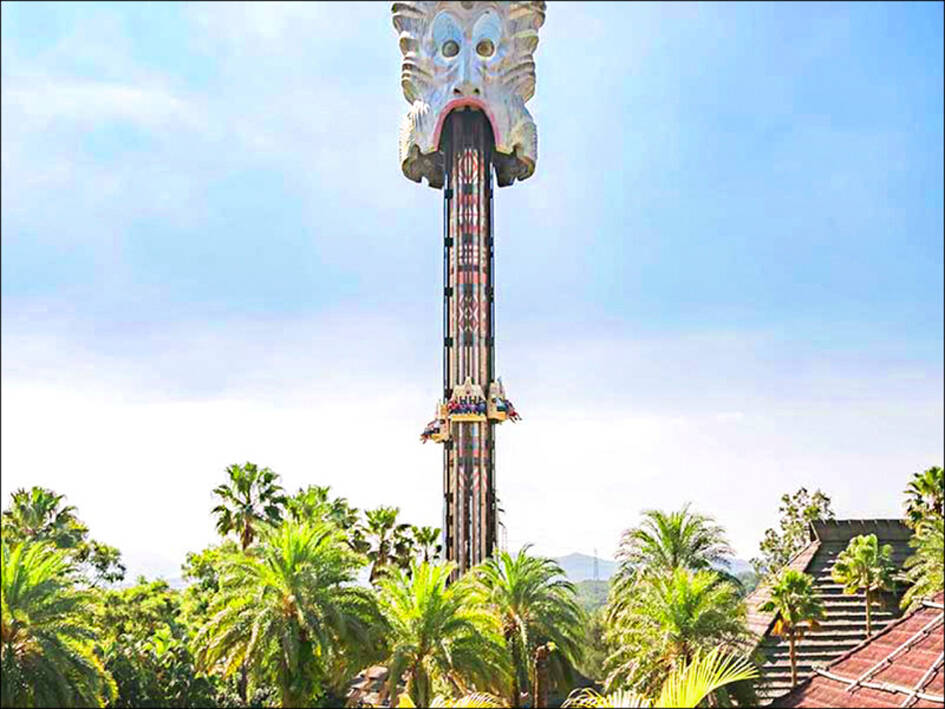
Photo: Screen grab from Leofoo Village Theme Park’s Web site
A woman surnamed Ouyang (歐陽) in 2022 reported feeling a headache, nausea and numbness in the extremities following a free-fall ride and was helped to the amusement park’s infirmary, the court said.
Ouyang lost consciousness within 1.5 hours of being admitted to the infirmary and was sent to Taoyuan Armed Forces General Hospital, where a scan revealed bleeding in her skull, it said.
She died two days after that, the court said.
Ouyang’s mother, surnamed Chan (詹), filed a NT$10 million (US$308,452) civil lawsuit against Leofoo Development Co, the company that owns the amusement park.
Chan said the park’s health warning — mentioning health risks to pregnant women and people with blood pressure issues — was insufficient, as her daughter did not have any of the conditions it mentioned, the court said.
The plaintiff also argued that the park did not have qualified medical care personnel on site and failed to send Ouyang to a hospital promptly, leading to her death, it said.
After consulting evidence supplied by the litigants, no scientific link could be found between Ouyang’s death and the free-fall experience, the court said.
Citing a medical report submitted by Taipei Veterans General Hospital, the last hospital to treat Ouyang, the court said doctors were not sure if the ride directly caused her death.
A medical study submitted by the plaintiff speculated that the sheer g-forces created by a roller coaster could pose cardiovascular risks, but it did not apply to free-fall rides, which generate g-force for a short duration only, it said.
The park records showed that only 15 people felt ill after taking the free-fall ride in 12 years, or an incident rate of three cases in every 1 million users, it said, adding that no death or serious injury has happened before.
The court did not find liable faults with the amusement park personnel’s handling of Ouyang’s medical emergency, which followed all established standards and procedures, it said.
The park provided multiple forms of text-based and audible instructions for guests to assume a safe posture to avoid whiplash and other injuries, meeting the standards stipulated by the Consumer Protection Act (消費者保護法), the verdict said.
The court rejected Chan’s allegations and found the amusement park to not be at fault.

Considering that most countries issue more than five denominations of banknotes, the central bank has decided to redesign all five denominations, the bank said as it prepares for the first major overhaul of the banknotes in more than 24 years. Central bank Governor Yang Chin-lung (楊金龍) is expected to report to the Legislative Yuan today on the bank’s operations and the redesign’s progress. The bank in a report sent to the legislature ahead of today’s meeting said it had commissioned a survey on the public’s preferences. Survey results showed that NT$100 and NT$1,000 banknotes are the most commonly used, while NT$200 and NT$2,000

The Centers for Disease Control (CDC) yesterday reported the first case of a new COVID-19 subvariant — BA.3.2 — in a 10-year-old Singaporean girl who had a fever upon arrival in Taiwan and tested positive for the disease. The girl left Taiwan on March 20 and the case did not have a direct impact on the local community, it said. The WHO added the BA.3.2 strain to its list of Variants Under Monitoring in December last year, but this was the first imported case of the COVID-19 variant in Taiwan, CDC Deputy Director-General Lin Ming-cheng (林明誠) said. The girl arrived in Taiwan on

South Korea is planning to revise its controversial electronic arrival card, a step Taiwanese officials said prompted them to hold off on planned retaliatory measures, a South Korean media report said yesterday. A Yonhap News Agency report said that the South Korean Ministry of Foreign Affairs is planning to remove the “previous departure place” and “next destination” fields from its e-arrival card system. The plan, reached after interagency consultations, is under review and aims to simplify entry procedures and align the electronic form with the paper version, a South Korean ministry official said. The fields — which appeared only on the electronic form

The Ministry of Foreign Affairs (MOFA) is suspending retaliation measures against South Korea that were set to take effect tomorrow, after Seoul said it is updating its e-arrival system, MOFA said today. The measures were to be a new round of retaliation after Taiwan on March 1 changed South Korea's designation on government-issued alien resident certificates held by South Korean nationals to "South Korea” from the "Republic of Korea," the country’s official name. The move came after months of protests to Seoul over its listing of Taiwan as "China (Taiwan)" in dropdown menus on its new online immigration entry system. MOFA last week


 RSS
RSS