


Taiwan People’s Party caucus whip Huang Kuo-chang (黃國昌) yesterday said the party caucus has already signed onto a constitutional amendment to abolish the Control Yuan, although the Chinese Nationalist Party (KMT) was reluctant to support the idea.
The comments came after the Legislative Yuan passed a third reading of some of the amendments to the Act Governing the Legislative Yuan’s Power (立法院職權行使法), which the Control Yuan alleged breached the separation of powers in the Constitution.
Huang said the abolition of the Control Yuan is one of the TPP’s cornerstones, and vowed that the caucus would propose a constitutional amendment on the matter.
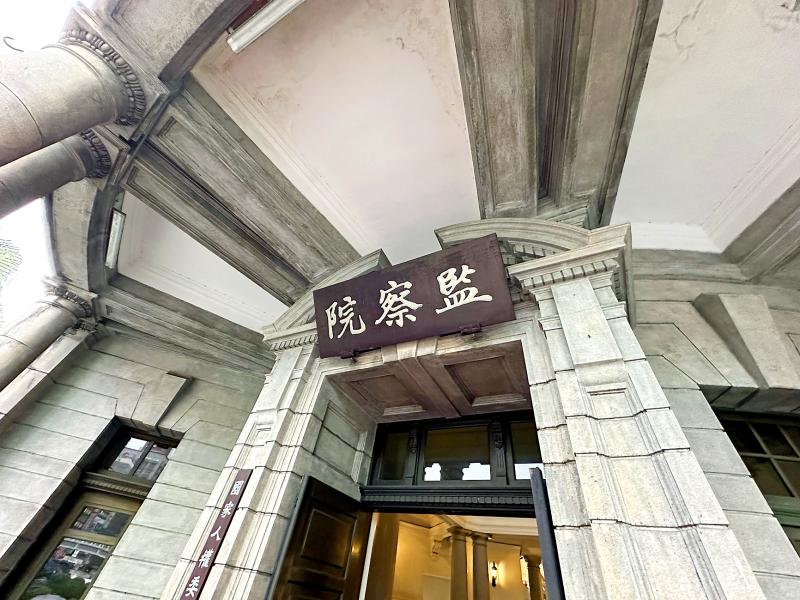
Photo: Lin Che-yuan, Taipei Times
The Control Yuan costs NT$1 billion (US$30.83 million) per year of taxpayers’ money, but has proven worthless, he said, adding that it is the public’s consensus that such a useless organ be abolished.
KMT opinions were split between KMT caucus whip Fu Kun-chi (傅崑萁), who voiced support for the motion, and the KMT Central Committee, which stated that the separation of powers is based on the framework crafted by Republic of China founder Sun Yat-sen (孫逸仙).
KMT Culture and Communications Committee head Lee Yen-hsiu (李彥秀) yesterday said in a statement after the party’s Central Standing Committee meeting that the Control Yuan, under the leadership of Control Yuan President Chen Chu (陳菊), had accomplished nothing.
Lee said the organ, which is supposed to provide government oversight, has become a tool of political oppression.
He was referring to the Control Yuan’s investigation into the arrest of the late Columbus Leo (羅益世) by then-Taipei Zhongshan Precinct Criminal Investigation Division director Hou You-yi (侯友宜) 35 years ago when Leo returned to Taiwan.
The Control Yuan respects legislators’ rights and powers, so long as such a motion is made through a constitutional amendment, as the Constitution establishes the Control Yuan’s powers, Control Yuan Secretary-General Lee Chun-yi (李俊俋) said.
Lee opposed freezing or removing the Control Yuan’s budget, because such methods would only affect how the government is run.
Democratic Progressive Party (DPP) Legislator Wang Ting-yu (王定宇) yesterday said the motion to abolish the Control Yuan was another attempt to expand the power of the legislative branch.
Wang accused Fu and Huang of being “power hungry” and that such a situation was detrimental to the nation’s development.
Commenting on amendments to the Act Governing the Legislative Yuan’s Power that have already been passed, Wang said the DPP caucus would demand a constitutional interpretation and file for an injunction against the amendments to prevent them from coming into effect.
Additional reporting by CNA

Considering that most countries issue more than five denominations of banknotes, the central bank has decided to redesign all five denominations, the bank said as it prepares for the first major overhaul of the banknotes in more than 24 years. Central bank Governor Yang Chin-lung (楊金龍) is expected to report to the Legislative Yuan today on the bank’s operations and the redesign’s progress. The bank in a report sent to the legislature ahead of today’s meeting said it had commissioned a survey on the public’s preferences. Survey results showed that NT$100 and NT$1,000 banknotes are the most commonly used, while NT$200 and NT$2,000

The Centers for Disease Control (CDC) yesterday reported the first case of a new COVID-19 subvariant — BA.3.2 — in a 10-year-old Singaporean girl who had a fever upon arrival in Taiwan and tested positive for the disease. The girl left Taiwan on March 20 and the case did not have a direct impact on the local community, it said. The WHO added the BA.3.2 strain to its list of Variants Under Monitoring in December last year, but this was the first imported case of the COVID-19 variant in Taiwan, CDC Deputy Director-General Lin Ming-cheng (林明誠) said. The girl arrived in Taiwan on

South Korea is planning to revise its controversial electronic arrival card, a step Taiwanese officials said prompted them to hold off on planned retaliatory measures, a South Korean media report said yesterday. A Yonhap News Agency report said that the South Korean Ministry of Foreign Affairs is planning to remove the “previous departure place” and “next destination” fields from its e-arrival card system. The plan, reached after interagency consultations, is under review and aims to simplify entry procedures and align the electronic form with the paper version, a South Korean ministry official said. The fields — which appeared only on the electronic form

The Ministry of Foreign Affairs (MOFA) is suspending retaliation measures against South Korea that were set to take effect tomorrow, after Seoul said it is updating its e-arrival system, MOFA said today. The measures were to be a new round of retaliation after Taiwan on March 1 changed South Korea's designation on government-issued alien resident certificates held by South Korean nationals to "South Korea” from the "Republic of Korea," the country’s official name. The move came after months of protests to Seoul over its listing of Taiwan as "China (Taiwan)" in dropdown menus on its new online immigration entry system. MOFA last week


 RSS
RSS