


A slew of Taiwanese movies at the Cannes Film Festival offer Taiwan an increasingly rare chance to tell its stories on the global stage.
Introducing his neo-noir thriller Locust (蟲) at the world-famous festival, artist and director KEFF (王凱民) said he was “not interested in debating whether or not Taiwan should be a country.”
“But we’ve gotten to a point where to even reflect the reality of Taiwan is to be provocative, and I don’t agree with that,” he said.

Photo courtesy of CDP & Anupheap Production via CNA
Locust centers on Chung-Han (鍾翰), a restaurant worker who runs with a violent gang by night, and is mute — a striking metaphor for his homeland.
“Chung-Han represents a generation that is unable to speak for itself, but also a place, Taiwan, that is unable to speak for itself,” the director said.
Actor Liu Wei-chen (劉韋辰) was forbidden to speak for weeks before shooting began, to prepare for the role.
Meanwhile Mongrel (白衣蒼狗), which premiered on Monday, explores the lives of undocumented workers, including a caregiver living in the mountains of Taiwan.
Its producer, Lynn Chen (陳瑭羚), told The Hollywood Reporter that Cannes provides an opportunity to share a “unique and compelling cinematic experience.”
KEFF, who has lived much of his life in the US, set out to create his portrait of Taiwanese youth soon after moving back to Taiwan in 2019.
He said he observed a surprising lack of interest from younger generations in Beijing’s crackdown on nearby Hong Kong — an encroachment that many fear could preface a full-scale invasion of Taiwan.
The film also explores the lack of interest in international affairs among young Taiwanese.
KEFF said he wanted to tell human stories from a nation too often viewed by the rest of the world merely as a potential flash point for World War III or a source of top-end semiconductors.
“We’re not just a headline in the news,” he said.
The government has in the past few years tried to make up for its lack of diplomatic clout by building up soft power through film.
Taiwanese funding — including government-backed initiatives — is behind two other films: The Shameless, set in India, and Rendez-vous avec Pol Pot (約見波布, Meeting with Pol Pot), based in Cambodia.
Another, Traversing the Mist (穿越霧中) offers an immersive and explicit look inside a Taiwanese gay sauna.
“We’re not provocateurs, but we have a history of being brave, and so I feel that history should continue,” KEFF said. “Taiwanese people must continue to advocate for themselves. I’m not saying as a political entity, but as human beings.”
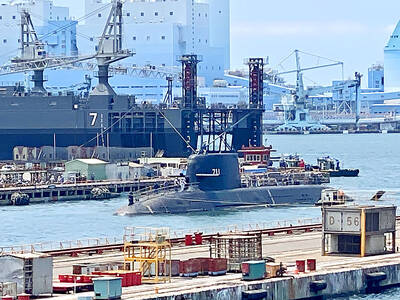
AGING: While Japan has 22 submarines, Taiwan only operates four, two of which were commissioned by the US in 1945 and 1946, and transferred to Taiwan in 1973 Taiwan would need at least 12 submarines to reach modern fleet capabilities, CSBC Corp, Taiwan chairman Chen Cheng-hung (陳政宏) said in an interview broadcast on Friday, citing a US assessment. CSBC is testing the nation’s first indigenous defense submarine, the Hai Kun (海鯤, Narwhal), which is scheduled to be delivered to the navy next month or in July. The Hai Kun has completed torpedo-firing tests and is scheduled to undergo overnight sea trials, Chen said on an SET TV military affairs program. Taiwan would require at least 12 submarines to establish a modern submarine force after assessing the nation’s operational environment and defense

A white king snake that frightened passengers and caused a stir on a Taipei MRT train on Friday evening has been claimed by its owner, who would be fined, Taipei Rapid Transit Corp (TRTC) said yesterday. A person on Threads posted that he thought he was lucky to find an empty row of seats on Friday after boarding a train on the Bannan (Blue) Line, only to spot a white snake with black stripes after sitting down. Startled, he jumped up, he wrote, describing the encounter as “terrifying.” “Taipei’s rat control plan: Release snakes on the metro,” one person wrote in reply, referring
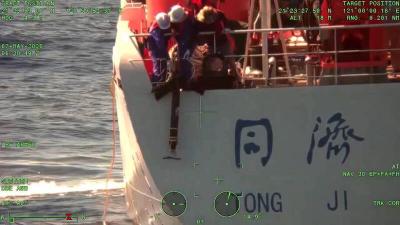
The coast guard today said that it had disrupted "illegal" operations by a Chinese research ship in waters close to the nation and driven it away, part of what Taipei sees a provocative pattern of China's stepped up maritime activities. The coast guard said that it on Thursday last week detected the Chinese ship Tongji (同濟號), which was commissioned only last year, 29 nautical miles (54km) southeast of the southern tip of Taiwan, although just outside restricted waters. The ship was observed lowering ropes into the water, suspected to be the deployment of scientific instruments for "illegal" survey operations, and the coast
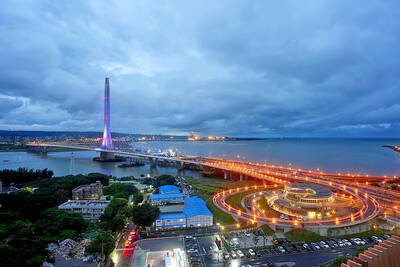
An inauguration ceremony was held yesterday for the Danjiang Bridge, the world’s longest single-mast asymmetric cable-stayed bridge, ahead of its official opening to traffic on Tuesday, marking a major milestone after nearly three decades of planning and construction. At the ceremony in New Taipei City attended by President William Lai (賴清德), Premier Cho Jung-tai (卓榮泰), Minister of Transportation and Communications Chen Shih-kai (陳世凱) and New Taipei City Mayor Hou Yu-ih (侯友宜), the bridge was hailed as both an engineering landmark and a long-awaited regional transport link connecting Tamsui (淡水) and Bali (八里)


 RSS
RSS