


Beijing’s Taiwan Affairs Office (TAO) — which manages relations with Taiwan — slammed President William Lai’s (賴清德) inaugural speech yesterday as sending a “dangerous signal.” China’s state news agency Xinhua reported.
TAO spokesman Chen Binhua (陳斌華) said Lai’s remarks “wantonly advocated separatism, incited cross-strait confrontation and sought independence by relying on foreign support and by force.”
He said Lai ignored Taiwan’s “mainstream public aspiration... for peace and development.”
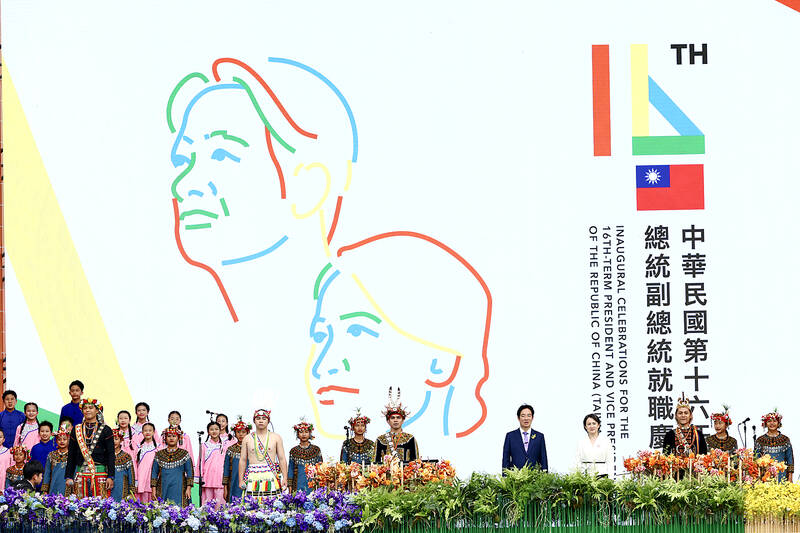
Photo: Ritchie B. Tongo, EPA-EFE
Separately, Chinese Minister of Foreign Affairs Wang Yi (王毅) said Taiwan’s internal politics did not change the “fact” it was part of China, calling efforts toward its independence “dangerous” after Lai was sworn in.
Speaking in Astana, Kazakhstan, at a meeting of Shanghai Cooperation Organization foreign ministers, Wang said “Taiwan independence efforts” represented “the most serious challenge to the international order.”
They were, he said, “the most dangerous change to the status quo in the Taiwan Strait, and the most significant disruption of peace in the Taiwan Strait,” a readout of his comments from the Chinese foreign ministry said.
“There is only one China in the world, and Taiwan is part of China,” he said, which the Ministry of Foreign Affairs rebutted later yesterday.
As Lai took office, Beijing imposed sanctions on three US defense companies over their sales of weapons to Taipei.
Although the US formally recognizes Beijing, it is Taipei’s main partner and supplier of arms.
The move is the latest in a series of sanctions Beijing has announced in recent years against defense companies for weapons sales to Taiwan.
The Chinese Ministry of Commerce placed Boeing’s Defense, Space & Security unit, General Atomics Aeronautical Systems and General Dynamics Land Systems, on what is called an “unreliable entities” list, forbidding their further investment in China, in addition to travel bans on senior management of the companies.
Meanwhile, Chinese social media Sino Weibo yesterday blocked hashtags referencing Lai’s inauguration.
A hashtag saying “Taiwan 520 new authorities take office,” referring to yesterday’s date, was removed, with a notice saying that “according to relevant laws, regulations, and policies, the content of this topic has not been displayed.”
Another that said “Lai Ching-te [Lai’s Chinese name] takes office” was also taken down while hashtags featuring Lai’s name and that of outgoing Taiwan president Tsai Ing-wen (蔡英文) were unavailable.
However, search results for Lai’s name and other topics still yielded results.
Sino Weibo often blocks hashtags deemed politically sensitive to prevent them from trending on the platform, used by hundreds of millions in China.
During the presidential election in January, the platform blocked a hashtag on the poll after it became one of the site’s top-trending topics.
There has been scant mention of Lai’s inauguration in China’s state-run media.

The military has spotted two Chinese warships operating in waters near Penghu County in the Taiwan Strait and sent its own naval and air forces to monitor the vessels, the Ministry of National Defense (MND) said. Beijing sends warships and warplanes into the waters and skies around Taiwan on an almost daily basis, drawing condemnation from Taipei. While the ministry offers daily updates on the locations of Chinese military aircraft, it only rarely gives details of where Chinese warships are operating, generally only when it detects aircraft carriers, as happened last week. A Chinese destroyer and a frigate entered waters to the southwest

A magnitude 6.1 earthquake struck off the coast of Yilan County at 8:39pm tonight, the Central Weather Administration (CWA) said, with no immediate reports of damage or injuries. The epicenter was 38.7km east-northeast of Yilan County Hall at a focal depth of 98.3km, the CWA’s Seismological Center said. The quake’s maximum intensity, which gauges the actual physical effect of a seismic event, was a level 4 on Taiwan’s 7-tier intensity scale, the center said. That intensity level was recorded in Yilan County’s Nanao Township (南澳), Hsinchu County’s Guansi Township (關西), Nantou County’s Hehuanshan (合歡山) and Hualien County’s Yanliao (鹽寮). An intensity of 3 was
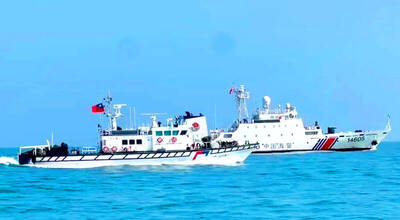
Instead of focusing solely on the threat of a full-scale military invasion, the US and its allies must prepare for a potential Chinese “quarantine” of Taiwan enforced through customs inspections, Stanford University Hoover fellow Eyck Freymann said in a Foreign Affairs article published on Wednesday. China could use various “gray zone” tactics in “reconfiguring the regional and ultimately the global economic order without a war,” said Freymann, who is also a nonresident research fellow at the US Naval War College. China might seize control of Taiwan’s links to the outside world by requiring all flights and ships entering or leaving Taiwan
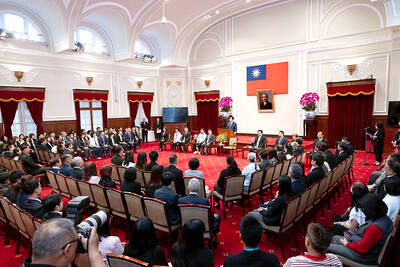
The next minimum wage hike is expected to exceed NT$30,000, President William Lai (賴清德) said yesterday during an award ceremony honoring “model workers,” including migrant workers, at the Presidential Office ahead of Workers’ Day today. Lai said he wished to thank the awardees on behalf of the nation and extend his most sincere respect for their hard work, on which Taiwan’s prosperity has been built. Lai specifically thanked 10 migrant workers selected for the award, saying that although they left their home countries to further their own goals, their efforts have benefited Taiwan as well. The nation’s industrial sector and small businesses lay


 RSS
RSS