


The government should not return to nuclear energy after transitioning to renewable energy, and old nuclear power plants must retire as scheduled, environmental activists told a news conference at the Legislative Yuan on Tuesday.
Whether the new government led by president-elect William Lai (賴清德) would tap into nuclear energy to address the power shortage problem after taking office on Monday next week has been closely monitored by the activists.
Tung Tzu-hsien (童子賢), chairman of contract electronics maker Pegatron Corp, said last week that non-nuclear renewable energy would not be sufficient for the world to reach net zero emissions by 2050.
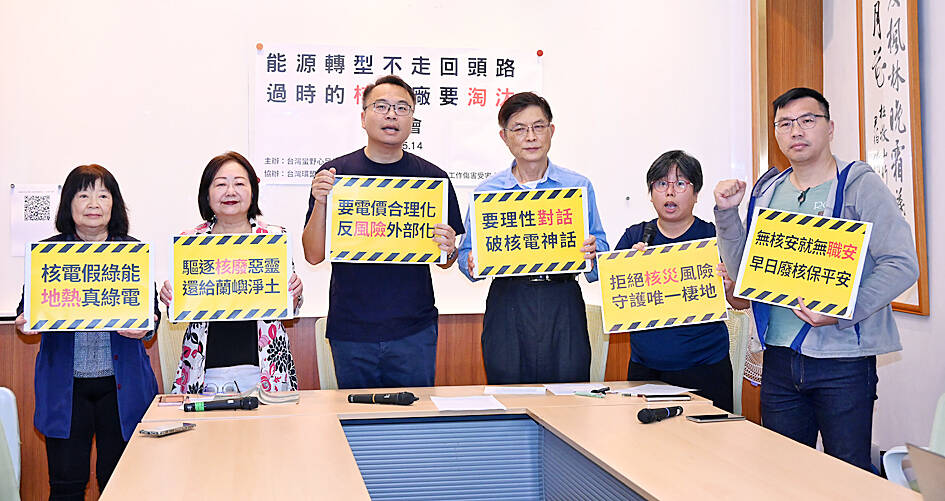
Photo: Liu Hsin-de, Taipei Times
Taiwan could immediately raise its non-carbon-emitting power to about 50 percent of its energy mix from the current 16 percent by building a new kind of nuclear power plant designed by Finish engineers called OL3 and extending the service of the Guosheng and Ma-anshan nuclear power plants, he said.
Tung’s comments have raised particular attention as he is vice chairman of the New Frontier Foundation, a Democratic Progressive Party-affiliated think tank.
Compared with companies in other countries, Taiwanese companies have relatively cheaper access to power because of government subsidies, Wild at Heart Legal Defense Association chairman Chen Hsien-cheng (陳憲政) said.
As such, one cannot accurately gauge how their production processes have damaged the environment and at what costs, Chen said.
Extending the service of the two nuclear power plants or building new ones would only keep the electricity charge low, and more companies would be less motivated to invest in energy-conserving equipment, he said.
Taiwan is a high-risk zone for natural disasters, with earthquakes, tsunamis and extreme weather more likely to occur than in other countries, Chen said.
“Aside from costs needed to shore up the safety of these facilities against natural disasters, have we taken into account the costs of handling nuclear waste and removing decommissioned power plants? All costs would have to be borne by the people,” he said.
“Generational justice would not be served if we enjoy cheaper power now and let our next generation bear the consequences,” he said.
Taiwan Environmental Protection Union chairman Yeh Kuo-liang (葉國樑) said that the government would have to spend a huge sum overseeing the treatment of nuclear waste.
“The waste would need to be stored for more than 10,000 years before the radiation would drop to a safe level. If problems occur during the process, it could cause cancer and other illnesses. Nuclear energy is expensive and dangerous,” Yeh said.
“Taiwan should advance further in the development of renewable energy, power storage system and smart power grid,” he said.
Citizens Association For Public Policies executive director Chen Hsueh-li (陳雪梨) said supporters of nuclear energy should first explain what they would do with the nuclear waste and their evacuation plans for people living within 20km of a nuclear power plant.
“The country should not be divided by energy policy,” she said, adding that Taiwan has the natural resources to develop geothermal energy.


UPGRADE: The Kang Ding-class frigate is replacing its Chaparall missiles with Tien Chien II and Hua Yang VLS, which would provide it with long-range, 360° air defense Taiwan plans to produce 1,200 to 1,376 Hai Chien II missiles (海劍二, Sea Sword II) — also known as TC-2N — to serve as the standard air defense system of the navy’s surface combatant fleet, a source said yesterday. Last week, the Hai Chien II, the naval version of the Tien Kung II missile (天劍二, Sky Sword II), completed a live-fire test in waters off the National Chungshan Institute of Science and Technology’s Jiupeng facility (九鵬) in Pingtung County’s Manjhou Township (滿州). The MIM72 Chaparral and other dated air defense missiles that currently arm Taiwanese ships have inadequate range to combat Chinese

REASONS FOR TRAVEL: An assistant professor said that proposed amendments to penalize drivers if they used drugs overseas would not deter people from traveling People who operate a motor vehicle under the influence of marijuana would have their driver’s license revoked, even if they used the substance while overseas, the Ministry of Transportation and Communications said yesterday, citing proposed amendments to the Road Traffic Management and Penalty Act (道路交通管理處罰條例). The amendments would also authorize the government to revoke the licenses of people determined to have used Category 1 or Category 2 narcotics, even if they were not operating a vehicle while under the influence of drugs, as well as ban them from taking the license test for three years, the ministry said. People aged 18 or
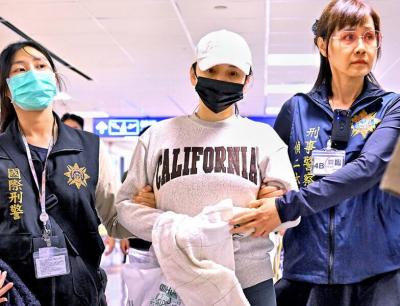
Johanne Liou (劉喬安), a Taiwanese woman who shot to unwanted fame during the Sunflower movement protests in 2014, returned to Taiwan last night after being deported from the US. She is to stand trial in Taiwan for charges involving embezzlement, fraud and drug crimes. The Criminal Investigation Bureau (CIB) said it took her into custody at Taiwan Taoyuan International Airport and would first question her before transferring her to the New Taipei District Prosecutors’ Office. She was arrested upon disembarking a flight from San Francisco that landed shortly before 7pm. Liou absconded to the US in 2019 after jumping bail
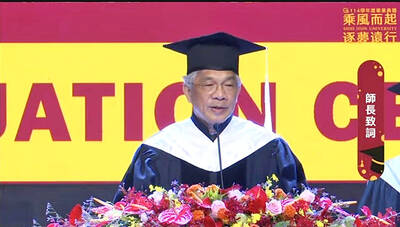
Shih Hsin University President Chen Ching-he (陳清河) yesterday issued a public apology for comments made in his commencement speech last week, stating that he has asked the school to suspend his duties and halt his wages for two months as a show of contrition. At the commencement ceremony on May 30, Chen said, “If you don’t manage your time well, or your own emotions, or your health, then I am telling every one of you — put a quick end to ‘you,’ because the world has no need for ‘you.’” The comments have sparked significant controversy online, and Chen through an open


 RSS
RSS