


Two brothers from New Taipei City have been arrested on suspicion of purchasing more than NT$250,000 worth of damaged and unauthenticated NT$50 coins at a discount, and then exchanging them at Taipei MRT stations.
The Taipei City Police Department’s Rapid Transit Division on Sunday said that it began an investigation after it was contacted by the MRT operator, which said that “large quantities” of NT$50 coins being used at certain MRT stations were being refused by financial institutions, because of doubts about their authenticity.
Police discovered that the suspects had been using the coins to add value to their MRT cards at the Banqiao, Ximen, Jiangzicui and Xingtian Temple stations since Feb. 12 last year.
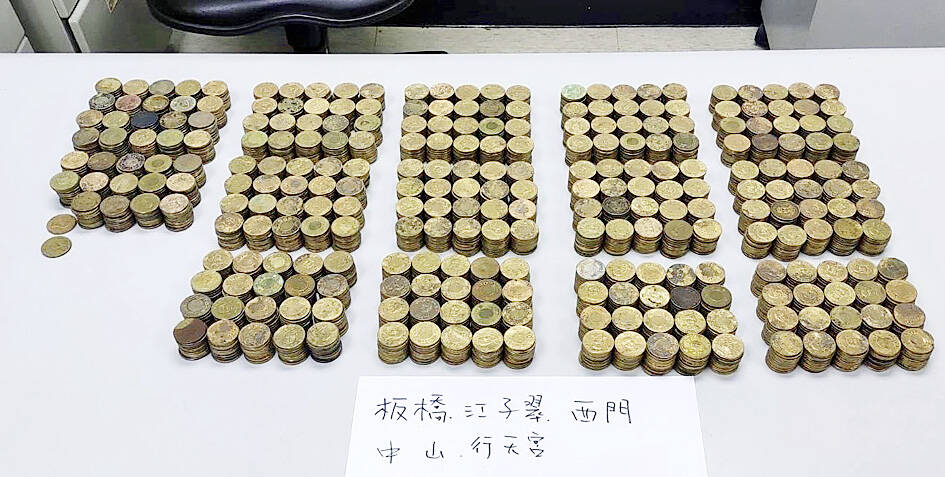
Photo copied by Wang Kuan-jen, Taipei Times
After topping up their cards, the suspects applied for cash refunds from station information desks, the department said.
Investigators focused on an incident on Feb. 16 last year, when a man complained to a station worker about a ticket machine not accepting the coins he was using to add money to his iPass card, police said.
Using surveillance camera footage, police identified one of the suspects as a 48-year-old man employed in the tourism industry, surnamed Tsai (蔡). The man’s 45-year-old brother was identified as a suspect soon after.
On March 9 last year, police brought the elder Tsai back for questioning and seized 98 NT$50 coins from his possession after he was spotted by Taipei MRT staff at Jiangzicui Station.
During questioning, the brothers said they had been purchasing the coins from “recycling companies” in Taiwan and China for between 60 and 70 percent of their face value.
The brothers said they had no way of knowing whether they were real or fake, as the companies had told them the coins were retrieved from the bottoms of fountains.
They initially tried to exchange the coins at banks, but were told they would have to pay a fee to authenticate them, so they exchanged them at MRT stations instead.
The brothers exchanged at least 5,148 of the suspect NT$50 coins, with a total value of NT$257,400, police said.
The central bank later determined that only 33 of the coins used by the brothers were counterfeit.
However, police said the brothers had broken the law by using coins of questionable validity, rather than trying to authenticate them.
After completing their investigation, police turned the brothers over to Taipei prosecutors on April 24 on suspicion of fraudulent offenses under Articles 339-1 and 339-2 of the Criminal Code and circulating counterfeit currency. They have not yet been charged.
The authentication process costs NT$0.5 for NT$1 coins, NT$2.5 for NT$10 coins and NT$7 for rarely seen NT$20 coins and NT$50 coins, the central bank said.

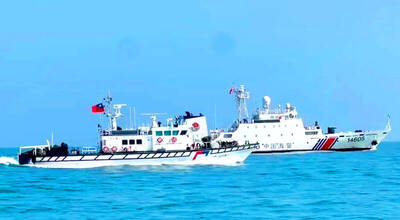
The military has spotted two Chinese warships operating in waters near Penghu County in the Taiwan Strait and sent its own naval and air forces to monitor the vessels, the Ministry of National Defense (MND) said. Beijing sends warships and warplanes into the waters and skies around Taiwan on an almost daily basis, drawing condemnation from Taipei. While the ministry offers daily updates on the locations of Chinese military aircraft, it only rarely gives details of where Chinese warships are operating, generally only when it detects aircraft carriers, as happened last week. A Chinese destroyer and a frigate entered waters to the southwest
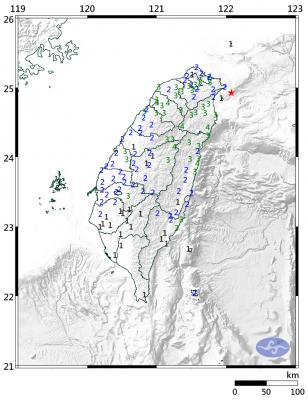
A magnitude 6.1 earthquake struck off the coast of Yilan County at 8:39pm tonight, the Central Weather Administration (CWA) said, with no immediate reports of damage or injuries. The epicenter was 38.7km east-northeast of Yilan County Hall at a focal depth of 98.3km, the CWA’s Seismological Center said. The quake’s maximum intensity, which gauges the actual physical effect of a seismic event, was a level 4 on Taiwan’s 7-tier intensity scale, the center said. That intensity level was recorded in Yilan County’s Nanao Township (南澳), Hsinchu County’s Guansi Township (關西), Nantou County’s Hehuanshan (合歡山) and Hualien County’s Yanliao (鹽寮). An intensity of 3 was

Japanese Prime Minister Sanae Takaichi’s comment last year on Tokyo’s potential reaction to a Taiwan-China conflict has forced Beijing to rewrite its invasion plans, a retired Japanese general said. Takaichi told the Diet on Nov. 7 last year that a Chinese naval blockade or military attack on Taiwan could constitute a “survival-threatening situation” for Japan, potentially allowing Tokyo to exercise its right to collective self-defense. Former Japan Ground Self-Defense Force general Kiyofumi Ogawa said in a recent speech that the remark has been interpreted as meaning Japan could intervene in the early stages of a Taiwan Strait conflict, undermining China’s previous assumptions
Instead of focusing solely on the threat of a full-scale military invasion, the US and its allies must prepare for a potential Chinese “quarantine” of Taiwan enforced through customs inspections, Stanford University Hoover fellow Eyck Freymann said in a Foreign Affairs article published on Wednesday. China could use various “gray zone” tactics in “reconfiguring the regional and ultimately the global economic order without a war,” said Freymann, who is also a nonresident research fellow at the US Naval War College. China might seize control of Taiwan’s links to the outside world by requiring all flights and ships entering or leaving Taiwan


 RSS
RSS