


Vice president-elect Hsiao Bi-khim (蕭美琴) on Wednesday called for support from the US Congress and business leaders for Taiwan’s inclusion in the US defense supply chain.
“I seek your support for Taiwan’s inclusion in the DoD [US Department of Defense] NDIS [National Defense Industrial Strategy] international collaboration mechanisms, such as SOSA, security of supply arrangements,” Hsiao said in a prerecorded video at the Hill and Valley Forum in Washington.
While Taiwan is striving to uphold the values of democracy and freedom, it is facing daily challenges to its cyberspace, information technology and telecommunications infrastructure, maritime and airspace, she said.
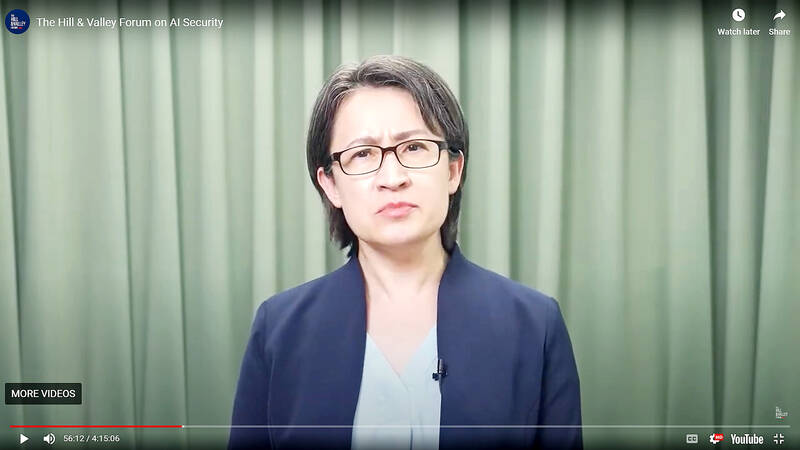
Photo: screen grab from YouTube
The peace and security of Taiwan “is essential to global prosperity” as the nation is an “irreplaceable and indispensable contributor to global technology advancements,” Hsiao said.
She called on public and private stakeholders around the world to work together to ensure that “peace and prosperity prevail.”
Hsiao said that the current US defense industry base is producing “neither enough nor on time” the hardware to meet global demand.
The US Department of Defense in January published the National Defense Industrial Strategy to guide the improvement and the modernization of the US defense industrial base ecosystem “so it delivers at speed and scale for our war fighters,” US Deputy Secretary of Defense Kathleen Hicks said at the time.
The strategy underlined the importance of international collaboration, Hsiao said.
“I believe this is where a Taiwan partnership with the United States is not only a force multiplier, but an absolute necessity,” she said.
She proposed an integrated collaboration or coproduction scheme that leverages Taiwan’s advantages in hardware manufacturing and the US strength in security technologies to “add resilience and efficiency to our defense supply chains.”
“Together we can manufacture nearly anything as efficiently and reliably as anyone in the world,” Hsiao said.
The forum is dedicated to “harnessing the power of technology to address America’s most pressing national security challenges,” according to its Web site.
Hsiao said that she hoped the forum would help foster “an even closer Taiwan-US partnership in the realm of technology and national security.”
Asked about Hsiao’s speech, Minister of Foreign Affairs Joseph Wu (吳釗燮) yesterday told reporters at the legislature in Taipei that integrating Taiwanese and US industries would be “highly beneficial to both parties.”
Taiwan’s defense industry has a strong foundation and other relevant industries are also well-developed, he said.
Joining the US defense supply chain would not only be a good thing for Taiwanese industries and national defense, but also for the nation’s allies and partners, Wu said.
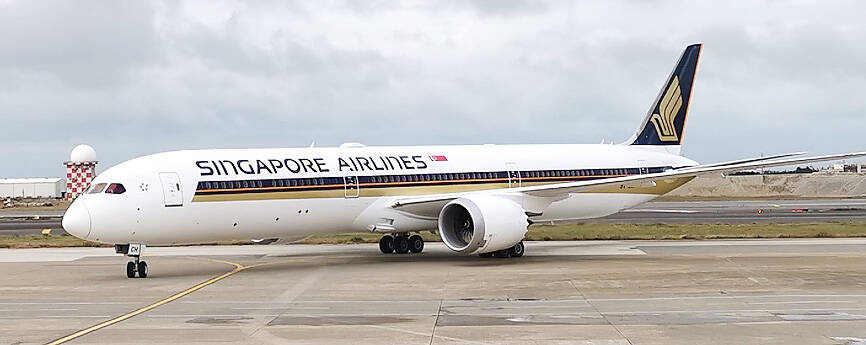
INCREASED CAPACITY: The flights on Mondays, Wednesdays, Fridays and Sundays would leave Singapore in the morning and Taipei in the afternoon Singapore Airlines is adding four supplementary flights to Taipei per week until May to meet increased tourist and business travel demand, the carrier said on Friday. The addition would raise the number of weekly flights it operates to Taipei to 18, Singapore Airlines Taiwan general manager Timothy Ouyang (歐陽漢源) said. The airline has recorded a steady rise in tourist and business travel to and from Taipei, and aims to provide more flexible travel arrangements for passengers, said Ouyang, who assumed the post in July last year. From now until Saturday next week, four additional flights would depart from Singapore on Monday, Wednesday, Friday
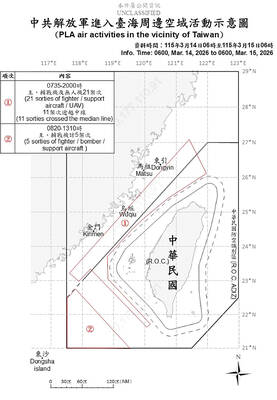
The Ministry of National Defense yesterday reported the return of large-scale Chinese air force activities after their unexplained absence for more than two weeks, which had prompted speculation regarding Beijing’s motives. China usually sends fighter jets, drones and other military aircraft around the nation on a daily basis. Interruptions to such routine are generally caused by bad weather. The Ministry of National Defense said it had detected 26 Chinese military aircraft in the Taiwan Strait over the previous 24 hours. It last reported that many aircraft on Feb. 25, when it spotted 30 aircraft, saying Beijing was carrying out another “joint combat
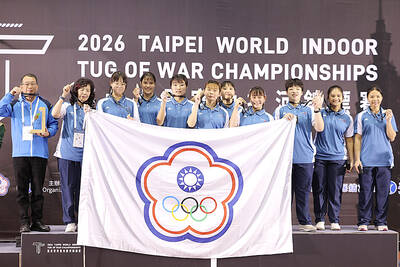
Taiwan successfully defended its women’s 540 kilogram title and won its first-ever men’s 640 kg title at the 2026 World Indoor Tug of War Championships in Taipei yesterday. In the women’s event, Taiwan’s eight-person squad reached the final following a round-robin preliminary round and semifinals featuring teams from Ukraine, Japan, Thailand, Vietnam, the Basque Country and South Korea. In the finals, they swept the Basque team 2-0, giving the team composed mainly of National Taiwan Normal University students and graduates its second championship in a row, and its fourth in five years. Team captain
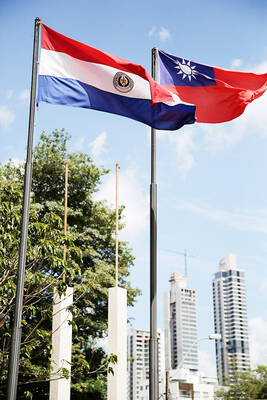
When Paraguayan opposition lawmaker Leidy Galeano returned from an all-expenses-paid tour of six Chinese cities late last year, she was convinced Paraguay risked missing out on major economic gains by sticking with longtime ally Taipei over Beijing — a message that participants on the trip heard repeatedly from Chinese officials. “Everything I saw there, I wanted for my country,” said Galeano, a member of the newly-formed Yo Creo party whose senior figures have spoken favorably about China. This trip and others like it — which people familiar with the visits said were at the invitation of the Chinese consulate in Sao Paulo


 RSS
RSS