


Vice president-elect Hsiao Bi-khim (蕭美琴) on Thursday touted Taiwan’s progress in gender equality by saying that the country should aim for women to make up 50 percent of lawmakers in the Legislative Yuan, at an event celebrating diversity, equity, inclusion and accessibility (DEIA).
At the DEIA forum held by the American Institute in Taiwan and the American Chamber of Commerce in Taiwan (AmCham), where Hsiao gave the closing remarks, she said Taiwan could reach 50 percent female representation in the legislature, as it already had 40 percent when she left the Legislative Yuan in 2020.
“When I first joined the legislature [in 2002], only 20 percent were women,” she said, adding that over the years the legislator has seen a steady increase in female representation.
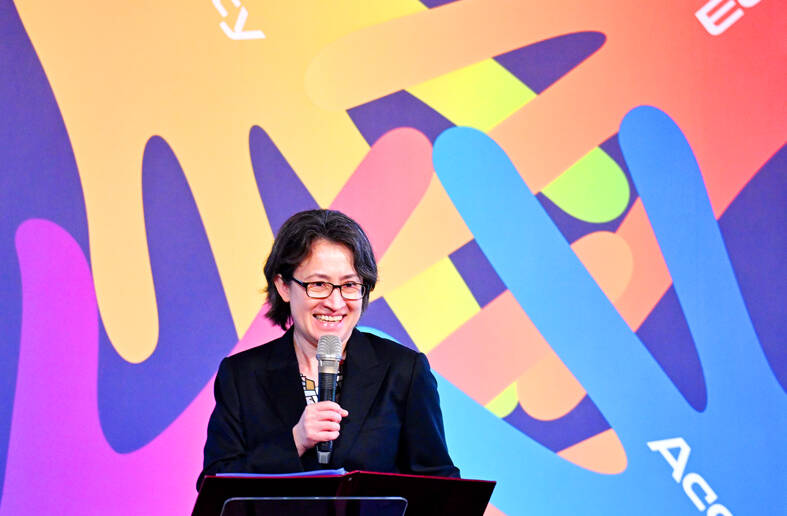
Photo: Liu Hsin-de, Taipei Times
In the ninth legislature for which Hsiao was elected a member in 2016, 38.1 percent of lawmakers were women and in the next legislature in 2020 that rose to 41.6 percent.
“Of course, we have a goal of making it 50 percent, and I’m sure we will get there pretty soon,” Hsiao said.
In the current legislature, which was elected in January, 41.6 percent of lawmakers are women.
On female participation in politics, the vice president-elect also said that Taiwan has “a record that is better than the US,” having elected the first female president and now the second female vice president, Hsiao herself.
The audience laughed in response.
Of the 535 members of the 118th US Congress, 155 are women, representing 29 percent of all lawmakers.
To show Taiwan’s progress “beyond statistics and representation,” Hsiao said that when she was in the legislature more than 20 years ago, “we often heard comments made on gender-based prejudices in the Legislative Yuan.”
“Those comments are no longer acceptable on today’s floor, as they will be condemned,” she said. “They now occasionally appear, but they are less tolerated.”
In July last year, President Tsai Ing-wen’s (蔡英文) administration “took extraordinarily swift actions to pass amendments to the three gender equality laws — the Gender Equality and Employment Act (性別平等工作法), Sexual Harassment Prevention Act (性騷擾防治法) and Gender Equity Education Act (性別平等教育法),” Hsiao said.
The laws were amended after a spate of accusations that became known as Taiwan’s #MeToo movement, when various accusations of sexual harassment and abuse were made across Taiwanese society, from politics to business and the media.
She pledged that proactive measures would be taken to ensure fairness in the regulatory environment and the legal environment, and that “broader awareness and education initiatives” would continue to be supported by the government.
AmCham Taiwan’s 2024 DEIA Celebration Forum, aims to promote the principles of DEIA and create a platform for businesses to co-learn with governments through partnerships and the sharing of best practices, the business chamber said.
An executive order signed by US President Biden and enacted in 2021 said that all US federal agencies “must remove barriers to equal opportunity and provide resources and opportunities to strengthen and advance DEIA,” AmCham said.

FUKUOKA SITUATION: Japanese media reported that the pathogen is expected to be identified by the summer, while the CDC downplayed the idea that it was hMPV A “mysterious cold-like illness” reported in Japan’s Fukuoka Prefecture does not seem to be a new disease, but Japanese authorities have been asked about the situation, the Centers for Disease Control (CDC) said yesterday. The Fukuoka Prefectural Medical Association on Wednesday told a news conference that a “mystery cold” that has become a hot topic on social media is “highly likely to be caused by some kind of viral infection,” Japan’s KBC News reported. “Many people are experiencing symptoms starting with a sore throat, followed by a runny nose, phlegm and a severe cough,” KBC News reported, citing association officials. Health authorities are

Nvidia Corp CEO Jensen Huang (黃仁勳) arrived in Taiwan yesterday ahead of upcoming AI and technology events, saying he plans to meet with clients and Taiwan Semiconductor Manufacturing Co Chairman C.C. Wei (魏哲家) during his visit. After landing at Taipei Songshan Airport, Huang posed for photos with fans and handed out Yakult drinks to reporters and supporters waiting at the scene, saying he has “a lot to do” during the trip. Asked about reports that Nvidia’s planned headquarters site in Taipei’s Beitou Shilin Technology Park could break ground on May 27, Huang said that if the company holds an event, he would

The Ministry of Finance this afternoon announced the winning numbers for the March-April uniform invoice lottery. The winning number for the NT$10 million (US$318,060) special prize is 19531471, and the winning number for the NT$2 million grand prize is 85941329. Three numbers were drawn for the NT$200,000 first prize: 07225810, 20231230 and 83518781. Those with receipts matching the last seven digits of any of the first-prize numbers will win the NT$40,000 second prize, while those matching the last six digits will win the NT$10,000 third prize. Those whose receipts match the last five digits of the first-prize numbers can claim the NT$4,000 fourth prize,
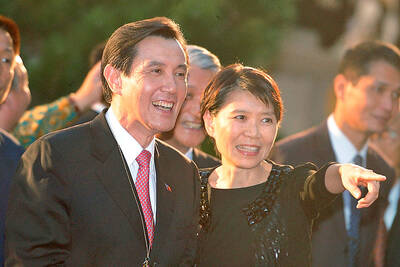
Former president Ma Ying-jeou (馬英九) yesterday expressed “shock and regret” over a statement issued by his wife without his consent, and rejected her assertion that his eldest sister, Ma Yi-nan (馬以南), would manage his medical care or act as his spokesperson amid an ongoing embezzlement probe into his foundation. Ma Ying-jeou in a statement said he was shocked by a statement by his wife, Chou Mei-ching (周美青), regarding his affairs. Ma Yi-nan “must not” be in charge of his healthcare and other personal affairs, nor can she be allowed to represent the Ma family, the former president said. He said he was also


 RSS
RSS