


Advocates lobbying for cannabis decriminalization organized a series of activities this past week to promote the “Green Sensation” Festival tomorrow, including a march around the Legislative Yuan in the afternoon.
Every year “420 International Weed Day” is marked around the world on April 20, and the Taipei event is to have music entertainment, speeches, display booths and vendors to create a “fun street fair” starting at noontime and running until evening, Green Sensation spokesman Chung Ho-yun (鍾和耘) said yesterday.
Kaohsiung-based rapper Savage M and Taiwanese metalcore band Setback Line are the headliners, with hip hop artists BR and IronBoss, Thaiboy41, Acrack 47 and other entertainers also playing, Chung said, as he called on activists for personal liberty and supporters of medical and recreational use of cannabis to attend the march and activities.
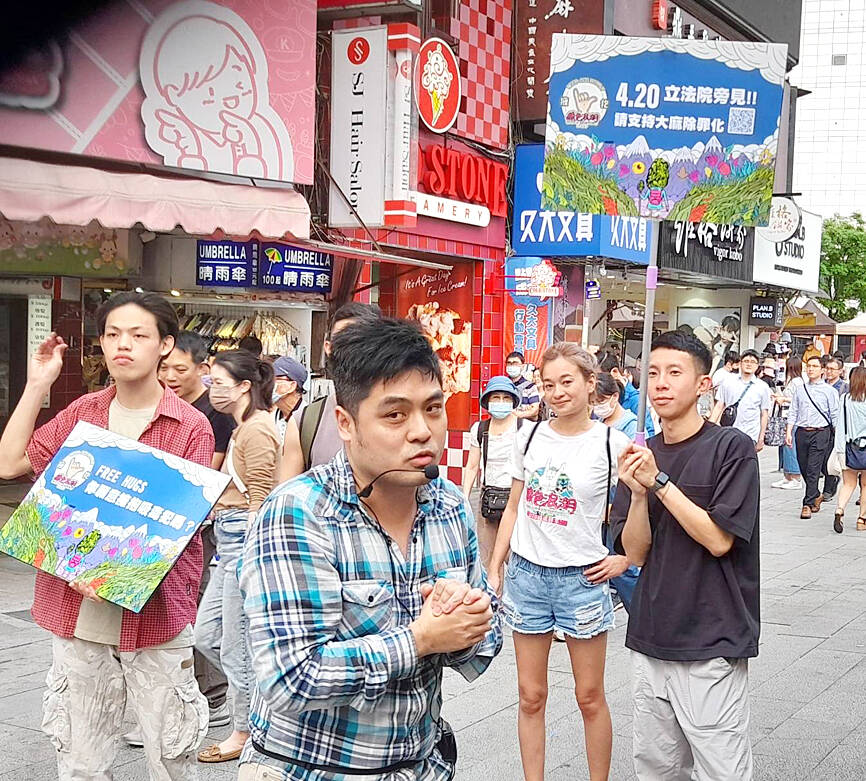
Photo: Jason Pan, Taipei Times
The event has received official approval after submitting an application, which permits the organizers to hold the street fair at the south side of the Legislative Yuan on Jinan Road.
The march will begin at 4:20pm and walk around the whole block before returning back to the street fair, Chung said.
“Taiwan is a free, democratic country, and citizens have the freedom of expression and personal liberty. So we have the right to hold the 420 event each year, to advocate for decriminalization, and for medical use of cannabis, although the authorities and their outdated laws still treat it as a narcotic, instead of a natural medicine as it is,” he added.
Chung said his group and supporters want Taiwan to join the many advanced nations that have decriminalized cannabis, or permit its use for medical purposes or for personal consumption.
These include Canada, Germany, the Netherlands, Spain, Portugal, Jamaica, Mexico, Uruguay, Argentina, South Africa, Australia, Thailand and many US states.
They listed their demands for Taiwan to gradually relax the prohibition on the natural plant cannabis sativa and products derived from it, starting by stopping the stigmatization of personal consumption; to conform to global decriminalization trends by removing it as a Category 2 narcotic drugs; and raise the allowable level at current 10ppm for tetrahydrocannabinol in hemp products to the same level as US at 3,000ppm.
Asked about the prospect for changing the law under the new administration, as president-elect William Lai (賴清德) is to be inaugurated next month, Chung said he hopes to see a reassessment of cannabis and drugs policies, “but we don’t have much hope for change, because the designated new justice minister Cheng Ming-chien (鄭銘謙) comes from the same conservative mindset of the Taiwan justice system, and they are rigidly fixed in viewing cannabis as an ‘evil narcotic.’”
Meanwhile, the nation’s “weed lawyer” and Green Party member Zoe Lee (李菁琪) on Sunday convened a discussion with audience members during the Taiwan International Democratic Film Festival in Taipei, after screening the 2018 US documentary film Breaking Habits, a film about Sister Kate and her commune of nuns in California who ran a cannabis farm. The nuns produced medical marijuana to help treat people with cancer and other major illnesses.
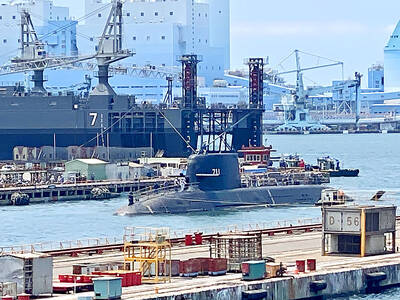
AGING: While Japan has 22 submarines, Taiwan only operates four, two of which were commissioned by the US in 1945 and 1946, and transferred to Taiwan in 1973 Taiwan would need at least 12 submarines to reach modern fleet capabilities, CSBC Corp, Taiwan chairman Chen Cheng-hung (陳政宏) said in an interview broadcast on Friday, citing a US assessment. CSBC is testing the nation’s first indigenous defense submarine, the Hai Kun (海鯤, Narwhal), which is scheduled to be delivered to the navy next month or in July. The Hai Kun has completed torpedo-firing tests and is scheduled to undergo overnight sea trials, Chen said on an SET TV military affairs program. Taiwan would require at least 12 submarines to establish a modern submarine force after assessing the nation’s operational environment and defense

Yangmingshan National Park authorities yesterday urged visitors to respect public spaces and obey the law after a couple was caught on a camera livestream having sex at the park’s Qingtiangang (擎天崗) earlier in the day. The Shilin Police Precinct in Taipei said it has identified a suspect and his vehicle registration number, and would summon him for questioning. The case would be handled in accordance with public indecency charges, it added. The couple entered the park at about 11pm on Thursday and began fooling around by 1am yesterday, the police said, adding that the two were unaware of the park’s all-day live
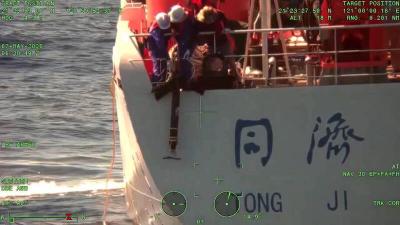
The coast guard today said that it had disrupted "illegal" operations by a Chinese research ship in waters close to the nation and driven it away, part of what Taipei sees a provocative pattern of China's stepped up maritime activities. The coast guard said that it on Thursday last week detected the Chinese ship Tongji (同濟號), which was commissioned only last year, 29 nautical miles (54km) southeast of the southern tip of Taiwan, although just outside restricted waters. The ship was observed lowering ropes into the water, suspected to be the deployment of scientific instruments for "illegal" survey operations, and the coast

A former soldier and an active-duty army officer were yesterday indicted for allegedly selling classified military training materials to a Chinese intelligence operative for a total of NT$79,440. The Taipei District Prosecutors’ Office indicted Chen Tai-yin (陳泰尹) and Lee Chun-ta (李俊達) for contravening the National Security Act (國家安全法) and the Anti-Corruption Act (貪污治罪條例). Chen left the military in September 2013 after serving alongside then-staff sergeant Lee, now an army lieutenant, at the 21st Artillery Command of the army’s Sixth Corps from 2011 to 2013, according to the indictment. Chen met a Chinese intelligence operative identified as “Wang” (王) through a friend in November


 RSS
RSS