


A New Taipei City high school rescinded a top art prize for a student after Internet sleuths discovered that an image generation tool was used to create the award-winning entry.
Fu Hsin Trade and Arts School, a private school with a renowned commercial art program, held a teacher-student art show on March 25 and April 2 to celebrate the 67th anniversary of its founding.
The top award in the digital art category went to the creation by a student, surnamed Lin (林), titled: Danao Longgong (大鬧龍宮), a work that aroused suspicion from other contestants and Internet users that it might have been generated by artificial intelligence (AI).
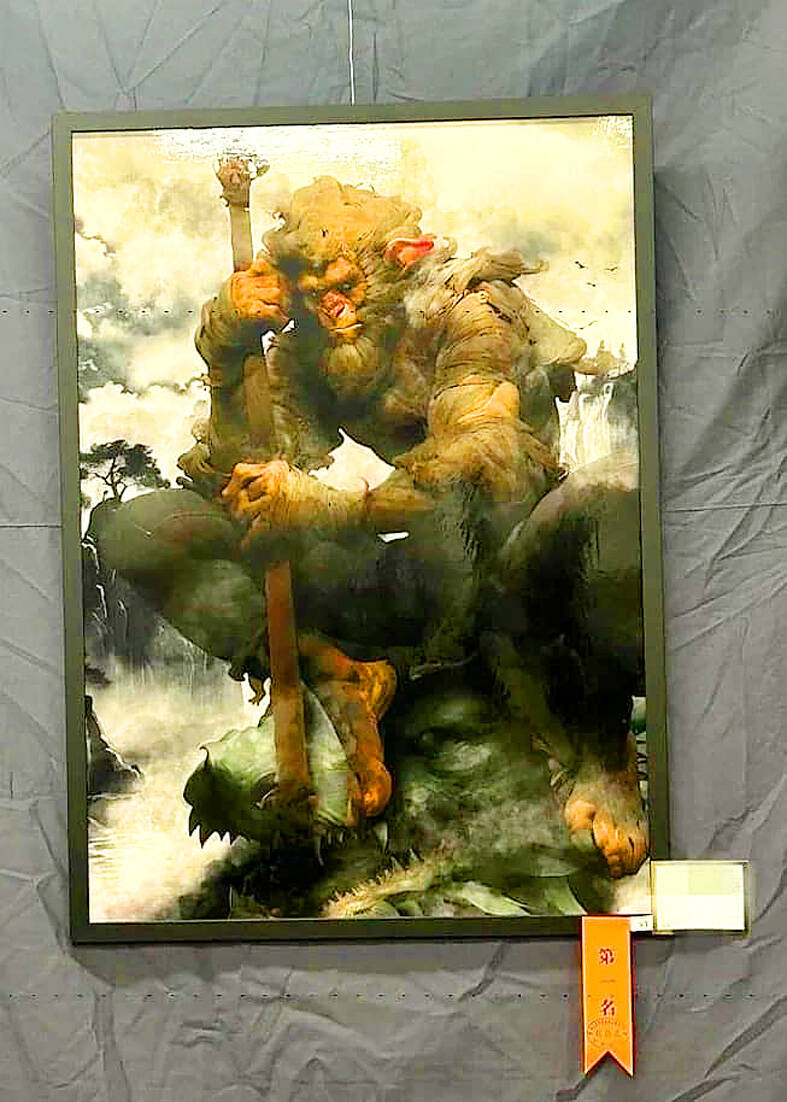
Photo: Screen grab from Facebook page
The competition’s rules do not allow the use of image generators.
On Wednesday, a YouTuber known as Boss Kuma published a video on his channel discussing the ethics of AI art, in which he criticized the competition’s judges for failing to spot AI content.
The Monkey King character depicted in the piece had deformed hands and feet, anatomically incorrect thigh muscles, and weird textures in its hair and bandages, which are common signs of AI art, he said.
“This is not just an AI-generated picture but one that has not even been touched up. I do not know what the creator of this submission went to three years of art school for. So pathetic,” he said.
In a Facebook post on Sunday last week, Fu Hsin Trade and Arts School said that following an explanation by Lin and repeated examinations by teachers with a professional specializing in the subject, Lin admitted to misapplying AI.
“The student and his parents have apologized and the awards will be changed according to the scores of the submissions,” it said.
Reports that the whistle-blower has received a major demerit is incorrect, the school added.
New Taipei City Department of Education said that it would emphasize the need for experts on the judging panel of art competitions.
New guidelines and tools for detecting AI art should be used for art shows and competitions, it added.
Schools are additionally reminded of the importance of teacher-student communication and using positive reinforcement instead of punitive discipline, the department said.
Tunghai University College of Fine Arts and Creative Design director Hsu Ho-chieh (許和捷) said that educators in the field of commercial art and design should acknowledge the rise of AI and change the skills they teach students to use accordingly.
Solid training in basic skills, and an eye for aesthetics and innovation are as important as ever, since AI art generators cannot be used effectively if the creator is unable to see and correct mistakes, he said.
Copyright must be understood and respected, as AI use poses significant risks of infringement, he added.
Educational institutions should be careful in writing competition guidelines on tools and media to ensure students understand the assignment, National Taichung University of Education professor Lu Shih-yun (盧詩韻) said.
Schools should do a better job of integrating AI art as a tool in the creative process and re-evaluate their definition of art to include the utilization of new technology, she said, adding that the use of image generation tools should be accepted as an art form.
The point is not to prevent students from using AI to make art but to teach them how to use it correctly, National Chiayi University Department of Visual Art chair Hsieh Chih-chang (謝其昌) said.
Creators can and should make use of AI so long as the work they created is unique and distinctly theirs, he added.

NATIONAL SECURITY: Authorities are working to confirm the identities of the military personnel involved and investigating possible illegal conduct and regulatory violations Authorities are probing possible national security implications after Kinmen police and immigration officers on Sunday found a Chinese woman allegedly posing as a tourist while engaging in prostitution involving more than 10 military personnel. The woman, surnamed Chen (陳), has since been deported, authorities said, adding that investigators are still working to confirm the identities of those implicated, as the records only listed code names and aliases. The case stemmed from a report received by the Kinmen District Prosecutors’ Office on Friday last week from the Jinhu Precinct of the Kinmen County Police Bureau. On Sunday, police, along with the National Immigration

GLOBALGIVING: ‘ Caving to external pressure is not acceptable for an organization that has cultivated justice reform and human rights for 30 years,’ one NGO said A slew of non-government organizations (NGOs) have withdrawn from the GlobalGiving fundraising platform after it announced it would use “Chinese Taipei” instead of “Taiwan” from next month. The Taiwan Good Rice Association wrote on Facebook on Friday that it was informed on April 28 via a teleconference call of the change, which was made because the platform wanted to operate in China. Taiwan Good Rice is to terminate all cooperative relationships with GlobalGiving in response to the platform’s “unilateral and non-negotiable” decision to remove references to Taiwan, the NGO said. “Taiwan is in the official name of Taiwan Good Rice Association and the
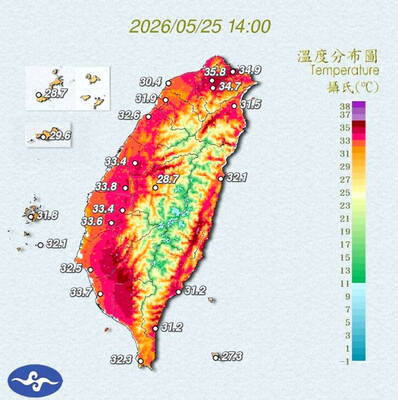
STAY COOL: The HPA recommended that people stay hydrated, use air-conditioning or fans while indoors, wear loose-fitting clothes and walk in the shade while outdoors Employers must implement measures such as installing cooling equipment, and providing drinking water and rest breaks for outdoor workers starting from Monday next week, the Taipei Department of Labor said on Sunday. Employers who fail to comply could face fines of NT$30,000 to NT$300,000 under the Occupational Safety and Health Act (職業安全衛生法), the department said. Businesses in Taipei employing fewer than 100 workers, as well as registered self-employed workers with labor insurance coverage, could receive on-site assessments and guidance from occupational safety consultants to help them apply for central government subsidies to implement or improve heat-protection measures, it said. Under the Ministry of

HEAVY WEATHER: Typhoon Jangmi is due to crash straight into the Ryukyus as airlines look to shift flights to larger aircraft or cancel flights to Okinawa entirely Taiwan’s international air carriers announced flight adjustments over the weekend as Typhoon Jangmi is forecast to hit the Ryukyu Islands today and tomorrow. The Central Weather Administration (CWA) upgraded Jangmi from a tropical storm to a typhoon at 8am yesterday, with the eye located 580km south of Naha city. It was moving north at 19kph. Today, China Airlines’ CI-120, CI-121, CI-122 and CI-123 flights between Taoyuan and Naha, Okinawa, have been canceled as well as CI-132 and CI-133 between Kaohsiung and Naha. EVA Air’s BR-112, BR-113, BR-186 and BR-185 flights between Taoyuan and Naha are also canceled. Low-cost carrier Tigerair Taiwan canceled IT-230,


 RSS
RSS