


Hong Kong political exiles yesterday slammed the passage of a restrictive national security law in the Chinese territory, and urged Taiwan and other democratic nations to unite in fighting the oppressive Chinese regime.
Sky Fung (馮詔天), secretary-general of the Taiwan-based exile group Hong Kong Outlanders, and others held up placards reading “Evil Law,” in reference to the “Safeguarding National Security Bill” under Article 23 of the Basic Law of Hong Kong, which was approved on Tuesday.
“Article 23 has killed freedom of speech, right to peaceful assembly and freedom of association for Hong Kongers, and is a severe violation of human rights,” Fung told reporters at the Democratic Progressive Party’s (DPP) caucus office in Taipei.
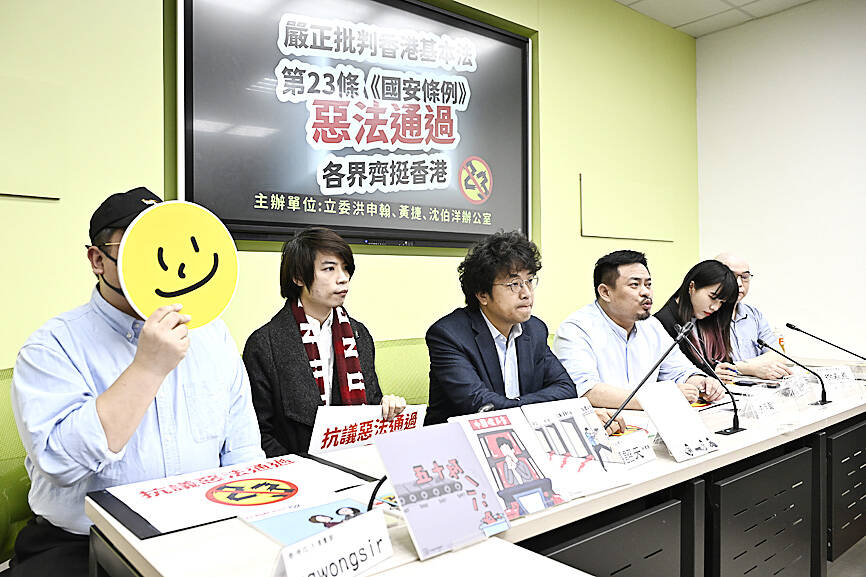
Photo: Chen Chih-chu, Taipei Times
“It is important to let young Taiwanese know that we are facing a totalitarian Chinese regime and must not believe its word. Taiwanese must not trust politicians who are colluding with the Chinese regime and betraying cherished values of freedom and democracy,” he said.
Many artists have left Hong Kong because of the law, Hong Kong political cartoonist “vawongsir” said.
“Many other Hong Kong exiles wanted to join this media event to express their thoughts about Article 23, but later decided not to come because of safety concerns for their families who are still living in Hong Kong,” he said.
Eric Tsui (徐承恩), a Hong Kong historian who obtained Taiwanese citizenship in 2022, called on citizens of all democratic countries to unite in condemnation of the national security law and Article 23 as a harsh repression of the rights of Hong Kongers.
China has broken its promise to grant Hong Kong a high level of autonomy in contravention of the International Covenant on Civil and Political Rights, Tsui said.
Beijing has therefore lost its legitimacy, and the international community should support self-determination for Hong Kong, he added.
He also urged Taiwan and other countries to review their political and economic ties with China and Hong Kong, and to stop these two authoritarian regimes from trade and accessing the resources of democratic countries.
“In addition, we must support Hong Kong activists who are still there fighting for their rights and freedom,” Tsui said, calling for permanent residency status for those asking for political asylum.
DPP Legislator Hung Sun-han (洪申翰) and other party members voiced their support for the group.
“China had dictated the expeditious passage of Article 23. In doing so, it is able to come down hard to crush any hopes of freedom and democracy for its residents,” Hung said.
Article 23 has imposed more severe conditions and punishments, as it expanded the scope of interference by external forces and state secrets to include computer data, DPP Legislator Puma Shen (沈伯洋) said.
Anyone linking to networks and servers in Hong Kong and expressing critical comments could be deemed to be engaged in sabotage or treason against the Chinese government, he said.
At a separate event in Taipei on Thursday, Hong Kong visual artist Kacey Wong (黃國才) said he brought the final edition of Hong Kong’s Apple Daily newspaper when he left two years ago.
“It is a piece of Hong Kong history, but now this newspaper is deemed as inciting political action for which a person found in possession of it can be jailed for three years,” Wong said.
“This new law is a tool of the authoritarian regime to suppress Hong Kong’s people. China pushed for its swift passage so that the international community do not have time to react. Now no matter if you are a citizen of Hong Kong, Taiwan or other countries, you could be charged with these offenses,” he said, calling for united action in opposition.
Article 23 focuses on five types of crimes: treason, insurrection, sabotage that endangers national security, external interference in Hong Kong’s affairs, and espionage and theft of state secrets, with punishments ranging from 20 years in prison to life sentences.
Two to three years in prison could also be added for those found guilty of “colluding with external forces” to commit an offense.
The existing sedition offenses were expanded in Article 23, on inciting hatred against the Chinese Communist Party leadership, which is punishable by up to 10 years in jail.

The Ministry of Finance this afternoon announced the winning numbers for the March-April uniform invoice lottery. The winning number for the NT$10 million (US$318,060) special prize is 19531471, and the winning number for the NT$2 million grand prize is 85941329. Three numbers were drawn for the NT$200,000 first prize: 07225810, 20231230 and 83518781. Those with receipts matching the last seven digits of any of the first-prize numbers will win the NT$40,000 second prize, while those matching the last six digits will win the NT$10,000 third prize. Those whose receipts match the last five digits of the first-prize numbers can claim the NT$4,000 fourth prize,

SIX SUBSIDIES: The monthly allowance for older farmers is to increase to NT$10,000, and NT$5,000 is to be given to homemakers under the national pension system, Lai said The government is to implement major welfare policies for disadvantaged groups, including raising the monthly allowance for older farmers to NT$10,000 and providing homemakers with NT$5,000 per month, President William Lai (賴清德) said yesterday. Lai made the remarks during a visit to Wangling Temple in Chiayi County, saying that the planned increases were being introduced amid economic growth and an increase in tax revenue. Touting a policy, in which the government plans to provide a monthly allowance of NT$5,000 for every child under the age of 18 in a bid to address Taiwan’s low birthrate, Lai said that if received for the
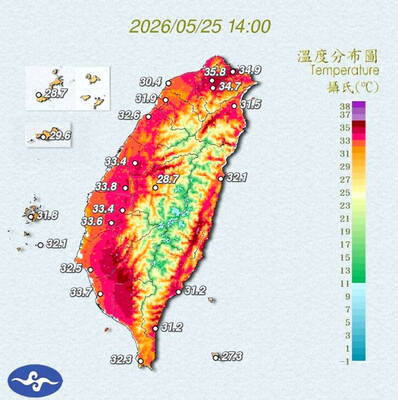
STAY COOL: The HPA recommended that people stay hydrated, use air-conditioning or fans while indoors, wear loose-fitting clothes and walk in the shade while outdoors Employers must implement measures such as installing cooling equipment, and providing drinking water and rest breaks for outdoor workers starting from Monday next week, the Taipei Department of Labor said on Sunday. Employers who fail to comply could face fines of NT$30,000 to NT$300,000 under the Occupational Safety and Health Act (職業安全衛生法), the department said. Businesses in Taipei employing fewer than 100 workers, as well as registered self-employed workers with labor insurance coverage, could receive on-site assessments and guidance from occupational safety consultants to help them apply for central government subsidies to implement or improve heat-protection measures, it said. Under the Ministry of
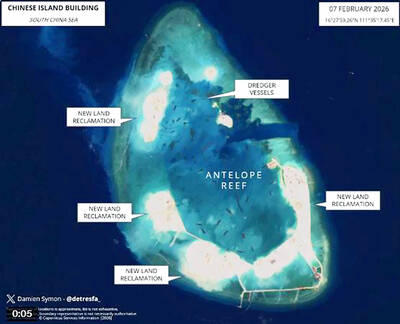
ISOLATION: The outposts would serve as support and backup bases, forcing US forces to either face China head-on or reroute, increasing travel time and operational costs China’s outposts in the South China Sea could be used to delay and constrain foreign forces during a conflict in the Taiwan Strait, giving Beijing a critical window to carry out amphibious landing and blockade operations, a report said. The Chinese Communist Party’s (CCP) forward operating bases on islands and reclaimed features in the South China Sea could delay foreign forces long enough for the Chinese People’s Liberation Army (PLA) to secure a key 48-to-72-hour window in the Taiwan Strait, a report commissioned by the Mainland Affairs Council found. The report, conducted by the Institute for National Defense and Security Research, examined


 RSS
RSS