


Legislative Speaker Han Kuo-yu (韓國瑜) breached the rules by abruptly revoking floor time of Democratic Progressive Party (DPP) members, DPP lawmakers said yesterday.
According to the legislative schedule, lawmakers were supposed to participate in a general question-and-answer session yesterday.
Chinese Nationalist Party (KMT) Legislator Lo Ming-tsai (羅明才) replaced his verbal questions with written questions shortly before the session and did not attend.

Photo: CNA
Lawmakers after Lo in the order were also absent, having expected him to use his time.
However, Han closed the floor and moved on with the session after three roll calls, saying that the members scheduled to speak were not present.
DPP lawmakers told a news conference later that Han had committed “a gross act of disrespect” to lawmakers and procedure.
DPP Legislator Hung Sun-han (洪申翰) said he showed up nearly 30 minutes before his scheduled time only to find that Han had already terminated proceedings.
The speaker should have handled the absence of a lawmaker by calling a recess instead of taking away the time altogether, Hung said, adding that Han had “an arrogant attitude” when lawmakers protested his decision.
The speaker’s decision was completely unreasonable and harmed voters, whose representatives were denied a chance to speak in defense of their interests, DPP Legislator Chiu Chih-wei (邱志偉) said, adding that Han should apologize for his actions.
Han later spoke with the DPP lawmakers affected in his office.
A DPP lawmaker who attended the meeting cited Han as saying he would speak with the caucus whips of all parties to allow redress for the lost time.
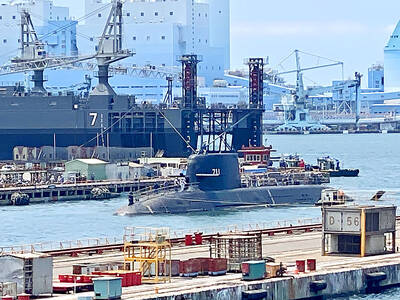
AGING: While Japan has 22 submarines, Taiwan only operates four, two of which were commissioned by the US in 1945 and 1946, and transferred to Taiwan in 1973 Taiwan would need at least 12 submarines to reach modern fleet capabilities, CSBC Corp, Taiwan chairman Chen Cheng-hung (陳政宏) said in an interview broadcast on Friday, citing a US assessment. CSBC is testing the nation’s first indigenous defense submarine, the Hai Kun (海鯤, Narwhal), which is scheduled to be delivered to the navy next month or in July. The Hai Kun has completed torpedo-firing tests and is scheduled to undergo overnight sea trials, Chen said on an SET TV military affairs program. Taiwan would require at least 12 submarines to establish a modern submarine force after assessing the nation’s operational environment and defense

A white king snake that frightened passengers and caused a stir on a Taipei MRT train on Friday evening has been claimed by its owner, who would be fined, Taipei Rapid Transit Corp (TRTC) said yesterday. A person on Threads posted that he thought he was lucky to find an empty row of seats on Friday after boarding a train on the Bannan (Blue) Line, only to spot a white snake with black stripes after sitting down. Startled, he jumped up, he wrote, describing the encounter as “terrifying.” “Taipei’s rat control plan: Release snakes on the metro,” one person wrote in reply, referring
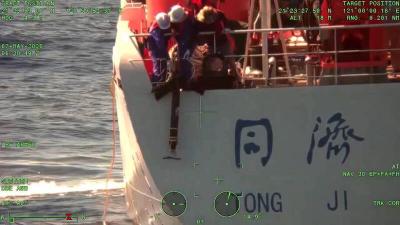
The coast guard today said that it had disrupted "illegal" operations by a Chinese research ship in waters close to the nation and driven it away, part of what Taipei sees a provocative pattern of China's stepped up maritime activities. The coast guard said that it on Thursday last week detected the Chinese ship Tongji (同濟號), which was commissioned only last year, 29 nautical miles (54km) southeast of the southern tip of Taiwan, although just outside restricted waters. The ship was observed lowering ropes into the water, suspected to be the deployment of scientific instruments for "illegal" survey operations, and the coast

Yangmingshan National Park authorities yesterday urged visitors to respect public spaces and obey the law after a couple was caught on a camera livestream having sex at the park’s Qingtiangang (擎天崗) earlier in the day. The Shilin Police Precinct in Taipei said it has identified a suspect and his vehicle registration number, and would summon him for questioning. The case would be handled in accordance with public indecency charges, it added. The couple entered the park at about 11pm on Thursday and began fooling around by 1am yesterday, the police said, adding that the two were unaware of the park’s all-day live


 RSS
RSS