

Runway maintenance at Taiwan Taoyuan International Airport is to conclude at least 16 hours early, following complaints about severe flight delays, Minister of Transportation and Communications Wang Kwo-tsai (王國材) said on Monday.
Annual maintenance on the southern 05R/23L runway began at 10am on Sunday and was scheduled to finish at 4pm on Tuesday, leaving only the northern runway open.
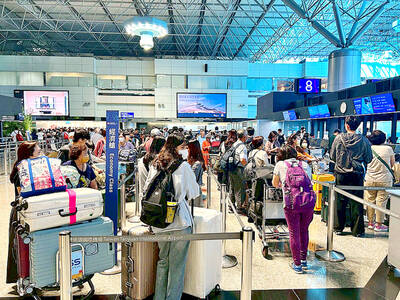
Some flights were redirected to land at other airports, reportedly to refuel after circling the Taoyuan airport waiting for clearance.
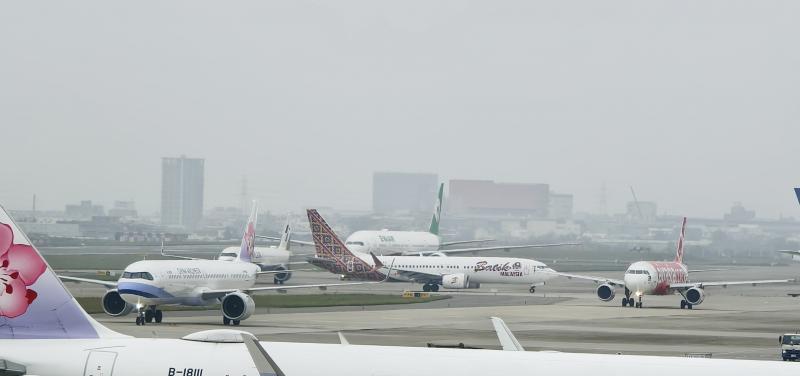
Photo: Yao Chieh-hsiu, Taipei Times
Flight tracking data showed that six flights were diverted to Kaohsiung International Airport and four were diverted to Taipei International Airport (Songshan airport) as of 9pm.
Wang on Monday confirmed to reporters that the runway closure created a backup at the airport.
As its effect on flights was greater than anticipated, maintenance would end early at midnight at the latest, Wang told reporters.
Officials were sent to the airport overnight to handle the matter, and all affected flights had been processed by 2am, he said.
Additional reporting by CNA
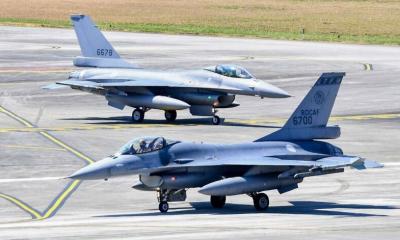
The first two F-16V Block 70 jets Taiwan purchased from the US were spotted unexpectedly turning back after departing from Hawaii yesterday, potentially further delaying delivery of the aircraft. Taiwan has purchased 66 of the F-16 C/D Block 70 jets to be deployed at Chihhang Air Base (志航基地) in Taitung County and operated by the air force's 7th Tactical Fighter Wing to defend Taiwan’s eastern region. Two single-seat jets, bearing serial No. 6727 and 6728, were spotted taking off from Hickam Field in Hawaii yesterday, observers said. Based on the precedent set during the delivery of Taiwan's older F-16 Block 20s, the new
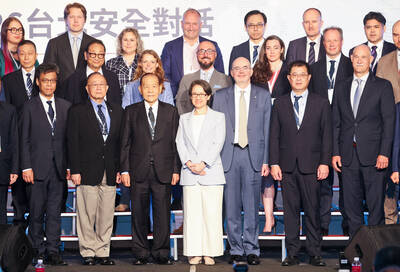
Taiwan’s growing defense preparations might be sending a stronger signal to the US than to Beijing, highlighting the need for Taipei to tailor its deterrence efforts to different audiences, a US security academic said yesterday. Stanford University Freeman Spogli Institute for International Studies fellow Oriana Skylar Mastro made the comment during a Taipei Security Dialogue panel examining lessons Taiwan could draw from the wars in Ukraine and the Middle East. Mastro said she was impressed by Taiwan’s increased defense spending, emphasis on asymmetric capabilities and efforts to prepare society for conflict, but questioned whom those initiatives were influencing. She said when she asked
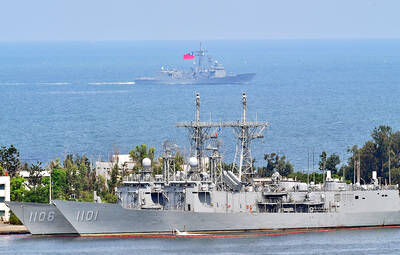
SIZE MATTERS: Large ships are politically attractive as visible symbols of national defense, but small surface combatants are more likely to survive an initial strike Taiwan needs to restructure its naval fleet from focusing on large warships, which are “sitting ducks” for China’s advanced tracking technology, to smaller, stealthy corvettes that are harder to detect but retain sufficient firepower to deter a Chinese invasion, a Taiwanese academic and a former US military commander said in an article published on Friday in the journal Foreign Affairs. Taiwan does not need a fleet capable of competing with the Chinese navy for traditional control of the Taiwan Strait, but rather “sea denial” capabilities that would prevent China from freely using the waterway, Taiwanese aerospace and security expert Holmes Liao
EVA Airways Corp is to raise excess baggage fees and revise other international baggage charges beginning on Sept. 29, citing higher fuel prices and rising global operating costs amid economic and geopolitical pressures. The changes would apply to international flights with travel dates on or after Sept. 29, the Taiwanese carrier said in a statement on its Web site. The revised baggage policy covers excess baggage, prepaid excess baggage, overweight and oversized baggage fees. It also covers updated pricing rules, and fees for transporting pets and sports equipment. Under the new rates, excess baggage fees would increase by between US$20 and US$90 per


 RSS
RSS